Showing posts with label free speech. Show all posts

Tuesday, August 11, 2009

Free Speech and Benevolent Rulers

As I have written before on this blog, I have been editing papers on the historical origins of free speech in the 18th century, which, it is hoped, will appear in a published volume. One of the papers is by Douglas Smith, writing on free speech in Russia during the reign of Catherine the Great. Catherine (1729-1796) is one of the three "enlightened despots," along with Frederick of Russia and Joseph II of Austria. Catherine, in the spirit of the Enlightenment, endorsed a liberal policy of freedom of expression, without going so far, however, as to institute it in law. She also relaxed press censorship after 1783.

Freedoms bestowed by a sovereign, however, can also be also be taken away by a sovereign, as was the case when a book appeared that tested the limits of freedom of expression in Russia. This was Alexander Radishchev's Journey from Saint Petersburg to Moscow, which portrayed the evils of Czarist Russia, particularly serfdom. It could not have appeared at a worse time, at least as far as the author was concerned, 1790. Catherine was not amused, and Radishchev was lucky to escape with his head. Before her death Catherine instituted a system of censorship, citing "the need to put an end to various inconveniences resulting from the free and unrestricted publciation of books." After Catherine, Russia was even more intolerant to freedom of expression.

The second installment of a biography of Austria's Joseph II, by Derek Beales, has just appeared. The review in the TLS (July 31, 2009) confirms what I wrote above about freedoms bestowed by "enlightened" rulers. According to reviewer Steven Beller, Joseph was a great reformer: "Once he became sole ruler in 1780, Joseph unleashed a barrage of directives which amounted to one of the most radical reform packages yet put forward by a major European monarch." Among his achievements: he imposed the most expansive religious toleration in Catholic Europe; he began the emancipation of Habsburg Jewry; he was liberal in regard to press censorship.

Joseph was also, according to Beller, "almost a populist." He liked to travel incognito among his subjects, in order to understand their needs. But he always considered himself a sovereign, not a citizen. Thus, he had no use for constitutional representative government. Instead, he saw government "in stark terms of an unmediated relationship between sovereign and subjects." Traditional elites and the people, too, especially in Hungary, were suspicious of his plans, including the census he instituted as a first step to "rational modern government there."

For James Madison, author of the U.S. Bill of Rights, "the people, not the government, possess absolute sovereignty." Freedom of speech and the press, set down in the First Amendment to the U.S. Constitution, were instruments by which the people would exercise "censorial power" over the government, not the other way around. Europeans, on the other hand, still seem very much under the influence of paternalistic notions of government as exemplified by rulers like Catherine, Joseph, and, later, Napoleon.

In Europe, it is still felt that well-intentioned elites can lead citizens to virtue and to the public good. Thus, although Article 10 of the European Convention on Human Rights guarantees freedom of expression, it is limited by "the protection of the reputation or rights of others." What this limitation had led to throughout Europe is a suppression of a discussion of contentious issues.

In the U.S. we would call this "political correctness," of which there is plenty here. Nevertheless, contentious public issues (gay marriage; affirmative action) are still debated, and in the process we work our way as a nation to some kind of resolution. It takes time, of course, but life exists in real time, not in an abstract, universal dimension. Rights have to be fought for by citizens, not bestowed by wise rulers (especially not by judges who think they know what is right). People in Iran and other countries fighting for liberties are learning for themselves what the West should have learned after several centuries of experience.

The recent protests at Town Hall meetings are impossible to imagine in Europe these days, but they are certainly a vivid illustration of what Madison had in mind when he declared that the citizens were to exercise censorial power over the government. These contentious forums are not "unpatriotic," as some members of Congress have asserted. We have had more contentious disagreements in our history. Frankly, my own opinion is that, when Congress doesn't do things, we are better off as a nation. (For a large image of the chart below, showing the bone of contention at Town Halls, go to Sherry Mowery's blog.

Saturday, May 2, 2009

Goethe and Politics

"In the fatal circumstances in which he is now trapped, it seems as if his genius has completely abandoned him. His power of imagination seems to have burned out; instead of the invigorating warmth that he used to exude, there is political frost all around him."

This morning I came across the above quote from Wieland, writing to Merck about Goethe on July 13, 1777. It was a serendipitous discovery. Yesterday, after two weeks of writing, editing, and rewriting, I finally finished a draft of my introduction to the book of essays on free speech. Goethe was occasionally on my mind as I was writing, yet as I immersed myself in the historical material in preparation for writing the introduction he never seemed relevant to the issue.

Yesterday I consulted the Goethe-Handbuch entry on "politics." It was written by Ekkehart Krippendorff, a retired professor of political science at the Free University of Berlin. He writes that the "political dimension" of Goethe's oeuvre and life is a "stepchild" of scholarly study and that, from the point of view of the ordinary person, Goethe's role as a politician ("als nicht nur nomineller, sondern aktiver Angehöriger der politischen Klasse seiner Zeit") is practically unknown.

Krippendorff himself has written two studies on this political dimension. The first, as far as I can tell, was Goethe: Politik gegen den Zeitgeist, which appeared in 1999. The other was a "duography," namely, Jefferson and Goethe, from 2001.

For those familiar with Goethe, his service as minister in Weimar is well known, including his administrative duties, whether these be oversight over the mine at Ilmenau, improvements in canal and road construction, at the university in Jena, and so on. This is not politics as we know it, but rather the work of what we might call today a cabinet member. Krippendorff underlines Goethe's aversion to the power politics of his day and sums up Goethe's political attitude as one "principally of administrative activity in the service [of others]" (vorrangig dienende Verwaltungstätigkeit).

Politics of usefulness is probably the case with Goethe, and it may also be why Krippendorff himself would be drawn to this aspect. I discovered a review of his 1999 book (subtitled "politics against the 'Zeitgeist'") that was titled "Attorney for the Underprivileged." Krippendorff, despite a successful academic career, appears to have been in his formative years influenced by the German student movement. He claims not to have been a "68er" (though see this report of a "Rudi Dutschke" conference, quoting Krippendorff). Thus the appeal of a great figure who was free of the compromises that plague politicians in a democracy.

I am not criticizing Krippendorff so much as pointing out a distinctive difference between the political system of the Old Regime and that of the modern liberal order. This difference struck me very forcefully while I was writing my introduction to the volume of essays on free speech in the 18th century. A characteristic of the Old Regime was that rulers did not make a distinction between themselves and their subjects. A phenomenon of the 18th century was the "enlightened monarch." Among these were Frederick the Great in Prussia and Catherine the Great in Russia. Thus, these monarchs introduced certain reforms in their realms, mostly in order to improve technology and economic life and in that way provide benefits to their subjects. All very admirable, of course, and it certainly seems a better way of ruling than, say, that of the Spanish monarchs, who simply taxed and plundered and thereby prevented any economic growth or improvement.


In this period there was also a growing class of men (and they were principally men) who were interested in the moral improvement of the masses. Some of these advised sovereigns (e.g., Voltaire); some labored in universities. Gottsched is a good example, from his seat in Leipzig seeking to improve the Germans linguistically and otherwise. It was all a very admirable Enlightenment project. It would seem, at least following Krippendorff, that Goethe was in this mold. He quotes from Maximen und Reflexionen (967): "Herrschen lernt sich leicht, regieren schwer" (ruling is easy to learn, governing difficult). Goethe's "political ethics" derives from the principle of renunciation, according to Krippendorff: "The only one [I am quoting Krippendorff here] who has the qualifications for political activity and for governing is [the man] who has the inner strength -- and the outer independence, not least of all economic -- that make it possible to resist the temptations that are connected with the privileges of power." In attributing such an attitude to Goethe, Krippendorff makes Goethe sound very Old Regime. I'm sure a lot of our contemporary American politicians, especially those who have served five or six terms in Congress or the Senate, have the same attitude. The public can't do without their selfless service ("dienende Verwaltungstätigkeit"?) to our nation, right?

Helena Rosenblatt, in her contribution to the free speech volume, writes that it was Benjamin Constant (1767-1830) who would rearticulate the issue of free speech by introducing skepticism about power, no matter who wields it. Thus, Constant made individual rights the cornerstone of liberal government. His crucial role was to argue that it was not the role of government to regulate morals or to mold public opinion through education or to "enlighten" citizens. If Rousseau wished for the reign of virtue, to be established by a unanimous will, Constant extolled the collision of opinions.

In 1814 Goethe sent back to Karl Ludwig von Knebel Benjamin Constant's anti-Napoleonic treatise De l'esprit de conquête et de l'usurpation. In his letter to Knebel Goethe said that he had not been able to read it; indeed he resisted the ideas in it. Later Constant visited Weimar with Madame de Staël. There are references in Goethe's diaries to these visits, without details. Goethe had a very retentive memory, however, and it strikes me that his later (not until the 1820s) concept of "world literature" derives from a less paternalistic attitude toward the masses. World literature, after all, concerns the free movement of ideas among peoples. Goethe could not foresee the explosive "collision of opinions" that characterizes the early 21st century. I am not even sure that he would really have admired it, though one must be cautious in attributing opinions post hoc facto to him.

The liberal political order that began to take shape in the early 19th century was based on the concepts of individual rights and little government interference. This means that people would be free to craft their own individual destiny, for good or bad, in association with other individuals. In the West in recent years, however, there is less confidence in this order, especially as we have seen the failures of attempts to transplant it to non-Western countries. This failure has allowed the "do gooder" class, 21st-century versions of Gottsched and Voltaire, to reemerge, seeking to impose a kind of enlightened moral consciousness on citizens. One sees this in particular in the universities, which should be bastions of free speech but in which reigns instead a pervasive uniformity on otherwise contentious issues. Thus, my hat is off to Miss California, who was so incautious recently as to express her true opinion on marriage. And she gave up being Miss USA! A heroine of free speech is a beauty pageant contestant.

Tuesday, April 7, 2009

Goethe and China

Some day soon I want to post something about Goethe and Chinese literature, but for the next two weeks total focus on another subject is required. Last year, as chair of the Columbia University Seminar on 18th-Century European Culture, I held a series of talks on the historical origins of free speech in the 18th century. I have edited the papers of the participants in that series and am now writing the introduction to the proposed volume. Thus, the single-minded focus on a non-Goethe subject. "Goethetc," however, has become well known enough that it will soon be featured in the online Yareah magazine.

In lieu of a posting on Goethe and China, let me post some photos from our recent bike ride down to New York's Chinatown. Rick and I had planned to go to the Battery, but when we reached Canal Street he said, "let's go get some fish for dinner." There is a nice bike lane across Grand Street on which we traveled to Elizabeth Street, where Rick's favorite market is located.

He wanted to ride my bike.

Alligator legs

We finish our purchases

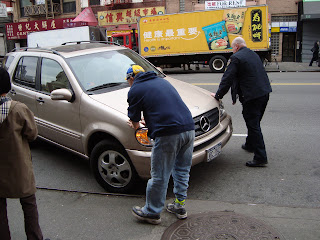
Rick helps move a car

The silver 10 Yuan Goethe coin at the top of the post was issued in 1992.