Showing posts sorted by relevance for query blue goethe. Sort by date Show all posts

Friday, January 6, 2017

The blue-green Goethe

M.s Sehnsuchtsbild by Guntram Erbe

Michel Pastoureau, French scholar of the Middle Ages, has produced some very lovely and also scholarly volumes on the history of colors, beginning with Blue: The History of a Color (Princeton UP, 2001). It was followed (in English translation) by Black (2008) and Green (2014), both subtitled "the history of a color" and also published by Princeton. I have just received Red (also Princeton UP; publication date is Valentine's Day), which I am reviewing for a national magazine. In preparation I have the pleasant task of going through the preceding volumes, beginning with Blue.

Not surprisingly, Blue includes a section on Goethe, both on his theory of colors as well as on the significance of Werther's blue-and-yellow outfit. According to Professor Pastoureau, Goethe gave his hero a blue coat because blue was in style in Germany in the 1770s. The novel, however, because of its popularity reinforced the fashion for blue, causing the color to leap from the realm of dress -- serving as the favored color of the French kings since the beginning of the 18th century and, in turn, of the nobility and the well-off bourgeoisie -- into the arts of painting, engraving, and porcelain.

Goethe's color circle
Pastoureau is very sympathetic to Goethe's color theory, even if he concedes that the discussion of physics and the chemistry of colors in the Farbenlehre is "flawed." As he writes: “Instead of creating a work based on his remarkable poetic intuition and his feeling that color always has an important anthropological dimension, he wished to write a learned treatise that would be recognized as such.” In his view,  the most original chapter of the didactic section of the Farbenlehre is the one on “physiological” colors, “in which Goethe argues forcefully for the subjective and cultural nature of perception, an idea that was almost completely novel at the time.” Challenging the Newtonians, Goethe was “the first to reintroduce the human being into the problems of color and to dare to declare that a color that no one sees is a color that does not exist.”

Since this is a book on blue, the Farbenlehre is of interest to Pastoureau because of the important place Goethe accords to that color, “which along with yellow is one of the poles of Goethe's color system. He saw in the juxtaposition (or the fusion) of these two colors the absolute form of chromatic harmony.” The lovely painting above by Guntram Erbe immediately made me think of Goethe's color preferences.

Blue Flower (Homage to Novalis) by H.H. Miyakawa (2011)
Alongside Goethe, Pastoreau cites Novalis's Heinrich von Ofterdingen and the poet's search for the "little blue flower" as contributing to blue's status as "the world's most popular color," solidifying it as the color of love, melancholy, and dreams. (See my earlier post.) Yet, as can be gleaned from Blue, Goethe's embrace of blue has a long historical background.

It turns out that the rise of blue as a color preference was a very late emerging Western phenomenon. As Pastoreau writes in Blue, red, white, and black were the basic colors of all cultures from time immemorial, and all social codes and systems of representation were organized around these three. Blue, on the other hand, had no symbolic value, and it even seems that the ancients could not even "see" blue. In the ancient Greek language, for instance, blue was never used to describe the sky or the sea. The term glaukos, much used by Homer, could refer to gray, blue, and sometimes even yellow or brown. Eventually the Romans took their color terminology from Germanic and Arabic words: blavus and azureus. For the Romans blue appears to have had a negative value: it was associated with the underworld, while blue eyes were considered a deformity or a sign of bad character, not to forget that blue was the color of the eyes of the Germanic barbarians.

In the Carolingian period, the emperors and nobles followed the Roman custom, wearing red, white, and purple, while blue was worn only by those of low rank. A change occurred in the 12th century, with the creation of blue stained glass, but otherwise blue was essentially absent from Christian worship, with white being the supreme Christological color (innocence, purity) and black denoting abstinence, penance, and suffering. Red, of course, was the blood spilled by Christ, his passion, sacrifice, martyrdom, divine love. There developed by the 12th century a split between "chromophiles" and "chromophobes," represented, on the one hand, by the abbots of Cluny and, on the other, by the Cistercians. In the churches of the former blue and gold were united to evoke the splendor of God's creation, while the Cistercians were opposed to luxury in all forms, including color.

Hyacinthe Rigaud: Portrait of Louis XV as 5-year-old (detail)
The rise of the cult of the Virgin in the 12th century and also the adoption by French kings of blue in their coat of arms lent prestige to blue, while progress in dyeing techniques also assisted its success. French and German cities (including in Thuringia) were sustained by their dyeing industries. Saint Louis and Henry III began wearing blue, a custom not known among earlier kings. Naturally, their entourages followed suit. Even King Arthur was depicted in blue.

And then came the Reformation, which was already preceded by moralizing trends. The Reformists sought to cleanse churches of color, especially of red, which stood not for Christ's blood and passion but for folly and, in Luther's eyes, the papacy. The polychromy on church statues suggested idolotry, and the vestments of priests and the rituals of the mass were "a theater of color" distracting from the more crucial purpose of saving one's soul. For the Reformers, good Christians should wear sober colors, thus the rise of black in art. Pastoreau mentions Rembrandt, from Calvinist Holland, whose "color asceticism [was] based on a limited palette of dark and discreet tones." Rome, with the Counter-Reformation, responded in kind: thus, the blazing glory of Baroque and Jesuit art.

Perhaps because of its long absence from historical and theoretical reflection, blue was not affected by the "chromoclasm" of the Reformers. Indeed, according to Pastoreau, it became "the only honest color worthy of a good Christian." Thus, the great Reformers were portrayed as austerely dressed in black, set against a bright blue background suggesting heaven, to which they all aspired. Among French landscapists influenced by Jansenism, brown and indigo wash drawings of the 17th century created dream-like distant backgrounds that seemed to reach to infinity.

Newton's spectrum experiment
In 1666 Newton discovered the spectrum, an order of color that contained neither black nor white, which (for an Anglican like Newton) confirmed Protestant moral practices. The spectrum unended the ancient and medieval color hierarchy, in which red had resided dominantly. The center was now occupied by blue and green, and "colormetry" began to invade the arts and sciences. In being mastered, however, color lost much of its mastery. Here is where Goethe enters the picture.

Pastoreau mentions that Goethe's "personal taste" distanced him from red, but by the mid 1770s blue had become the favorite color of European society. (Can we imagine Werther wearing a red vest?) By the 18th century, slavery in the Americas lowered the cost of indigo production, and a variety of dark and solid blues could be produced that were resistant to sunlight and soap. Chemistry also began to play a role: it was in the early 18th century that "Prussian blue" was discovered in Berlin, which aided painters in producing strong or translucent tones, and numerous learned societies sponsored competitions to find solutions for obtaining more vivid and less costly blues and greens than those achieved by indigo.

Here is Werther speaking about his blue coat: “It cost me much to part with the blue coat which I wore the first time I danced with Charlotte. But I could not possibly wear it any longer. But I have ordered a new one, precisely similar, even to the collar and sleeves, as well as a new waistcoat and pantaloons. But it does not produce the same effect upon me. I know not how it is, but I hope in time I shall like it better.”

Picture credit: Guntram Erbe; Hikaru H. Miyakawa; Colour Management

Saturday, January 21, 2017

Goethe and green

Mr. Knightly in blue Werther coat
In connection with my previous post on "the blue-green Goethe," I came across a short book by Angelika Overath, Das andere Blau: Zur Poetik einer Farbe im modernen Gedicht. The first chapter concerns "The Symbolism of Blue circa 1800," in which Overath discusses the representation of blue in Goethe's Dornburg poem beginning "Früh, wenn Tal, Gebirg und Garten/ Nebelschleiern sich enthüllen." I wrote about Goethe's Dornburg poems ages ago (go here), and Overath's discussion reminded me anew of how the poem, written in 1829, replicates the syntax of Werther's May 10 letter, written in the 1770s.

For Overath, the syntactic "dynamism" (the textual movement of the wenn/dann verse structuring) of the Dornburg poem reflects Goethe's view that colors are entities that the eye, so to speak, activates, brings into being: the one does not exist without the other. As Goethe writes in another connection:

Wär nicht das Auge sonnenhaft,
Die Sonne könnt' es nie erblicken;
Läg nicht in uns des Gottes eigne Kraft,
Wie könnt uns Göttliches entzücken?


(Were not the eye sunlike
It could never see the sun
Were not within us God's own force
How could we delight in anything divine?)

Even if The Sorrows of Young Werther contributed to the rage for blue in the late 18th century, Goethe found that the color, by itself, was cold. As he writes in Theory of Colors: "Blue gives an impression of coldness and also reminds us of shadows. We have already remarked on its affinity with black" (782). Further, "Rooms hung with pure blue appear to some degree larger, but are actually empty and cold" (783) and "Objects seen through a blue glass appear gloomy and melancholy" (784). These also seem to be "Romantic" associations with blue, as in Novalis's "blue flower."

Because of this coldness, Goethe thought that a bit of green (on the "plus" side of his color circle) would alleviate the "negative" aspects of blue. In particular: "Sea green is a rather pleasing [liebliche] color" (785).

Goethe's associations of blue with the sky and the sea with green are modern.

Michel Pastoureau, as I mentioned in my last post on his new book Red: The History of a Color, blue was a color that was seemingly absent in the consciousness of the earliest humans, with a meager presence in the ancient world, Egypt excepted, poorly adapted to transmitting ideas or evoking emotional or aesthetic responses. Blue was so unrepresented in Ancient Greek that even the sky and the sea were textually associated with other colors. The Latin terms, blavus and azureus, were imported from the Germanic languages and Arabic. It was only in the 12th century, with the creation of blue stained glass, that it began to achieve artistic existence. The Virgin, in earlier centuries portrayed in dark colors, became the first person in the West to be clothed in blue, if still in tones indicating mourning. The sky finally appeared as blue in illuminated manuscripts.

Something similar was the case with green, according to Pastoureau. Although ubiquitous in the plant world, a green pigment was made and mastered late and with difficulty. The Romans had a good word for it (viridis) — it was Nero’s favorite color (emeralds) — but it long remained a minor color, playing little role in social life, and its symbolic power was limited. Its rise accompanied that of blue in the Middle Ages, as the emblematic color of the plant world and the color of hope in life eternal among liturgical colors. (Since the 12th century, as Arabs distinguished themselves from Crusaders, green has been the sacred color of Islam.) It was the favorite color of “solitary walkers” in the late 18th century, associated with health and freedom. In the dark 19th century, urban dwellers longed for green spaces. In the 1880s, with the invention of artificial paints, available in tubes, artists left their studios for the outdoors, transforming landscape painting anew. In the new millennium green has replaced red as an ideological marker. It has become “the messianic color,” according to Pastoureau: “Long unnoticed, disliked, or rejected, now it is entrusted with the impossible mission of saving the planet.”

And, for many, Goethe has become a "Green."

Thursday, August 27, 2020

Adventures in Goethe Blogging

Like all bloggers, I occasionally check on the response to the blog, i.e., the number of visitors. I noticed a couple of days ago that the "all time number of page views" had exceeded 500,000. That only took eleven years!

Almost three years ago I gave a presentation at a meeting of the Goethe Society of North America entitled “Blogging Goethe.” As far as I knew then, my Goethe blog was the only such blog. Since then I have encountered another one (über goethe) in Germany, but that blogger posts even more irregularly than I do. It takes work to blog.

It was back in 2008, when everybody seemed to be setting up a website, that I thought of creating one as a site for posting my own work on Goethe, but I didn’t know how to go about it. Then one night at dinner my step-daughter said, why don’t you just do a blog?, and she, being very computer savvy, went to the “Blogspot” site and created this one. I wanted to call it Goethe.blogspot.com, but someone already had that one, so my husband suggested Goethetc.

Mackerel sky over Central Park
For a long time it was really Goethe Etcetera, since I wasn’t sure what to do with a blog, and I would often simply write about my life in New York. I don’t do any other social media, so the blog became sort of a Facebook substitute.  But eventually I did start blogging about Goethe. For instance, an early post showed the clouds in  the sky over Central Park in Manhattan, entitled "Mackerel Sky," which drew on Goethe’s admiration for Luke Howard’s categorization of clouds. And more and more I began to post about whatever I was reading, as in this post on Goethe and beggars. Clearly, I spend a lot of time looking for images.

Like many people I found myself coming across Goethe in unexpected contexts and would post on them, for instance, a post on Stephen Spender writing about Goethe.

Over time, I have posted on lots of subjects, and Google very nicely makes available the numbers of "hits" on specific posts. At the GSNA talk, I circulated a handout that showed, in descending order, the number of page views for specific subjects. Some very arcane subjects even had some respectable numbers: Branconi, Stolberg, Arnim. At the time of my talk, the one post exceeding all the others in page views (6,161) was “Goethe and Schiller and the French Revolution.” The second highest number of hits was “Goethe and Grief” (5,330),  on which I posted at the end of 2011, shortly after my husband's death. This number is interesting, especially since, as I wrote in a recent post (on the death of his sister), Goethe wrote very little in his life on the subject of his own grief.  There are some subjects I have covered often (46 on Goethe and world literature, for instance), but I only wrote once on Goethe and grief. And yet it continues to draw visitors to the site. My entry on Goethe and geology had by 2017 a quite respectable number of viewers, 1,023. In the meantime, the most visited post is now "Goethe and Romanticism" (7,813 visits, thus surpassing "Goethe and the French Revolution.)

Blue: the color of peace, consensus
At the beginning of 2017, the site became compromised in respect of the number of visitors. In that month I did four posts on  a book I was reviewing for a national magazine by the French medievalist Michel Pastoureau, who has written four large beautiful volumes on colors and their social representation. Pastoureau mentioned Goethe frequently, so it was a no brainer that I would post about this connection. The fourth Pastoureau post was entitled "Red versus Blue." Red, according to Pastoureau, was the primordial color of all civilizations, but in the 12th century in the West it began to be competitive with blue. By the 18th century, Goethe, according to Pastoureau, contributed to this ascendence of the social preference for blue. The title of the post had nothing to do with the inauguration of Donald Trump, but the subject of "blue" and "red" America apparently still resonated. As of today, over 5,000 visitors have looked at that post! The spike in views changed my status in the Google algorithm and led subsequently to Google sending more visitors to my blog, whatever the subject.

Red: the color of danger
Already in the summer of 2016 I had noticed that I was getting a lot of hits on the site from Russia. At first, I thought, how interesting: all these people in Russia reading my blog about Goethe. At some point, however, I got in touch with Google  and asked why there were so many hits from Russia, the Ukraine, and even the UAE. Google seems to have disabled them from registering, although every now and then I notice the appearance of several hundred visitors from unexpected places on the planet.

So, Goethe Etcetera will go on. Let's hope we reach a million visitors before another decade passes!

Friday, August 26, 2016

Was Goethe blue?

The Blue Goethe and a herd of imposters
I have frequently mentioned that one comes across Goethe in unexpected places. Today it was a piece on the site The Smart Set by the German writer Bernd Brunner. The title of the piece, “Encyclopedia Blue: A History of What May Be the World’s Most Beloved Color,” overstates things, for the piece itself is (for the internet) remarkably short. Brunner does nod to Goethe’s Farbenlehre, and his reference to the sky's color:

“Johann Wolfgang Goethe, the great German poet-philosopher who couldn’t help also being a natural historian, reminds us in his (otherwise debatable) Theory of Colors (1810) that ‘the highest is to understand that all fact is really theory. The blue of the sky reveals to us the basic law of color. Search nothing beyond the phenomena, they themselves are the theory.”

Following links attached to the piece, I discovered that Brunner has written the book When Winters Were Still Winters: The History of a Season (Als die Winter noch Winter waren: Geschichte einer Jahreszeit). His website has a nice description of the book, along with a quote from a letter of Ivan Turgenev to Gustav Flaubert, written in February 1870, while Turgenev was staying at the Hotel de Russie in Weimar:

I have been here for about ten days and my sole preoccupation is keeping warm. The houses are badly built here, and the iron stoves are useless.”

Clearly, France was a warm place to live in contrast to Germany in the 19th century.

While reading Sigrid Damm’s book Goethes Freunde in Gotha und Weimar, I came across complaints from Goethe about the freezing conditions at Friedenstein castle in Gotha. Goethe was a welcome and frequent guest at the ducal court. In a letter to Carl August in January 1782 he complains how the many court activities in Gotha are a waste of time, before mentioning that reluctance to go there has much to do with the coldness of his quarters:

Bedenk’ ich noch dazu den Zug auf dem Gotischen Schlosse, die Kälte und daß man weder Herr von seinem Rock noch Fußbekleidung bleibt, so schreckt mich das Ganze in mein Dachsloch zurück, wo mich ohnedies eine hypochondrische Vorliebe gefangen hält.”


Sunday, May 10, 2009

An Eminent Victorian on Goethe's Color Theory

"It might be thought that Goethe had given himself but little trouble to understand the theorems of Newton and the experiments on which they were based. But it would be unjust to charge the poet with any want of diligence in this respect. He repeated Newton's experiments, and in almost every case obtained his results. But he complained of their incompleteness and lack of logical force. What appears to us as the very perfection of Newton's art, and absolutely essential to the purity of the experiments, was regarded by Goethe as needless complication and mere torturing of the light."

Rick, the scientist in our family, has been studying Goethe's scientific works for a while now. Indeed, when Amazon delivered my copy of Robert Richards' book on "romantic science" in Germany, it was a year before I had an opportunity to read it. As a physicist, however, Rick is more interested in Goethe's work on optics, in particular Die Farbenlehre, the so-called color theory. Thus, he recently brought to my attention the work of the eminent Victorian physicist John Tyndall (1820-1893), from whom the above quotation is taken.

The British Dictionary of National Biography describes Tyndall as "physicist and mountaineer." According to his obituary in the Times of London on December 5, 1893, "Although not the first to reach the summit of the Matterhorn, he was intimately associated with the early attempts on that remarkable mountain." A peak near the Matterhorn is named after him.

As an impecunious young man Tyndall went to Marburg, where he attended lectures on experimental and practical chemistry in the laboratory of Robert Bunsen and on mathematics and physics with C.L. Gerling and K.H. Knoblauch. He graduated doctor of philosophy in 1850, after two years, an achievement that seems to have been par for the course among some Victorians. In 1851 he went to Berlin and did diamagnetic research in the laboratory of Gustav Magnus and became acquainted with many German scientists, including Helmholtz.

It was also in 1851 that he began a friendship with T.H. Huxley. In 1853 Tyndall was chosen professor of natural philosophy at the Royal Institution in London, which made him a colleague of Faraday. If those weren't famous friends enough, he and Thomas Carlyle were also friends, and it was at Carlyle's instigation, according to Tyndall, that he decided to undertake an investigation of Goethe's color theory, which appeared as a two-part essay in Popular Science Monthly (vol. 17) in 1880. It begins by drawing attention to his hesitations concerning the color theory:

My reverence for the poet had been awakened by the writings of Mr. Carlyle, and it was afterward confirmed and consolidated by the writings of Goethe himself. But there was one of the poet's works, which, though it lay directly in the line of my own studies, remained for a long time only imperfectly known to me. My opinion of that work was not formed on hearsay. I dipped into it so far as to make myself acquainted with its style, its logic, and its general aim; but having done this I laid it aside, as something which jarred upon my conception of Goethe's grandeur.

Tyndall thus decided to abandon the "Farbenlehre" and to look up to Goethe "on that side where his greatness was uncontested and supreme." In May of 1878, however, Carlyle paid him a visit. "He was then in his eighty-third year, and looking in his solemn fashion toward that portal to which we are all so rapidly hastening." As a "farewell gift," Carlyle presented him with "the two octavo volumes of letter press and the single folio volume, consisting in great part of colored diagrams," that Goethe had sent to Carlyle in June 1830.

By 1880 Tyndall (pictured here in a portrait by George Richmond), along with Huxley and Charles Darwin, were the most famous scientists in Britain, and Tyndall is in fact associated with the same scientific materialism. Some of his scientific work touches on areas of Goethe's interest. For instance, the "Tyndall effect" concerns the scattering of light particles in the atmosphere. Among the research cited by the Dictionary of Scientific Biography are Tyndall's efforts to verify the high absorptive and radiative power of aqueous vapor and to explain the selective difference of the atmosphere on different sounds.
 Like Goethe, Tyndall seems to have been interested in practical matters. His investigations on sound, for instance, attempted to establish efficient fog signals upon British coasts.  Also in a sense replicating Goethe is Tyndall's The Glaciers of the Alps (1860), based on his measurements of glaciers of Switzerland.

For anyone interested in Goethe's color theory, Tyndall provides the most lucid of introductions as well as an analysis, from the point of view of a scientist, of where Goethe went wrong. He truly grappled with Goethe's way of thinking, and comes to a conclusion with which many of us can identify: "I can not even now say with confidence that I fully realize all the thoughts of Goethe. Many of them are strange to the scientific man. They demand for their interpretation a sympathy beyond that required or even tolerated in severe physical research." He gives full credit to Goethe's industry ("The observations and experiments there recorded astonish us by their variety and number"). He goes right to the center of Goethe's thinking and to his missteps.

This question of turbid media took entire possession of the poet's mind. It was ever present to his observation. It was illustrated by the azure of noonday, and by the daffodil and crimson of the evening sky. The inimitable lines written at Ilmenau ["Über allen Gipfeln/ Ist Ruh'/ In allen Wipfeln/ Spürest du/ Kaum einen Hauch"] suggest a stillness of the atmosphere which would allow the columns of fine smoke from the foresters' cottages to rise high into the air. He would thus have an opportunity of seeing the upper portion of the column projected against bright clouds, and the lower portion against dark pines, the brownish yellow of the one and the blue of the other being strikingly and at once revealed.

As long as Goethe remained in the region of fact, Tyndall finds that his observations are of permanent value, "but by the coercion of a powerful imagination he forced his turbid media into regions to which they did not belong, and sought to overthrow by their agency the irrefragable demonstrations of Newton." In the end, "his turbid media entangle him everywhere, leading him captive and committing him to almost incredible delusions."

Tyndall finds it natural that such a singular "character" as Newton would have arrested Goethe's attention and that he must "add it" to a theory of Newton. And here, according to Tyndall, "the great German is at home," prefacing his sketch of his rival's character "by reflections and considerations regarding character in general. Tyndall concludes that the ethical image Goethe draws of Newton --  "vehement persistence in wrong thinking" -- may perhaps coincide with Goethe himself.

I think this provides some flavor of the great Tyndall. He was among the great popularizers of science in the Victorian era. (The illustration at the top of the post is one of his experimental apparatuses for showing that sound is reflected in air at the interface between air masses of different densities.) Tyndall's popular lectures were published as Fragments of Science for Unscientific People. Something of the character of the man can be seen from the fellowships he endowed for students at three American colleges after his lecture tours in the U.S. in 1872-73.

Tuesday, December 30, 2008

Goethe's Sonnets

Since my posting on Goethe's "Christmas-Box" poem, I have discovered that it was indeed occasion specific. The sonnet was sent from Weimar on 24 December 1807 to Minna Herzlieb, along with a box of home-baked Christmas sweets for the Frommann children. Though Minna is regarded as the immediate inspiration for Goethe's sonnet cycle, I have learned that caution is in order in identifying her with the female beloved in the cycle of poems. I went back to some of the early scholarship on the sonnets, to an article from the PMLA in 1896, by "J. Schipper." How I love this old scholarship, which still has much to offer. And how low in the world of scholarly writing has the PMLA sunk in the meantime! But that is another story.

Schiffer goes into the background of the sonnet tradition in Europe as well as the circumstances of Goethe's composition of the cycle in 1807/08. It seems that sonnets were scorned by a wide range of 18th-century German writers: Bodmer, Breitinger, Hagedorn, Klopstock, Lessing, and Schiller. This is surprising in Schiller's case, since his dramatic language clearly owes much to Petrarchan diction.

Johann Wilhelm Ludwig Gleim (1719-1803), however, tried his hand at the form, but it was Gottfried August Bürger (here in the portrait by Tischbein, from 1771) who reignited interest, beginning in the late 1780s when he was teaching at the university in Göttingen. Schiffer calls his sonnets "formvollendete erotische Sonetten," but the few (e.g., "Molly und Liebe") I found seem hardly erotic in the conventional sense. From this 1771 portrait, Bürger would hardly seem to be in "utter want of moral balance" (as he is described in the 11th edition of Encyclopedia Britannica), nor does he look like a moral failure, a term often attached to him. No doubt, a complex heart is concealed by the formal dress and powdered wig: hardly the face of a man who would have written "Lenore." It was at the university in Göttingen that August Wilhelm von Schlegel met Bürger and began writing sonnets with Petrarchan form and content. He expanded his range in 1798 with "Geistliche Gemählden," on famous paintings in the Dresden galleries.

I mentioned in my earlier post the "sonnet competition" in the Frommann household in Jena at Advent 1807, but another female figure must be mentioned here, namely, Bettina Brentano (later von Arnim). Bettina deserves an entire posting of her own, but in connection with the sonnets, it need only be mentioned that in 1835, in Goethe's Correspondence with a Child, Bettina claimed that she was the inspiration for the sonnets and included them as well as correspondence between herself and Goethe in support of this claim. For instance, in a letter dated August 1, 1807, from Wartburg, she writes the following (in her own charming English translation of the Correspondence), clearly intimating that it was the source of sonnet no. 4 ("Abschied"):

"It was indeed a 'last kiss,' with which I was compelled to part, for I believed I must for ever hang up on thy lips; and as I drove through the walks and trees, under which we had wandered together, I thought I must hold fast by each trunk; but they disappeared; the green, well known spaces, melted i the distance, the loved meadows and they dwelling were long faded away, the blue distance seemed alone to keep watch over the enigma of my life. But even the distance was lost, and now nothing was left me but my ardent longing, and my tears flowed at this parting."

She then appends a letter allegedly from Goethe sending her the sonnet of which she provides an English translation. George Henry Lewes (among others), however, will have none of this. Of Bettina and her relationship to Goethe, he writes:

"I do not wish to be graver with Bettina than the occasion demands; but while granting fantasy its widest license, while grateful to her for the many picturesque anecdotes she has preserved from the conversation of Goethe's mother, ... the Correspondence is a romance." And further, "when one comes to think of it, the hypothesis of his using her letters as poetic materials does seem the wildest of all figments; for not only was he prodigal in invention and inexhaustible in material, but he was especially remarkable for always expressing his own feelings, his own experience, not the feelings and experience of others."

Well, there you have it. But Lewes (who was relying on the account of the sonnets' creation provided by Goethe's difficult and not entirely impartial colleague Friedrich Wilhelm Riemer) is mistaken in saying that the sonnets were written before Bettina visited Goethe in Weimar. From his diary, we now know that Goethe first met her there on April 23, 1807. Moreover, she was in Weimar for ten days, from November 1-10, thus right before Goethe reencountered Minna Herzlieb in Jena. We also know that Bettina and Goethe corresponded, though his (authentic) surviving letters to her are not in the warm tone of the Correspondence. Schipper is of the opinion that Bettina may have provided material for sonnets no. 4 ("Das Mädchen spricht"), 7 ("Abschied"), 8 ("Die Liebende schreibt"), 9 ("Die Liebende abermals"), 10 ("Sie kann nicht enden"), and even 1 ("Mächtiges Überraschen"). In these are reflected, according to Schipper, the "passionate, impulsive nature of the author of the Correspondence" as well as the figure of Luciane in Elective Affinities (with Minna perhaps serving as model for Ottilie in the novel), which Goethe began work on in 1808.

The distance between Bettina and Goethe and the later rupture of their relationship (rendered best by Milan Kundera in his novel Immortalitywhich, in a further case of artistic appropriation, steals much from Bettina's Correspondence as well as her other artistic enthusiasm, Beethoven) seem indicative of the rise of Romanticism and the quest for personal authenticity. The "experience," especially of love, which is often said to give rise to Goethe's poetry was not the subjectivity embraced by the German  Romantic writers. The women in Goethe's life have been the subject of much speculation in regard to his creativity, but Schipper suggests we regard the sonnets as "Stimmungsbilder" prompted by close encounters with two such different and attractive female figures as Minna Herzlieb and Bettina Brentano.

Friday, September 2, 2016

Mood Indigo

Asia, workshop of Jacob van der Borcht, Brussels
Coincidentally (since my previous post was on the "blue Goethe"), I had the occasion to see today the Mood Indigo exhibition at the Seattle Asian Art Museum. (Yes, I am back in the U.S., visiting relatives before returning to New York on Sunday). In the exhibition are 89 textiles from lightest to deepest blue from all over the world. The tapestry at the top, representing "Asia," is one of four monumental Flemish tapestries, with the continents personified by female figures, each wearing blue. The late 17th-century tapestry is the kind that Goethe might have seen, for instance, in Strassburg, as he relates in Book 9 of Poetry and Truth.

The Mysterious Draught of Fishes, studio of Pieter van Aelst
Shortly after his arrival in Strassburg in 1770, Marie Antoinette passed through the city on her bridal journey to Paris. A special hall was raised for her reception in which were hung tapestries based on cartoons by Raffael. They had been commissioned by Pope Leo X in 1515 and were to be hung in the Sistine Chapel. In his autobiography Goethe mentions that he returned on several occasions to see the tapestries. Nicholas Boyle calls Goethe's viewing of them his "first glimpse of Rome." As Goethe wrote: "I became acquainted with the true and the perfect on a large scale, though only in copies." The Vatican tapestries, representing scenes from the lives of Saints Peter and Paul, were woven in the workshop of Pieter van Aelst.

Herewith two others highlights from Mood Indigo.

Yoruban cloth
Japanese kimono

Friday, August 19, 2022

The Summer of '72


That was the summer Goethe spent in Wetzlar ostensibly building up his legal bona fides. As with Goethe’s earlier legal education (first in Leipzig, then in Strassburg), there was less attention to the law and more to cultivating friendships and to literary matters. And as in Leipzig and in Strassburg, there was a lady. This time, however, the lady was already promised to another. Yet the acquaintance with Lotte Buff (die Braut) and her fiancé, Johann Christian Kestner (der Bräutigam), was a close one, and the time they spent together that summer represented what Goethe called an authentic German idyll.

The story of this idyll, both the natural scenery and Goethe’s relationship with Kestner and Lotte, is beautifully rendered in Book 12 of Dichtung und Wahrheit, and is reproduced in The Sorrows of Young Werther. The description of Lotte in particular mirrors the character we know  from the novel, as well as Goethe’s infatuation with her. She was the person who introduced him to life’s everyday world (Alltagswelt), and they became inseparable companions in fields and meadows, in pastures and gardens. Sometimes Kestner even accompanied him, when not working! Goethe was the carefree one.


We can imagine how attractive the young Goethe must have been. He was gregarious, charming, attentive. He liked to talk about his ideas and to read aloud from what he was working on, but he was also open to learning from others. Kestner’s first sighting of him indicates he must have been jolly company. Kestner had gone on a walk with Friedrich Wilhelm Gotter, one of the founders of the Göttinger Musenalmanach, when they came across Goethe lying on the grass under a tree in discussion with three men whom Kestner characterized as an Epicurean philosopher, a Stoic one, and a “middle thing” between the two. Kestner also said that Goethe’s main interests in life were the fine arts and sciences, but not the “bread” sciences.

The other figure in this story was Karl Wilhelm Jerusalem, whom Goethe also considerately and courteously portrays in Book 12. He is one of several individuals whose name is still known to us today because he is the figure on whom Werther was modeled, including his blue tailcoat and yellow vest and his suicide due to unrequited love for a married woman. But we don’t get the whole story here; it takes up about five pages of fifty-six in Book 12 in the Hamburg edition.

In Book 13 Goethe states that, on hearing the news of Jerusalem’s suicide in November 1772, he immediately felt the similarity of his own intense experience in Wetzlar and Jerusalem’s and sat down to write the novel, without distinguishing between what was “poetic license” and reality. Isolating himself from friends and distractions, he finished The Sorrows of Young Werther in four weeks. Of course, that was not the case, as the novel appeared in the summer of 1774.


In 1773 he was at work on many things, including the drama that first brought him to literary fame, Gottfried von Berlichingen (Götz von Berlichingen in the revised edition of the play, 1775). It is treated rather summarily in Book 13, with more attention to the money spent on the financing of the publication (although I think we are meant to understand that the events of the imperial coronation narrated in Book 5 refer to the decrepit Reich that forms the background of the play).

His own letters of 1773, when Werther was probably gestating, do not reveal a man who was in great turmoil, but he was definitely feeling unanchored. He uses the word Grille to refer to his behavior. But what’s love got to do with it? Clearly, Goethe had been infatuated with Lotte Buff in the summer of 1772. After leaving Wetzlar he was in an extensive correspondence with Kestner, and every single letter testifies to how lovable he found Lotte. In hindsight, one could assume that he was fairly obsessed with her, and at one point he responds to something Kestner wrote to him concerning his effusions. 

But the letters don’t quite start out that way. There are many subjects covered in the letters, including the report of Jerusalem’s suicide in November 1772. On receiving the news from Kestner, he traveled to Wetzlar from Frankfurt with Georg Schlosser (soon to be his brother-in-law) to obtain more news. Not long thereafter, Kestner sent him a long report of the details of the events preceding the suicide and the suicide itself, which would two years later appear in The Sorrows of Young Werther.


The letters to Kestner, by the end of 1772 (a long Christmas letter), seem instead to show him trying out the matter of love, as he had done in correspondence with Behrisch in Leipzig in 1767, which resulted in his earliest poetry. This time, however, even though Goethe may have been besotted with Lotte Buff, it was not so torturous as with Kätchen Schönkopf. He was now almost ten years older and wiser: “It’s physical/Only logical/You must try to ignore that it means more than that.”

Most scholarship considers that he began writing the novel in January 1774, right after the marriage of Maximiliane von la Roche, she of the brown-eyed Lotte in Werther. However, in October 1773 he wrote to Johann Fahlmer (later his sister-in-law) that his “authorship” was an inconstant thing. He had been working on various pieces, but nothing had come to fruition. And then: “Ein schöner neuer Plan hat sich in meiner Seele aufgewickelt zu einem grosen Drama.” Drama, of course, could refer to the play Clavigo, which would also appear in 1774, but it could also apply to the drama in prose. Could it have been the news that Max was going to marry that spurred him?

Since Goethe relied on so many documentary sources in writing Dichtung und Wahrheit, was it likely that he conflated the date of Jerusalem’s suicide (1772) and the period in which Werther was written (late 1773–early 1774)? Perhaps it is the case that Goethe was inadvertently trying to establish a background for the reception of Werther on its appearance. Thus, the long excursus in Book 13 concerning the state of the soul of young men (in particular) in Germany in the 18th century, including the effects of morose English poetry. Unlike himself, many of the readers of the novel did not distinguish between poetic license and reality. Some were said to have committed suicide in emulation of Werther.

Werther reading Ossian to Lotte

I could write more, but this longwinded post concerning the genesis of Werther must suffice, treating only a few of the many influences on him, at least in his own account, that began with his return from Strassburg to Frankfurt in 1771. Goethe liked company and most of all liked to read aloud his ongoing work to others. In Book 13 he writes of himself (in the third person) using another technique when alone, that of imaginary listeners. Such are my posts as I continue my investigation of the young Goethe:

Er pflegte nämlich, wenn er sich allein sah, irgend eine Person seiner Bekanntschaft im Geiste zu sich zu rufen. Er bat sie, nieder zu sitzen, ging an ihr auf und ab, blieb vor ihr stehen, und verhandelte mit ihr den Gegenstand, der ihm eben im Sinne lag.

Whenever he found himself alone, he would mentally summon someone he knew, ask that person to  sit down, while he paced back and forth and discussed the subject that was on his mind.

Monday, March 22, 2010

Goethe's Third Italian Journey

As I have written elsewhere, Italy has had a special place in the imagination of German artists and writers. Think, for instance, of Thomas Mann's Death in Venice, which portrays the longing and repulsion. Albrecht Dürer first went there in 1494, two years after Columbus discovered the New World. The watercolor above, in the British Museum, was executed shortly after his return from Italy.

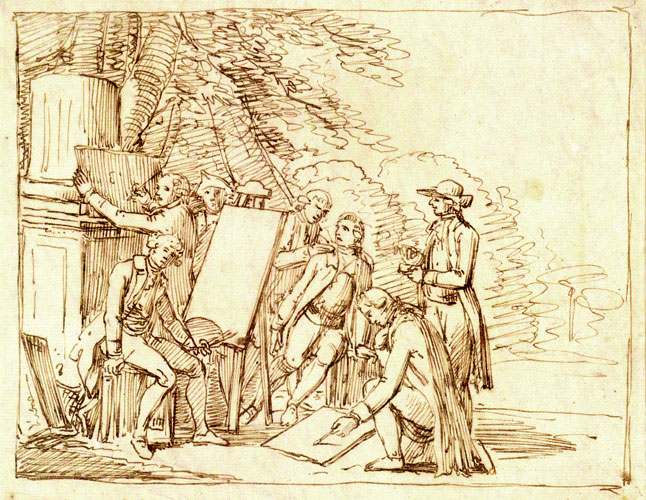
Goethe tried his hand at such landscapes as well. During his stay in Italy, from 1786 to 1788, most of his friends were artists. In the contemporary drawing below by Frederich Bury, Goeth is shown (third from right) with his German friends. Goethe even thought he might become an artist himself, but he soon gave up the notion.

He returned to Italy in 1790, to Venice, where he stayed for two months waiting for Anna Amalia, Carl August's mother, whom he was to accompany back to Weimar after her visit to Rome, which was no doubt inspired by Goethe's earlier journey. He seemed to have the same feeling about Venice as did Thomas Mann. He was enjoying domestic pleasures in Weimar with Christiane Vulpius, and his impressions of Venice, as recorded in the Venetian Epigrams (first published in 1796), are much more sharp and also lebensnah. Many of these poems are erotic, as per Goethe's model Martial, and they are also "snapshots" of daily life, culture, and politics in Venice. Goethe would seem to be prefiguring here the 19th-century flaneurs.

Here is an example, about a prostitute, in David Luke's translation:

"If I'd the husband I need, and if I kept house for him, I'd be
Happy and faithful and true, hug him and kiss him all day."
That was the song, among others more coarse, of a little Venetian
Whore; and so pious a prayer never I heard in my life.


Many of the epigrams suggest Goethe closely observed the habits of Venetian prostitutes. (See here for more translations of the epigrams, especially of the erotic ones.)

Goethe planned a third trip to Italy, in 1797, in order to make a comprehensive study of art. He got as far as Switzerland, before deciding to turn back. Napoleon's troops were all over the peninsula by now, and, like Hitler later, they were ransacking churches and private collections for art that would be transported back to Paris.

Though he didn't enter Italy, he sought to retrace the steps of his first trip to Switzerland, in 1774, during his Sturm und Drang period. Goethe was at that time engaged to Lili Schönemann in Frankfurt, but he was, as we would now say, "conflicted" about this engagement. He wrote a beautiful poem about his shifting moods, "On the Lake." The "high point" of this trip was his ascent with a travel companion to the Gotthard Pass, where they were welcomed at a Capuchin friary and served bread, cheese, and Italian wine.

In 1797, he repeated the ascent to the Gotthard Pass, as if to relive those earlier days. The pass is reached by several "bridges," which no doubt looked very much as in this painting of the pass by Turner, from 1803. Goethe wrote a lovely poem, which addresses the nearby summits whitened with snow. According to Goethe biographer Nicholas Boyle, Goethe was here acknowledging that this, his third Italian journey, "had become a journey into the 'autumn of life'":

Yesterday thy head was brown, as are the flowing locks of love,
In the bright blue sky, I watch'd thee towering, giant-like, above,
Now thy summit, white and hoary, glitters all with silver snow,
Which the stormy night hath shaken from its robes upon thy brow;
And I know that youth and age are bound with such mysterious meaning,
As the days are linked together, one short dream but intervening.

(This translation, by William Edmondstoune Aytoun, appeared in Blackwood's Edinburgh Magazine in 1845.)

Sunday, January 18, 2009

Countess Auguste Louise Stolberg

On this day in 1775 Goethe began a correspondence with a woman whose identity, initially, remained unknown to him. She had written to him of her enthusiasm for his novel The Sorrows of Young Werther, and her letter had been sent to Goethe by her brothers, who were studying in Göttingen. None of the letters she wrote to Goethe have survived, but the first one impressed him enough that he immediately replied. The small correspondence between the two in the following year (Goethe's responses survive), forms a small footnote in Goethe studies. The letters he wrote to her from Frankfurt, however, reveal much about his state of mind during the period when he was courting Lili Schönemann.

The lady in question was Auguste Louise Gräfin zu Stolberg (1753-1835), and she seems to have been urged to the bold step of writing to Goethe by Metta von Oberg, a German baronness, with whom she lived in a cloister for noble ladies in a place called Uetersen, in Schleswig-Holstein, which was then part of Denmark.

Her brothers were Friedrich Leopold and Christian. They too were Werther enthusiasts, and, on their way to Switzerland, in May 1775,  the young nobles stopped in Frankfurt and convinced Goethe to join them on their journey. Desiring to escape his entanglement with Lili, he did so. For the trip to Switzerland the brothers had clothes made to match the dress made famous by Werther: a blue frock coat, yellow leather knee breeches, and boots. Not only in their dress did the brothers cause a stir. 

They were adherents of what was called the cult of nature and, near Darmstadt, took the opportunity to swim naked in a pond. 
As Goethe wrote later of this episode in his autobiography: the sight of naked youths in the sunshine was no doubt a novelty but also caused a scandal. Well, we live in more enlightened times now. (Irony meter registering.)

Auguste fades out of Goethe's story in 1776, when he was becoming entrenched in Weimar and found in Frau von Stein a recipient for his outpourings. Auguste moved to Copenhagen in 1783 and married Andreas Peter von Bernstorff, an important government minister. The German-Danish writer Friederike Brun has many complimentary things to say about Bernstorff in her autobiography Wahrheit aus Morgenträumen. Brun's father, Balthasar Münter, was the Evangelical pastor at the court in Copenhagen, and it was he, along with Bernstorff, who accompanied Johann Friedrich Struensee on his ascent to the scaffold in 1772. Goethe, by the way, was one of the prominent European intellectuals of the time who wrote letters protesting Struensee's death sentence. An interesting portrait of this period in Denmark can be found in the novel The Royal Physician's Visit by Per Olov Enquist. Bruce Bawer, in his review of the novel, has a full account of what he calls "one of the strangest chapters in all of Scandinavian history."

The portrait of Auguste (now in the Goethe Nationalmuseum in Weimar) is by the contemporary Danish painter Jens Juelle, whose portrait of Klopstock is one of the most celebrated of that poet.

Sunday, December 23, 2018

Eckermann's Goethe

Johann Peter Eckermann
Work on a novel has kept Goethe Girl very busy with little time to think about blogging. Still, there is always a hankering to look at something concerning Goethe, and recently I had Amazon send me Gespräche mit Goethe in den letzten Jahren seines Lebens. It is the kind of book that I can pick up and read a discrete section and feel satisfied that I have learned something new about Goethe, even if filtered through the eyes of a person who seems to have given up everything, even the love of his life, to wait attendance on his hero. By the time I have written more posts on this subject, I may be able to come to my own conclusions about Eckermann, around whom the consensus seems to be mixed.

Margaret Fuller, who did much to transmit enthusiasm for Goethe and for German literature to Americans in the early 19th century, made the first English translation of the Conversations. She was self-taught in German, and, as I browsed her translation online, there were a few places where I was pulled up short and checked the German. I have a feeling it was less of failing to understand the meaning than that she was rapidly translating and did not go back to check things. There was one place, however, where I was struck by a very strange sentence. It appears during Eckermann's inaugural reception, on June 10, 1823, in the house on Frauenplan. He is escorted upstairs to meet Goethe, who soon appears. And here is the sentence in Fuller's translation:

"Goethe soon came in, dressed in a blue coat, and with shoes."

No fooling! Goethe wore shoes!

And then I checked the German. And here it is:

"Es währte nicht lange ... so kam Goethe, in einem blauen Oberrock und in Schuhen ..."

Is Goethe Girl missing something here?

Thursday, February 5, 2009

Sesenheim

"We never would have gone to Sesenheim at all, if it had not been for Rhodora."

Who could resist a story that opens like one by Ford Madox Ford, recalling the visit of proper English and American gentlefolks at "Nauheim" in The Good Soldier? This opening, however, is from "Sesenheim," by an American named Bliss Perry, which appeared in the May 1889 issue of The Atlantic Monthly. I came across it the other day while looking up something on Goethe. Perry (1860-1954) was an American scholar who edited, among others, the works of Edmund Burke, Sir Walter Scott, and Ralph Waldo Emerson. He also wrote a study of the works of Thomas Carlyle. He taught at Harvard and was also Harvard lecturer at the University of Paris, in 1909-1910.

"Sesenheim" as it appears in The Atlantic Monthly, is told by a first-person narrator who calls himself "the Scribe." He has been accompanying his friend John who "was inspecting the chemical laboratories of Germany universities." Rhodora, John's wife, is an American woman familiar from much fiction, with decided opinions. According to the Scribe she is a "delicate, sensitive, highly organized American woman." (Indeed, the name Rhodora sounds like "Leonora" in The Good Soldier, which, however, was not published until 1915.)
 
While the three of them are sightseeing in Strassburg, Rhodora notices the name of the owner on a bricabrac shop: "Brion": "'Brion,' she repeated. 'Brion? It must be a French name. ... Why, of course!' exclaimed Rhodora. 'Friederike Brion, Goethe's Friederike! John, Sesenheim must be near by, and I've always wanted to go here. It's so hot and dirty here; let's go to spend the Sunday at Sesenheim.'" And that, says the Scribe, is the reason the three happened to make a pilgrimage to the quiet Alsatian village, "whose sole claim to notice is that it was once the scene of a love episode more idyllic and more tenderly told than perhaps any other that ever won its gentle way into the world's literature."

The Scribe is dispatched -- it is Saturday afternoon -- "in search of a cheap edition of Dichtung und Wahrheit," which Rhodora claims to have read in her school days. Moreover, he also finds a tiny book on Friederike by "Pastor Lucius of Sesenheim." On the train the Scribe, with Dichtung und Wahrheit in one hand and the pastor's book in the other, is "deputed to read the important passages from the pastor's loving chronicle."

There follows a long passage rendering the events of the "Sesenheim idyll" (as recounted in books 9-11 of Goethe's autobiography): the ride of the brilliant, lovable 21-year-old student to Sesenheim in the autumn of 1770; the slender, light-haired daughter of the village pastor; the bright, tender, and infinitely winning letters; the verses with all the lyric passion of the "young Goethe"; the restiveness of genius; the departure without explanation; the final letter to her and her gentle answer, which "tore his heart." And then, years later, while journeying southward with the Duke of Weimar, Goethe stops at the parsonage, "to find all its inmates unchanged toward him, and Friederike calm and affectionate as of old, so that the next morning, at sunrise, he rode away from Sesenheim 'in peace,' as he wrote Frau von Stein." In sum, Goethe rose "steadily upon his splendid and solitary path, and Friedericke Brion, spinster, growing old and dying in 1813 at her brother's house in the tiny village of Meissenheim, having lived a life of such unselfish ministration and such sweetness that an old woman who has survived into our own day tells us that when as a child she heard about angels, she 'always thought of Aunty Brion in a white dress' and that 'the sick, and children, and old people' loved her." Sounds like the shade of Otillie in Elective Affinities.

Of interest in Bliss Perry's story are descriptions of a century ago -- 1899 -- which are much closer to the Sesenheim of Goethe's day than our own, which are so much obscured by features of modern life. 

For instance, this is the scene the Scribe sees from the window of the train: "To the left were the Vosges, in a retreating blue distance, while as we rolled northward, all along on the right, beyond the Rhine, were the wooded summits of of the Black Forest, misty yet and shadow-barred in the morning sunlight. It was Trinity Sunday, and the peasant in holiday costume thronged the station platform, intent upon excursions to neighboring villages." And then, indicating a misunderstanding of the German, the Scribe writes: "After an hour, we passed Drusenheim. It was the place where Goethe changed horses, and the next village was Sesenheim." True, Goethe did change horses at the inn in Drusenheim, but, more important, he was able to exchange clothes with the son of the innkeeper, in order to rid himself of his earlier "Verkleidung."

I made a trip to Sesenheim back in 1999. It is a well-preserved town in the best European welfare state fashion, but still retaining many of the sights described the Scribe. There were the reddish-gray roof tiles and the eight-sided tower of Pastor Brion's church, although I did not see the girl "busily at work draping a white cloth about a temporary roadside shrine of the Virgin, in honor of the feast day."
  
Like the travelers from 1899 I also went to an inn near the church. The present incarnation of the Gasthaus zum Anker they visited is "Au Boeuf," where I enjoyed one of the best meals of my own trip through the Vosges region.

They too had an Alsatian country dinner, during which Rhodora and John got in a heated argument about Goethe's abandonment of Friedericke. John didn't believe "any man of genius [had] the right to break the heart of a girl like Friederike."

After lunch they went to the church at which a funeral service was being conducted, for an old woman, "born in the very year that Friederike Brion died." In the aisle was a tombstone, with the inscription half effaced, bearing the date of 1557, "over which the young Goethe's feet one stepped so lightly; and there was the pastor's pew, in which, by the side of Friederike, he found her father's sermon 'none too long.'" The seats were filled with peasant women, "in dark, immobile rows." Their dress consisted of a black alpaca gown edged with velvet ribbon and a brocaded silk cloth, and they wore on their heads, "a queer little quilted black cap, with wide stiff bows of ribbon that stood out from the head like the wings of a butterfly."
 
I didn't see anything like that in 1999, but perhaps they resembled the headdress in this charming illustration from a book on Alsace-Lorraine from 1918.

Emerging from the church they encountered a dozen boys ranged along the wall of the churchyard. "Just as if it were a New England country meeting house!" exclaimed John. They proceeded to visit "the historic barn," and John reached his long arm over the fence and plucked a blossom "from the famous jasmine bush." They encountered the new "rosy-cheeked" pastor who explained why the old parsonage had been torn down. Here is Goethe's description of the parsonage, which suggests the fairytale state in which the Sesenheim idyll hovered: "Haus und Scheune und Stall befanden sich in dem Zustande des Verfalls gerade auf dem Punkte, wo man unschlüssig, zwischen Erhalten und Neuaufrichten zweifelhaft, das eine unterläßt, ohne zu dem andern gelangen zu können."

The parson tells them he had to read Dichtung und Wahrheit in order to answer all the questions of visitors, then invites them to his library to see one of Friederike's letters, the sight of which -- "a yellowed old letter" framed and hung -- makes them conscious that antiquarianism and curiosity had breathed a spirit of prose upon their hitherto unspoiled Sesenheim idyll.
 
Nowadays there is a charming museum at "Au Boeuf," where one can wander free of charge and inspect Sesenheim memorabilia and even some authentic documents.

Toward the end of the afternoon they find the hillock "where Friederike passed many an hour in that favorite arbor of which Goethe himself had much to say." Some Goethe lovers had bought the hillock and erected a new arbor with the inscription "Friederiken Ruh. 1770-1880." Arriving at this "reinlicher Platz mit Bänken, von deren jeder man eine hübsche Aussicht in die Gegend gewann," Goethe wrote that it did not occur to him that he had come to disturb its peace: "denn eine aufkeimende Leidenschaft hat das Schöne, daß, wie sie sich ihres Ursprungs unbewußt ist, sie auch keinen Gedanken eines Endes haben kann, und wie sie sich froh und heiter fühlt, nicht ahnden kann, daß sie wohl auch Unheil stifen dürfte."

It was perhaps with something of this disturbance in mind that the Scribe and his companions retired to an adjacent meadow, where they lay under a great ash and watched the clouds drift across the heaven and "pile themselves into a huge glistening mass above the Black Forest." Their talk drifted constantly back to Goethe. At sundown they turned their steps toward the train station, and Rhodora could be seen bending in the dusk above one of the bushes near the arbor, then returning with some white primroses in her hand. The primroses of course remind us of the Primrose family in The Vicar of Wakefield, by Oliver Goldsmith, on which Goethe consciously modeled his narration of the Sesenheim idyll. Rhodora gives each of the men one and sticks a third through the buttonhole of her jacket. John takes the final one and fastens it to the lattice of Friederike's arbor. "'Why, of course, John!' said Rhodora, softly. 'The poor girl!'"

The photos of contemporary Sesenheim are by the German photographer Ivo Schweikhart, who includes many more of interest on his website, along with quotations from Dichtung und Wahrheit.