The current issue of The Weekly Standard has a review of what seems an intriguing book, Nocturne: A Journey in Search of Moonlight, by James Attlee. I went to my local Barnes & Noble this afternoon, hoping to have a look, but it had not yet hit the shelves there. Am I wrong to think that modern interest in the moon began with Galileo's observations through his "spyglasses" (the term "telescopium" not yet having been invented)? The moon, the stars, the planets, and so on have been perennial poetic elements in the West, but the heavens took on a new aspect from the 17th century. Before Galileo the moon had been thought to be perfectly round and smooth -- the Earth being the only source of imperfection in the universe -- with the dark spots on its surface the result of the differing absorption of light. Probably books have been written on the changes in the treatment of the moon in poetry, but I will wait until I see Professor Attlee's book.
Goethe wrote several beautiful poems with the moon as subject. In one, "To the Rising Moon" ("Dem aufgehenden Vollmonde"), he addresses the moon directly:
Willst du mich sogleich verlassen?
Warst im Augenblick so nah!
Dich umfinstern Wolkenmassen,
Und nun bist du gar dicht da
Doch du fühlst, wie ich betrübt bin,
Blickt dein Rand herauf als Stern!
Zeugest mir, daß ich geliebt bin,
Sei das Liebchen noch so fern.
So hinan denn! hell und heller,
Reiner Bahn, in voller Pracht!
Schlägt mein Herz auch schmerzlich schneller,
Überselig ist die Nacht.
Here is a link to the English translation; though the first line of the translation addresses the sense, what Goethe says is, "Do you want to leave me so soon?"
I especially like another poem by Goethe, "At Midnight," in which the moon features:

Um Mitternacht ging ich, nicht eben gerne,
Klein, kleiner Knabe, jenen Kirchhof hin
Zu Vaters Haus, des Pfarrers; Stern am Sterne,
Sie leuchteten doch alle gar zu schön;
Um Mitternacht.
Wenn ich dann ferner in des Lebens Weite
Zur Liebsten mußte, mußte, weil sie zog,
Gestirn und Nordschein über mir im Streite,
Ich gehend, kommend Seligkeiten sog;
Um Mitternacht.
Bis dann zuletzt des vollen Mondes Helle
So klar und deutlich mir ins Finstere drang,
Auch der Gedanke willig, sinnig, schnelle
Sich ums Vergangne wie ums Künftige schlang;
Um Mitternacht.
Again, here is a translation. For a really good translation, however, one must go to David Luke, who writes about "At Midnight": "Goethe stated in his diary, and again in a later essay, that this mysterious poem was one of which he was particularly fond, all the more so because, on the bright moonlit night of 13 February [1818], it had come into his mind unexpectedly and without explanation. ... It seems, however, to be an evocation of three successive stages of life and thus to be what Goethe calls a 'song of life (Lebenslied).' It may also be significant ... that all three stanzas are linked by an imagery of light, of brightness increasing from that of the stars to that of the full moon."

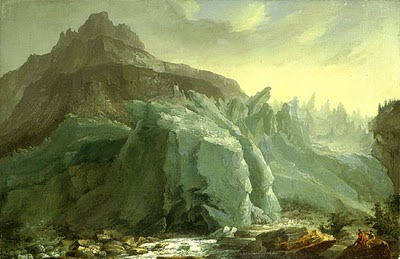
I particularly like the concrete imagery of the first stanza, the child walking home in the dark, a bit afraid, with only the stars guiding him. The poem also conveys the mood of many Romantic-period paintings, for instance, the two above by the English artist Samuel Palmer. The first, an etching in black ink, would seem even to portray the rural setting. I have been very fond of Palmer since encountering his work at an exhibition held by The Metropolitan Museum a few years back. Palmer seems to have been melancholic, which is appropriate for someone who painted so many moons.

The photo at the top of the post is of an Interstellar Light Collector from outside Tucson. According to The Weekly Standard review, it is a five-storey-high array of parabolic mirrors that, according to its builders, cure ailments by amplifying and directing moonlight at participants hoisted by a boom lift. For moonbeams closer to home, one might buy a moon jar.


 A reader of this blog has alluded to a fondness for Goethe's novel The Sorrows of Young Werther. In the first part of the novel, when Werther was feeling happy, his favorite reading matter was Homer's Odyssey. When his mind took its southward turn, he began reading the cycle of poems named after Ossian, supposedly the Gaelic bard in the Scottish Dark Ages. Like Homer, Ossian was blind, and he sings, among other things, of the life and battles of a warrior named Fingal. The tone is elegiac, reflecting, Götterdämmerung-like, the end of the warriors' way of life. Though it was discovered that the poems were a fabrication of the Scots poem James Macpherson, they were nevertheless the rage in the 18th century. No doubt the "rudeness" of the more primitive way of life appealed to the growing civilized habits of Europeans. Homer portrayed the world of gods and men; in Ossian a more elementary portrait of nature is conveyed. Herder called Ossian "Naturpoesie." Goethe, with his friend Merck, published an edition of The Works of Ossian (1773/77), and prepared the engraving for the title page himself.

 I digress. I wanted to write something about the sublime, with which I have been struggling for over a month, trying to write a decent scholarly article on the so-called "pre-Kantian sublime." Really, it's all about Bodmer and Breitinger again, with a dash of Goethe and Fuseli thrown in. Thus, it's not as if I don't have something to blog about, but the academic exercise demands a narrowness that is at odds with the freedom of posting one's thoughts.