Thursday, May 18, 2023

Goethe, Fuseli, and von Humboldt


Wilhelm and Alexander von Humboldt with Schiller and Goethe in Jena

After having finished the previous two posts, I have been brooding on certain commonalities of the three. All were “geniuses,” in the 18th-19th century sense of that term, and all of German-speaking background. From youth onward, their path forward in life would have been to follow in the path of their father. Fuseli would become a pastor, Goethe a lawyer, and Humboldt a high-ranking bureaucrat in the Prussian civil service. Nothing of the sort happened. All three might be said to have followed their own star.


As I mentioned in the post on Fuseli, that his life took such an unanticipated turn, that he became a great and original painter in England, rather than in Switzerland or Germany, was the result of a youthful imprudence, engaged in with Lavater, who did return to Switzerland and did become a pastor. As I mentioned in that post, the amount of scholarship on Fuseli is very sparse, but the alacrity with which he accepted the offer to travel to London in 1764 with the British ambassador to the Prussian court is perhaps an indication of a desire to mark out a new path.

About Goethe and von Humboldt, however, we know from their own writings how adverse they were, from a young age, to following in the well-trod path of their own fathers.

Goethe’s father, Caspar, had studied law as a young man in Leipzig and Strassburg, and followed up his studies with a grand tour that included Italy. He had inherited quite a fortune from his father, and it seems to have been the time of his life. Professionally, however, he made a wrong step on his return to Frankfurt in 1742, which left him without a position in the city’s administration.  He married into a prominent and old Frankfurt family, which raised his status considerably, but with a lot of time on his hands, he appears to have devoted it to the education of young Goethe and his sister Cornelia. Cornelia of course married, while his son was supposed to follow in his footsteps. So it was that young Goethe studied in both Leipzig and Frankfurt and was supposed to go to Italy before becoming a lawyer.

Johann Caspar Goethe

Well, Goethe did study law in Leipzig and Strassburg, and he even studied (as had Caspar) at the imperial court in Wetzlar, but between Leipzig and Wetzlar other things intervened, The Sorrows of Young Werther of course being the most notable. Already in 1768, however, when Goethe was still only nineteen, he wrote to a friend of his “efforts to become, and his fairly well founded hopes of becoming, a good writer.” (Mein feuriger Kopf, mein Witz, meine Bemühung und ziemlich gegründete Hoffnung, mit der Zeit ein guter Autor zu werden.) Nicholas Boyle in his biography of Goethe writes that Goethe “was no Rimbaud” (Goethe’s earliest surviving poetry gives evidence of that), but Rimbaud (b. 1854) came of age in a far different literary milieu. The French language was a well-formed literary language by the time of his birth, whereas Germany in 1749, the year of Goethe’s birth, was not even a united nation, while its writers were in the process of forging a common literary language. So, too, Goethe’s earliest efforts were a pastiche, a hodgepodge, a babel, a collage: imitation on a wide scale. It took him several years to get his feet on the ground, so to speak, and craft his own inimitable idiom.

Alexander von Humboldt’s father died when Alexander was still a child, but his mother undertook his education with the aim of outfitting him to occupy a role in the Prussian civil service. He did follow her orders for a while, went as far as becoming an inspector of mines, a very important position. Unlike with Goethe we have more evidence of his youthful unhappiness and of his many forays into different pursuits. For instance, he associated with members of the important Berlin salons. As Maren Meinhardt writes of Humboldt’s integration into this “new and mysterious world,” it offered him “the prospect of transformation, of being not quite who he was. The unknown, shimmering and colorful always seemed enticing to him.”

Guests at Henriette Herz's Literary Salon, ca. 1800

In the end, he didn’t even know what he would discover when he took off for South America in 1799: “no colonial power had sent him, nor did he represent any political or mercantile interest. Nor, for that matter, was anyone funding him. Instead, Humboldt put his own inheritance in the service of a scientific expedition for himself and his collaborator Aimé Bonpland, a journey that would last five years, the foremost purpose of which would be to satisfy his scientific curiosity.”

What Meinhardt writes of Humboldt could also be applied to Goethe’s early path in life: “his motivations were complex and the goal of his journey was to a very high degree unspecified.” Along with Fuseli, they were travelers, and their achievements came from uprooting themselves from familiar soil.

The influence of Goethe and Humboldt has been enormous, while the effect of Fuseli both during his life and afterward is still up in the air. While he occupied an important position in London literary and artistic life, his non-English background may have shortened his “outreach.”

 Image Credits: London Remembers; Schule.Judentum

Friday, May 12, 2023

Alexander von Humboldt (and a little Goethe)


Humboldt's Naturgemälde

Alexander von Humboldt has attracted some interest in recent years. (In what follows, I am assuming  that readers have heard of Humboldt’s famous five-year South American expedition, but, if not, I recommend the Britannica link.) First, in 2006, there was Daniel Kehlmann’s delightful novel Measuring the World (Die Vermessung der Welt), in which Humboldt shared the stage with the mathematician Karl Friedrich Gauss. It was followed in 2015 by The Invention of Nature: Alexander von Humboldt’s New World by Andrea Wulf, an in-depth biography that offers a  “global view” of Humboldt and his scientific achievements. As Wulf writes early on, the individual disciplines we recognize today as “science” — chemistry, physics, astronomy, and so on — were taking on distinct form by the end of the 18th century, breaking away from natural philosophy, which subsumed natural phenomena within a metaphysical framework. Humboldt was an experimentalist par excellence (as Wulf writes, “a man who discarded a life of privilege to learn how the world works”), but was not content to examine natural phenomena in isolation (think of Linneus’s neat classification of plants), but sought to study them within larger relationships in which they were embedded. Humboldt’s conception is graphically on view in his famous Naturgemälde der Anden, a depiction of the volcanoes Chimborazo and Cotopaxi in cross section, with detailed information about plant geography. (Click on the image above to enlarge.) The illustration was published in The Geography of Plants, 1807, in a large format. Wulf also trace Humboldt’s influence on later generations, especially writers and others who are concerned with the effects of human habitation of the Earth  (e.g., Thoreau and Ernst Haeckel), including subjects like deforestation and climate change.


A third book on Humboldt, by Maren Meinhardt, appeared in 2018 -- A Longing for Wide and Unknown Things -- which I discussed briefly in a post several years ago. Meinhardt was probably in the process of writing her own book on Humboldt in 2015, as can be seen by a long article she published in the magazine Guernica that year. (Very readable, much to be recommended.) She must have felt blind sided by the appearance of Wolf’s book, but she has produced a very different kind of study. It is a “life,” and not, as in Wulf, “a global Humboldt.” One learns more about the man close up. Meinhardt’s notes, for instance, which include the bibliographic references, are only thirty pages (in contrast to Wulf’s walloping 120 pages), and are drawn for the most part from contemporary documents, including correspondence.

Humboldt and Bonpland at Mt. Chimborazo, Ecuador

In places this biography is uncomfortable reading. Humboldt’s obsessive quests for knowledge of the natural world seemed reflected in several relationships, apparently non-sexual, with various men. Meinhardt treats these, quoting from effusive letters, which may suggest homosexuality, but, interestingly, there was one man whom he would seem to have known closest, Aimé Bonpland, and with whom he inhabited the closest quarters during their American travels, but with whom apparently no sexual relationship occurred. Meinhardt, and Wulf to some extent, deals with the Humboldt mother-son relationship, which seems to have had little room for close emotional contact. In Meinhardt, however, one learns that Humboldt’s desire to understand natural phenomena in terms of relationships also extended to his views of those between humans.

Which brings me to Goethe, who plays a major role in both books. In fact, already the second chapter of Wulf’s book is entitled “Imagination and Nature: Johann Wolfgang von Goethe and Humboldt.” It is a very thorough discussion of Goethe’s scientific pursuits, which the relationship with Humboldt revivified on their first meeting in Jena in 1794. Wulf’s wealth of bibliographic sources allows her a closer look at their get togethers. (For instance, it was freezing cold in Jena in December of that year: “The frozen Rhine became a thoroughfare for French troops on their warpath through Europe.”) It was a period when Goethe’s scientific ideas found little resonance among contemporaries, including Metamorphosis of Plants (1790) or his essays on optics (Beiträge zur Optik, 1791), a preface to his theory of colors. Meeting Humboldt, a “sparring partner,” caused him to start working on his scientific studies more intensely. We also learn that the young Goethe who had stormed Europe with his novel The Sorrows of Young Werther was now corpulent, “with a double chin and a stomach cruelly described by one acquaintance as ‘that of a woman in the last stages of pregnancy.’ His looks had gone — his beautiful eyes had disappeared into the ‘fat of his cheeks’ and many remarked that he was no longer a dashing ‘Apollo.’”

Chemical attractions in Elective Affinities

So be it. It is only in chapter 9 that Goethe gets his own chapter in Meinhardt, the title of which is “Chemical Attractions.” While discussing the coming together of Humboldt and Goethe and its electrifying effect on Goethe’s enthusiasm for scientific matters (Humboldt had by 1794, writes Meinhardt, “developed an almost obsessive interest in the idea of animal electricity, generally referred to as ‘galvanism’”), she focuses on the literary effect, namely, Goethe’s novel Elective Affinities, in which the relationships between natural phenomena offer a model for those chemical and human relationships portrayed in the novel. As Meinhardt writes: “Goethe puts his characters in the positions of chemical substances in the course of an experiment.” Further, “the novel is strongly preoccupied with the equilibrium that needs to be maintained,” but that, in the case of the relationship between Eduard and Charlotte, is disturbed by new elements. “Chemistry, following its inevitable course, quickly goes beyond the experimental setting and draws the characters into a destructive maelstrom.” Wulf mentions the novel in her study, but only in passing. Similarly, Meinhardt’s focus on the milieu of the first meeting of Humboldt and Goethe brought out something I had not known, namely, the role Wilhelm von Humboldt, Alexander’s brother, played in “engineering” the course of events that led to the fabled encounter between Schiller and Goethe, which was followed by dinner at the home of Wilhelm and Caroline von Humboldt in Jena in July of 1794. The rest is literary history.


Another chapter in which Goethe plays a role takes place after Humboldt’s famous American tour, when he and a group of friends, despite the warlike conditions in Europe, plan a trip to Italy in 1797. It is entitled “Goethe’s Caravan,” and at some point, according to Meinhardt, Goethe actually considered joining the group. The group venture “went south,” so to speak, not to Italy, but by now, Humboldt’s renown as a scientist “smoothed his path wherever he went.” His brother Wilhelm and Caroline did go to Italy, however, where they were neighbors with the German-Danish writer Friederike Brun, about whom I wrote a blog post back in 2012 in connection with “Goethe in Venice” and have also written an essay on Brun that appeared in this volume.

Like Fuseli (see previous post), Humboldt doesn’t inhabit a single world, escapes easy classification. He was “one of the most captivating and inspiring men of his time” (writes Wulf) and the most famous scientist of his day. The 100th anniversary of his birth, September 1869, was celebrated all over the world. Imagine that the streets of downtown New York City were lined with flags, and posters with his picture appeared on building fronts. Today, of course, as Wulf writes, very few outside of academia have heard of him, although that is probably only true in North America and the European world. Humboldt's name is everywhere in Latin America and in several African countires. According to the Alexander Humboldt Foundation, mountain peaks, bodies of waters, and entire regions bear his name, including the Humboldt Current.

Image credit:  Stiftung Preußische Schlösser und Gärten / Hermann Buresch; Sofatutor

Saturday, May 6, 2023

Henri Fuseli anew

Fuseli and Bodmer

Goethe Girl has been occupied with a couple of literary projects the past couple of months that kept me away from devoting as much time as I would like to Goethe and to this blog. But I have been saving up for a couple of weeks now a review in the New York Review of Books (4/20/23) of a book entitled Dinner with Joseph Johnson: Books and Friendship in a Revolutionary Age in which the Swiss artist Henry Fuseli (Heinrich Füessli) prominently features. Johnson was an English bookseller and befriended Fuseli after the latter's arrival in England in 1763. Considering that Goethe never met Fuseli, there are many posts on this site in which Fuseli and his work are mentioned. There were, after all, many links connecting Goethe and Fuseli. Goethe's first "foreign" travel, after all, was to Switzerland, where he met Bodmer, who had been Fuseli's mentor. If any reader wishes to know more about these connections, please enter "Fuseli" in the "Q" box at the top left, and you will be directed to quite a few posts.

Goethe's closest connection to Fuseli was through Johann Kaspar Lavater, a friend of Fuseli from Zurich. Both Lavater and Fuseli were fellow theology students, and the two were partners in the denunciation of a Swiss magistrate for his misdemeanors. It was a very celebrated affair that caused the magistrate to be condemned and exiled from Zurich, but since such youthful actions might affect their own future in the canton, they both undertook an educational tour of German lands in 1763, accompanied by Johann Georg Sulzer, a friend of Bodmer. In Berlin, Fuseli met the English ambassador at the Prussian court, and headed off to England with him. Lavater, meanwhile, through Sulzer's influence came in contact with individuals who (according to Goethe Handbuch 4/2) represented the leading theological, philosophical, and literary tendencies, among others Klopstock and Mendelssohn, Gellert and Gleim.

Lavater, Goethe, & Basedow

Lavater returned eventually to Switzerland, and by 1772 he was a well-known author outside his homeland with his Aussichten in die Ewigkeit (speculation re eternity), which Goethe reviewed in the Frankfurter Gelehrten Anzeigen that year; skeptically, according to Goethe Handbuch. In the same year, Lavater's small volume on physiognomy was reviewed in FGA by Johann Georg Schlosser. Goethe's own small tract, Briefe des Pastors zu *** an den Pastor zu ***, prompted Lavater to write to Goethe. It was in the summer of 1774 that they met and, for a while, formed a firm friendship and even partnership in connection with the subject of physiognomy. Together with Johann Bernhard Basedow they made a journey down the Rhine and the Lahn. (Richie Robertson has written a nice story of their "unusual friendship.") The friendship, as such, went from hot to cold within a decade or so, but Goethe wrote a wonderful account of the trio and their Rhein-Lahn journey in Book 14 of his autobiography.

This post is supposed to be about Fuseli and has turned out to be about Lavater, about whom there are also plenty of posts on this blog. As I mentioned, both he and Lavater were students of theology in Zurich, but while Lavater remained dedicated to the religious calling, Fuseli was apparently more of a free thinker. By 1779, Fuseli was firmly ensconced in London, but he remained in correspondence with Lavater. As I have discovered from some online research, Fuseli produced not only the first English translation of Winckelmann's history of Greek art, but also a book by Lavater entitled "Aphorisms on Man." The last-named was illustrated by William Blake. The review mentions Fuseli's plan to create a series of thirty huge paintings on the works of John Milton, which would be reduced to book size to illustrate the edition. Fuseli's interest is this English writer must certainly be traced back to his Swiss roots, to Bodmer, whose translation of Paradise Lost  made Milton accessible to Germans. The book did not come to fruition, but Fuseli apparently opened a Milton Gallery in 1799. Fuseli liked to portray literary topics.

Lady Macbeth Walking in Her Sleep (1784)

In London Fuseli really became "English." He was a member of Joseph Johnson's own "club" (similar to that of the 1760s of Dr. Johnson, memorialized by Boswell), which included such eminences as Joseph Priestly, William Godwin, Tom Paine, Samuel Taylor Coleridge. That guest list indicates the changing times, politically and socially. Moreover, Fuseli's most famous painting, The Nightmare ("unnervingly sexy," according to NYRB reviewer Miranda Seymour) dominated the room in which they convened. Joseph Johnson's table include women as well, e.g., Anna Laetitia Barbauld and Mary Wollstonecraft. Fuseli must have been a very attractive man. The review points out that Wollstonecraft "became close enough to Fuseli to seek even to join the artist's marriage," a "bold suggestion," which Fuseli later claimed "was fiercely rejected by this wife." In 1792 Johnson and the Fuselis and Wollestonecraft terminated their plans to travel to France to observe the revolution after the news of the royal family's failure to escape the country, and Wollstonecraft, "anxious to snap the painful chain of association with Fuseli," traveled on her own to Paris, where she met "a charming but fickle adventurer," with whom she gave birth to her first child.

As per the review in the NYRB review, the encounter of Johnson and Fuseli had the "most enduring effect on Johnson's life." Fuseli took rooms at Johnson's premises already in 1766 and, at Johnson's death in 1809, he was, with his wife, Johnson's "devoted caregiver."

One can't help wondering what Fuseli's status would be today if he had remained in Switzerland. He is something of an in-between figure, despite his role in this important circle of early 19th-century British life as well as a member of the Royal Academy of Arts and a professor there. (Sir Joshua Reynolds was a friend.) The Freies Deutsches Hochstift in Frankfurt has the largest collection of his works in Germany, while Fuseli has featured prominently in various exhibitions in recent decades, e.g., at the Getty.  Even in Germany there has been only one biography in recent decades, and only two in the 20th century in English.

Images: Lavater, Goethe & Basedow; Lady Macbeth (Musée du Louvre, Paris)

Tuesday, March 14, 2023

Goethe and the Cloud Messenger

Study of Cirrus Clouds by John Constable

Many years ago (2008!) I penned a short post in which I included a verse from a poem (in translation) by Goethe in honor of Luke Howard and the Englishman's classification of clouds. Among Goethe's many duties in the duchy was that of overseer of the meteorological station at the university in Jena. He became a systematic observer of cloud formations, and it was through this interest that he learned of Howard and his writings on clouds, or, according to the Marginalian, "humanity’s favorite atmospheric phenomena." We know that Goethe was interested in many eminent English, French, Italian, and American men of science (yes, most were men), but Howard might have appealed to him because he did not come from academia. Indeed, Howard was a Quaker, which meant that in England in the early part of the 19th century he was not permitted to attend the university, which was the case of many early inventors. Howard is the person who gave us the Latin names that became the basis for the classification of cloud formation: status, cumulus, cirrus. It turns out that, when Howard was criticized for his use of Latin rather than English terms, Goethe stepped in and wrote in Howard's favor that his nomeneclature “should be accepted in all languages; they should not be translated, because in that way the first intention of the inventor and founder of them is destroyed.” The image below, from the Cloud Appreciation Society website, shows "Altocumulus above patches of Altostratus spotted over Goethe’s home town of Weimar."


I found myself returning to the subject of clouds after recently reading the novel A Passage North by the Sri Lankan writer Anuk Arudpragasam. In this novel, the present-day narrator, sighing for the presence of a woman he loves, relates the story in the  Meghaduta by the Sanskrit writer Kalidasa of the neglectful deity banished from his Himalayan residence for a year by his master, the god of wealth, Kubera, for an offense and is thereby separated from his beloved. Espying a passing cloud, the banished yaksha requests of this cloud that it bear a message to his distant lover. The message is to the effect that his love for her is unchanged and that she should hold on to that love until his return. 


The majority of the poem is the narrator's description of the route that the Cloud Messenger is to take to reach her. For anyone interested, I came across a thesis from the faculty of theology and religious studies at the Reijksuniversiteit in Holland that has that route as its subject: "Exploring the Geographical Data of the Meghadūta: Reconstructing the Route of the Cloud." A map is included. It is in the second verse of Goethe's poem honoring Luke Howard that the cloud messenger is mentioned. (See this translation.)

Just when you think you have come up with something new to write a blog post about, someone has  already written a thesis on it! In preparing this blog post, I even came across a piece in an Indian journal concerning the reception in Germany of Kalidasa's work, including the drama Sakuntala, first translated from Sanskrit by Sir Willliam Jones into Latin, and then into German by Georg Forster, "the Mainz Jacobin," according to Indian Review, who then forwarded his translation to Goethe. What a small world.

And to top all this off, consider this bit of information, also from Indian Review. The posthumous publication of Heinrich Heine's works in 1869 revealed that Heine had noticed the use Goethe made of the Sakuntala, namely, in the "Vorspiel auf dem Theater" in Faust. In the Sakuntala drama, after an actor appears on stage and speaks a prayer to Shiva for the performance, the stage director appears and informs the leading actress "that the drama Sakuntala is to be performed before a cultured audience, so that the actors must do their utmost." As the writer in Indian Review acknowledges of the differences in the two prologues: "two different kinds of society, each with different expectations of the theatre." World literature, indeed, on the subject of which a colleague of mine in the Goethe Society of North America, Willi Goetschel, has recently published an article on Heine and world literature.

For those who have more interest in clouds, in particular in the writings of Germans, the Freie Universität has a nice post on the "Language of Clouds."

Saturday, February 18, 2023

Goethe and "evening's empire"


Copernicus Observing the Night Sky, by Jan Mateiko

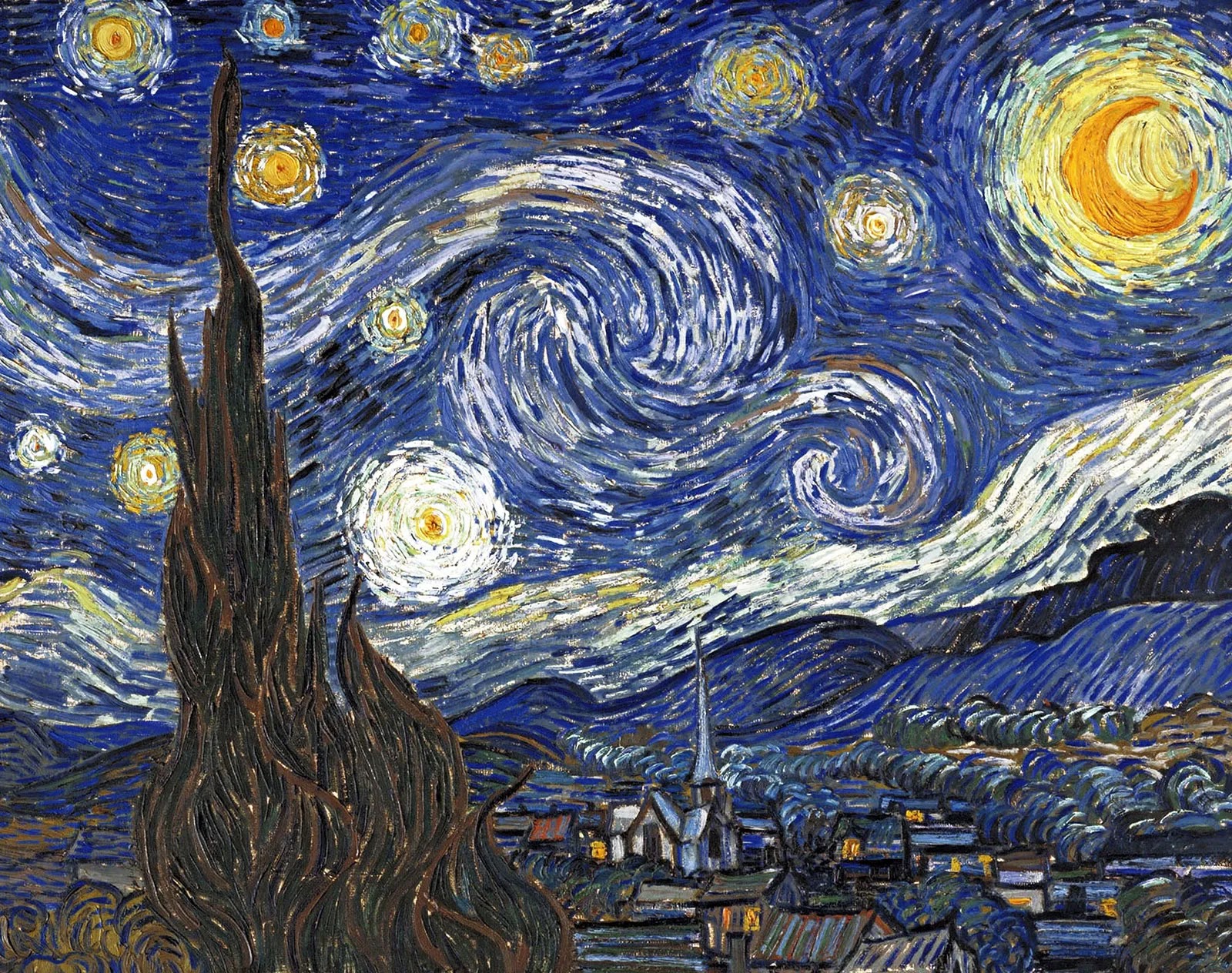
While Goethe Girl was following various trails that led from Grumach, subject of the previous post, there were along the way some interesting byways that led her to pause and take a look. A book that came to my attention was Evening’s Empire: A History of the Night in Early Modern Europe by Craig Koslofsky. As Professor Koslofsky writes on the first page, “The night imposed fundamental limits on daily life” for people of early modern Europe, while also “serving as a many-faceted and evocative natural symbol.” The subject of his study is the gradual “nocturalization” in the 17th and 18th centuries in European countries, a process that had a significant effect on social life. By 1700, for instance, all European cities had coffeehouses, which as we know from Habermas were sites of lively sociability. But even discussions of the scientific discoveries of the early modern period took place in the candlelight-illuminated indoors, as seen in the painting below.

I won’t go into the story of the discovery by Georg Rhätius in 1540 that night was an effect of the earth’s rotation. Previously, as Koslofsky writes, the space between the Earth and the circle of fixed stars was conceived as being illuminated by solar and divine light. The new astronomy would reveal an infinite universe of endless light. Imagine the effect on your thinking at such a discovery, although it probably didn’t really settle into men’s minds for a long, long time. with the night kept at bay.

Wright of Derby, The Orrery (1766)

You knew I would be getting around to Goethe at some point. Again, I am focusing on the “young” Goethe, before 1775, the date at which he went to Weimar and began, in my estimation, “to become Goethe.” There are three stages here: Frankfurt, Leipzig, and Strassburg.

In Book 5 of his autobiography, chronicling the period 1765–65, he writes of spending evenings away from his parental home in Frankfurt at a house where gathered a group of young folks his own age — in the telling he is fourteen going on fifteen — during which he first displayed his poetic talents. By then, Frankfurt was a major city of the Reich — it was the site in the year 1765 of the coronation of the emperor, a story also told in Book 5 — and would have had street lighting, which, as Koslofsky tells us, consisted of candles or oil lamps in glass-pained lanterns. So, we can imagine that Goethe had no trouble finding his way to the party and back home at a late hour without stumbling around in the dark. Before the inauguration of street lighting, anyone out after dark was required to carry a torch or a lantern: not to see so much as to be seen.

Vincent van Gogh, Starry Night
In 1765 he went to study law in Leipzig, which according to Richard Benz’s short bio of Goethe in vol. 14 of the Hamburg edition of Goethe’s works, was the most modern “Großstadt” of the time. The initiative for street lighting there had come from the Elector of Saxony, Augustus II (again, this and all info on street lighting is gleaned from Koslofsky), Leipzig being part of his fief. It was in particular the merchants’ guild that advocated street lighting because of nocturnal crime, and it was duly established in 1701. Leipzig’s prosperity, after all, depended on attracting merchants. (And of course Augustus taxed the residents for this amenity.) We know from the letters Goethe wrote home from Leipzig that he often went to the theater. Again, like coffeehouses, theater productions contributed to a lively street life with the advent of street lighting. Thus, we can see young Goethe — he is first sixteen, going on seventeen — heading out in the evening to the theater or to Auerbach’s Keller.


Finally, he arrived in Strassburg in 1770. Interestingly, as Koslofky writes, Strassburg was the “last word” in street lighting, where it was finally installed — and over the protests of citizens at that — in 1779, long after Goethe’s student days there. Goethe makes no mention in the autobiography of theater attendance in Strassburg, so we can imagine his nocturnal activities taking place indoors, spending many an evening, for instance, reading with Herder, who was undergoing eye surgery there. At the same time, he describes his horse rides in the Elsass as well as to Sesenheim to visit Friederike, and I wonder if those rides took place at night. It might have been pretty dangerous.

Francisco de Goya, Witches Sabbath (ca. 1823)

I am not sure whether night as subject in Goethe’s poetry and of his work in general has been investigated in detail, but, along with various night scenes in Faust, he wrote one very impressive poem in which night expresses the “Invisible World” of nocturnal ghosts and witches, as Koslovsky writes, before “the imprint of nocturnalization on the early Enlightenment helped reconfigure European views of human difference and the place of humankind in the universe.” That was “Der Erlkönig,” the effect of night in that poem being well evoked by Schubert. One of my favorite early Goethe poems concerning night, however, evokes both the “Schauer” (frisson) of night combined with the sweet experience of spending it with the beloved:

Gern verlaß ich diese Hütte,
Meiner Schönen Aufenthalt,
Und durchstreich mit leisem Tritte
Diesen ausgestorbnen Wald.
Luna bricht die Nacht der Eichen,
Zephirs melden ihren Lauf,
Und die Birken streun mit Neigen
Ihr den süßten Weihrauch auf.

Schauer, der das Herze fühlen,
Der die Seele schmelzen macht,
Wandelt im Gebüsch im Kühlen.
Welche schöne, süße Nacht!
Freude! Wollust! Kaum zu fassen!
Und doch wollt ich, Himmel, dir
Tausend deiner Nächte lassen,
Gäb mein Mädchen Eine mir
.

Friday, February 17, 2023

Goethe and the lightness of color


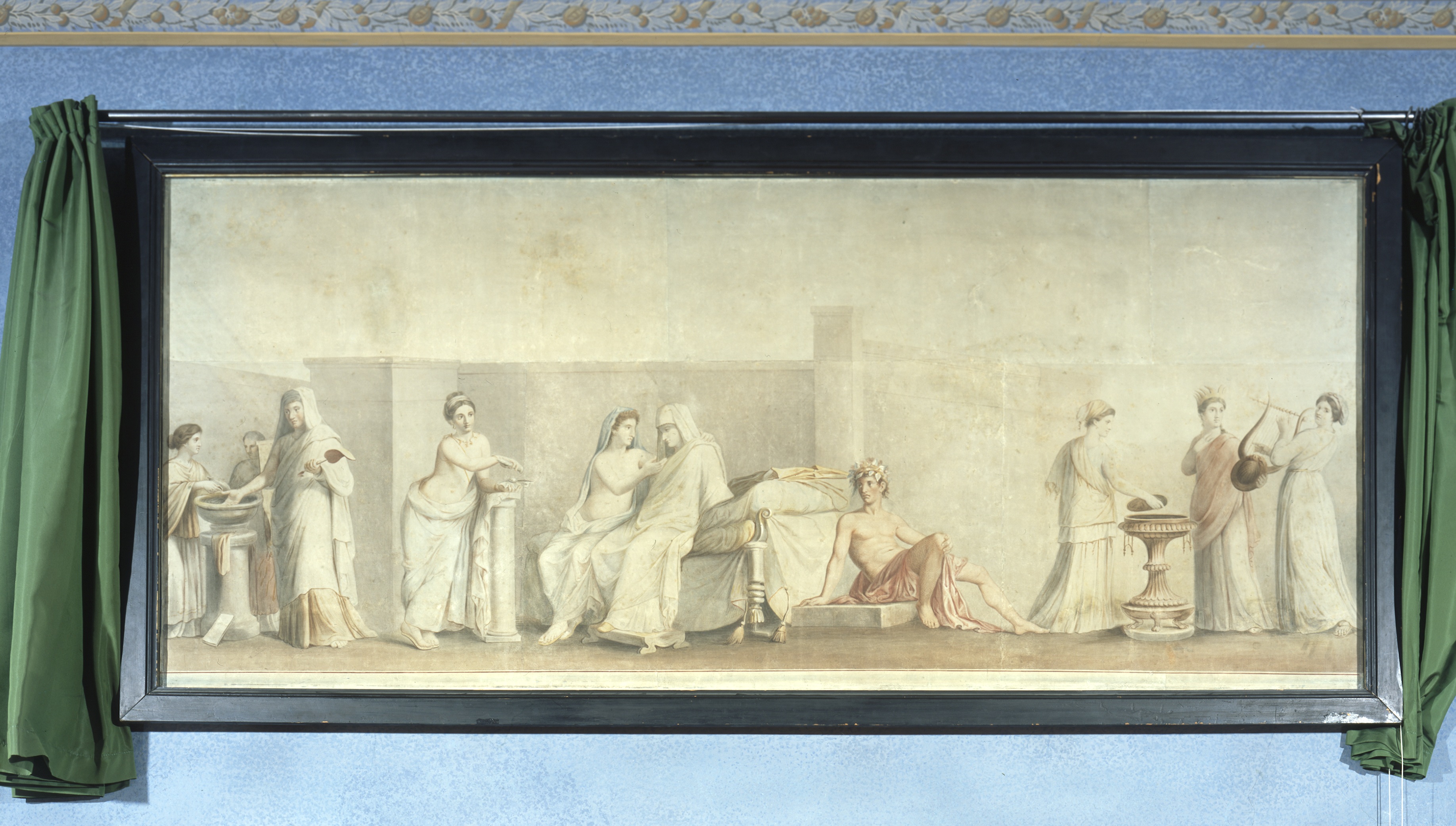
As I wrote in an earlier post, I have been expanding my reading in works of “later Goethe,” works after his return from Italy. My previous post on Erich Grumach has in the meantime led me to consult Grumach’s two-volume work Goethe und die Antike, an assemblage of everything Goethe expressed about Greek and Roman antiquity. As I was paging through this 1,100-page study, my eyes were caught by (among other subjects) the extracts from correspondence between Goethe and the Swiss artist Heinrich Meyer in the 1790s concerning The Aldobrandini Wedding. The image above is a lovely detail from this Roman fresco, a copy of an ancient Greek painting (for a full-scale image of the work, go here).

One reason that my posts on this blog are not as frequent as I would like is because, as soon as something like this subject interests me, it is necessary to dig into it, and I begin consulting the scholarly research on the subject, which always lead me far afield. The first stop was the article “Die Aldobrandinische Hochzeit als gemalte Farbentheorie” by Johannes Rössler, which appeared in the volume Farben der Klassik. Wissenschaft – Ästhetik - Literatur (2016). I am not an art historian, nor even very knowledgeable about Goethe’s color theory, and am really not competent to take apart Rössler awesomely compounded sentences. My take from his article is the following, namely, that the lack of action in the fresco is compensated for by the expressiveness of the color in the ancient work, in contrast to the “new painting” of the time.

Meyer, Die Aldobrandinische Hochzeit (1796)

Meyer, Die Aldobrandinische Hochzeit (1809)
In any case, it seems that the fresco was of such interest among connoisseurs in the 18th century and earlier that Meyer made several copies of it. The  top one pictured above hangs in the “Juno” room of the Haus am Frauenplan, with the green curtains that were to protect it from outside light. It was Meyer’s first copy, from 1796. A second one, from 1808/1809, is in the Klassik Stiftung Weimar. (Click to enlarge.) A comparison with the details in the image at the top of this post shows how difficult it is to reproduce the ancient effects. (Rössler did, however, make an interesting comparison of those effects with those in the painting Autumn Forest (1906) by the German Impressionist artist Max Stevogt.) (BTW, the reason I link to articles in Wikipedia is that the site does not include ads.)

Max Stevogt, Autumn Forest

Among the scholarship I discovered on this subject is the work of the late Pamela Currie, whose Goethe’s Visual World appeared in 2013. In the last chapter, “An Alternative Antiquity,” she discusses “Goethe’s preference for lightness in painting.” (I have not seen the book, so I am quoting from the 2015 Goethe Yearbook review by Walter Stewart.) Further, “In terms of specific artworks, Goethe and Meyer most preferred the lightness that they observed in The Aldobrandini Wedding.” An article by Currie in Oxford German Studies in 2008 has this to say: “Goethe's and Heinrich Meyer's idea of colour harmony in painting required all the six colours of the wheel, so arranged and modulated as to avoid harsh transitions between them. This prescription resembled the aesthetic of fresco as seen in the ancient Roman 'Aldobrandini Wedding' and in work by Raphael and Paolo Veronese.”

As I said, doing work on any specific area of Goethe leads you far afield. To get an idea of how much effort Goethe devoted to the effect of specific colors, one only has to the look at table of contents of the “Didactic” part of the Farbenlehre. Its final section concerns the “sensuous/moral effect of color” (sinnlich-sittliche Wirkung der Farbe) beginning with yellow, which, Goethe writes, “ist die nächste Farbe am Licht” (the closest color to light).

Image credits: Youpedia; Klassik Stiftung Weimar

Wednesday, January 11, 2023

Goethe scholars past


Ernst Grumach

Aside from a short excursus here and there, e.g.,  the subject of Goethe and world literature or a piece on Goethe and Fanny Burney (see this issue of Arion), my work on Goethe has focused on the “young Goethe,” specifically the years before he went to Weimar and he was still developing his literary creds. It’s not a well-traveled area of Goethe scholarship these days. Today the “Green Goethe” is a popular subject. So, in my research I end up reading authors whose work is more philological than theoretical. In this connection I came across a few days ago a fascinating article on Ernst Grumach (1902–67), whose initial scholarly studies lay largely in the field of classics. Within Goethe studies, he is the editor of the study Goethe und die Antike (publ. 1949). He is also the editor of a collection of essays that I wanted to consult on a very under-researched area of Goethe’s early efforts, the fragment of an epistolary novel entitled “Arianne an Wetty.” It was while Googling for this collection that I came across the above-mentioned article on Grumach in the Leo Baeck Institute Yearbook in 2018 by Anna Holzer-Kawalko: “Jewish Intellectuals between Robbery and Restitution: Ernst Grumach in Berlin, 1941–46.” Most of what follows is taken from this article, even when not directly quoted.

It turns out that Grumach’s Goethe scholarship arose principally after World War II. During the war, he worked as a forced laborer in the library of the Reichssicherheitshauptamt (RSHA) in Berlin in the years mentioned in the title of the article. While having trained in classical studies and pursuing a habilitation thesis on Lydian inscriptions, as a Jew he found his career upended in 1933 by the Aryan laws. He began working as a bookseller in Königsberg, where he sought emigration opportunities without success, but continued to be immersed in his own intellectual pursuits. In 1937, he moved to Berlin with his family, where he was employed as lecturer of classical philology and literature at the “Hochschule fur die Wissenschaft des Judentums.” This institution had been founded 65 years earlier as a center for the research and teaching of the so-called “science of Judaism,” but its curriculum expanded beyond Judaic subjects when Jews were denied entrance to universities in November 1938 and, as author Holzer-Kawalko notes (quoting Richard Fuchs), when “German universities had degenerated into biased Party institutions.”

Memorial at bus stop at Eichmann's former office

The story Holzer-Kawalko tells is quite gripping: one feels throughout that any false step would have landed Grumach on a train to Auschwitz. In 1941 he was assigned to be head of a group called “the Reich Association of Jews in Germany.” In other words, he went to work for the persecutors of Jews at the RSHA, established by Himmler in 1939, which played a major role in the NS extermination policies, alongside in seizing Jewish assets. After an interview at Adolf Eichmann’s office, Grumach became part of a group whose task was to “establish a bibliographic order” for the seized Jewish book holdings, which included manuscripts and rare volumes. Even as Jewish heritage was being banned and persecuted, here was this working group, under “the highest authorities of the holy Gestapo,” reading, enjoying, and discussing “what nobody else in Germany could view anymore.” Ideology and hatred were of course the reason for this “commitment” on the part of the Third Reich. I am reminded of something I learned while a student many years ago — it was still a divided Germany — while on a trip to Prague with a group of students from the university in Marburg, where I was studying. One of the sites we viewed on the week-long visit — this was in 1970 — was the oldest Jewish cemetery in the country, which the Nazis intended to be a monument to a vanished race.

Grumach was one of the only two librarians of “Department VII” of the RHSA who survived the war. Both were married to non-Jews, but, even though he had never been an observant Jew, Grumach  and wife raised their daughter as Jewish.

Portrait of young Gershom Scholem

As per the title of her article, Holzer-Kawalko’s subject is the restitution of Jewish heritage after the war. Grumach’s contribution, she writes, has “not gained public recognition or been the subject of comprehensive scholarly examination to date.” I won’t go into the details here. Suffice it to say that Grumach’s proposal for “the project of a Jewish central library or a ‘supreme collection of Jewish books in Europe’” came to nought amid other visions, including that of Gershom Scholem, who “categorically refused even to negotiate with those Jews who had stayed in Germany.” As Holzer-Kawalko writes: “He [Scholem] and other representatives of the Hebrew University sought to redefine the looted German-Jewish book collections as belonging to the collective body of Jewish people rather than to German-Jewish communities.”

In conclusion, she writes: “The heroic efforts of Jewish librarians working in the ‘Grumach Group’ to preserve Jewish literary heritage while being forced to serve the National Socialist project of ‘culturcide’, and the physical dismantling of German-Jewish libraries for the sake of post-war cultural restoration show the extreme complexity of this period, thus making easy historical judgements impossible.”

Image credit: Leo Baeck Institute; Wikipedia (Eichmann's office); Wikipedia (Scholem portrait)