Showing posts with label Heinrich Meyer. Show all posts

Friday, February 17, 2023

Goethe and the lightness of color


As I wrote in an earlier post, I have been expanding my reading in works of “later Goethe,” works after his return from Italy. My previous post on Erich Grumach has in the meantime led me to consult Grumach’s two-volume work Goethe und die Antike, an assemblage of everything Goethe expressed about Greek and Roman antiquity. As I was paging through this 1,100-page study, my eyes were caught by (among other subjects) the extracts from correspondence between Goethe and the Swiss artist Heinrich Meyer in the 1790s concerning The Aldobrandini Wedding. The image above is a lovely detail from this Roman fresco, a copy of an ancient Greek painting (for a full-scale image of the work, go here).

One reason that my posts on this blog are not as frequent as I would like is because, as soon as something like this subject interests me, it is necessary to dig into it, and I begin consulting the scholarly research on the subject, which always lead me far afield. The first stop was the article “Die Aldobrandinische Hochzeit als gemalte Farbentheorie” by Johannes Rössler, which appeared in the volume Farben der Klassik. Wissenschaft – Ästhetik - Literatur (2016). I am not an art historian, nor even very knowledgeable about Goethe’s color theory, and am really not competent to take apart Rössler awesomely compounded sentences. My take from his article is the following, namely, that the lack of action in the fresco is compensated for by the expressiveness of the color in the ancient work, in contrast to the “new painting” of the time.
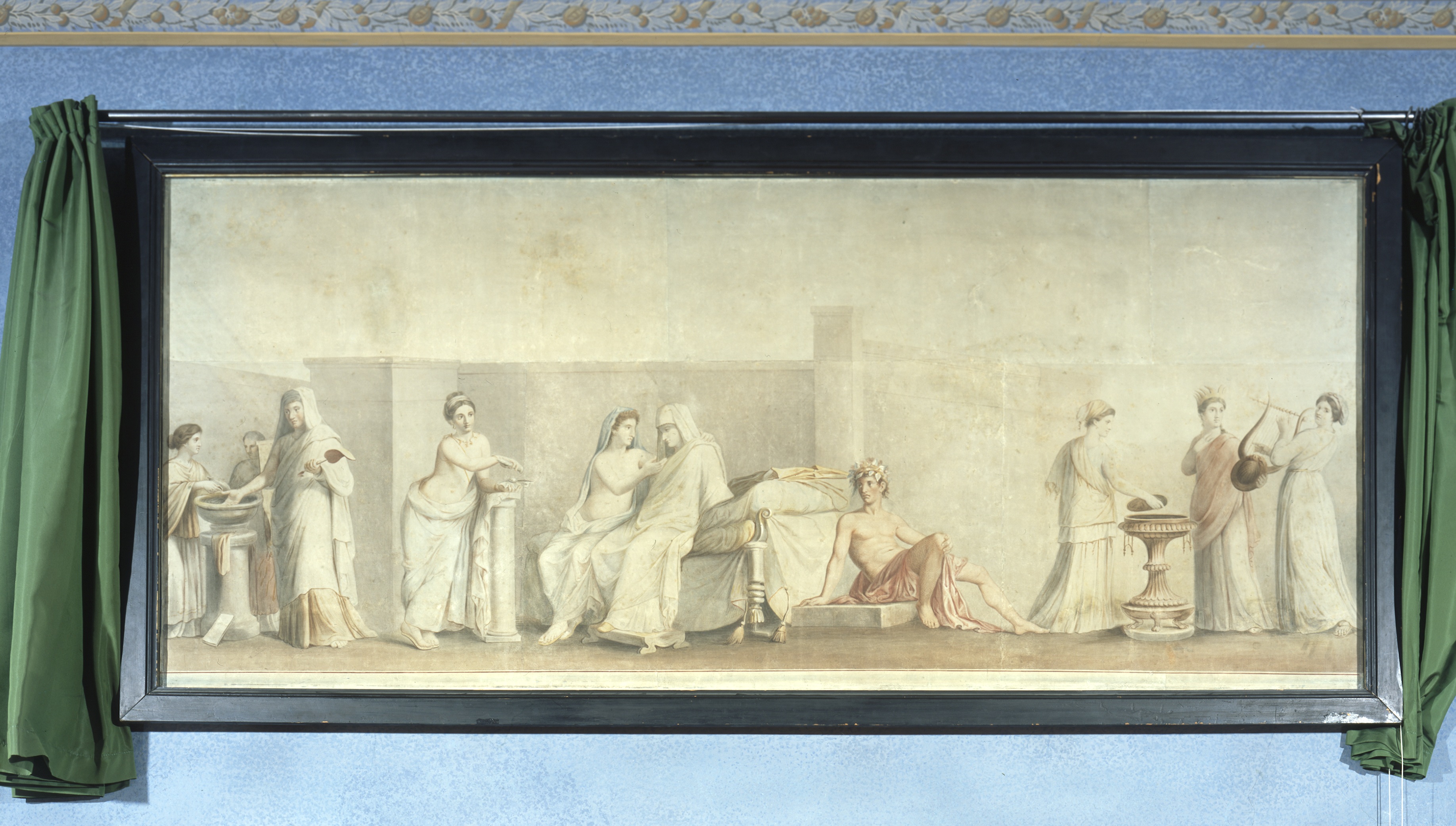
Meyer, Die Aldobrandinische Hochzeit (1796)

Meyer, Die Aldobrandinische Hochzeit (1809)
In any case, it seems that the fresco was of such interest among connoisseurs in the 18th century and earlier that Meyer made several copies of it. The  top one pictured above hangs in the “Juno” room of the Haus am Frauenplan, with the green curtains that were to protect it from outside light. It was Meyer’s first copy, from 1796. A second one, from 1808/1809, is in the Klassik Stiftung Weimar. (Click to enlarge.) A comparison with the details in the image at the top of this post shows how difficult it is to reproduce the ancient effects. (Rössler did, however, make an interesting comparison of those effects with those in the painting Autumn Forest (1906) by the German Impressionist artist Max Stevogt.) (BTW, the reason I link to articles in Wikipedia is that the site does not include ads.)

Max Stevogt, Autumn Forest

Among the scholarship I discovered on this subject is the work of the late Pamela Currie, whose Goethe’s Visual World appeared in 2013. In the last chapter, “An Alternative Antiquity,” she discusses “Goethe’s preference for lightness in painting.” (I have not seen the book, so I am quoting from the 2015 Goethe Yearbook review by Walter Stewart.) Further, “In terms of specific artworks, Goethe and Meyer most preferred the lightness that they observed in The Aldobrandini Wedding.” An article by Currie in Oxford German Studies in 2008 has this to say: “Goethe's and Heinrich Meyer's idea of colour harmony in painting required all the six colours of the wheel, so arranged and modulated as to avoid harsh transitions between them. This prescription resembled the aesthetic of fresco as seen in the ancient Roman 'Aldobrandini Wedding' and in work by Raphael and Paolo Veronese.”

As I said, doing work on any specific area of Goethe leads you far afield. To get an idea of how much effort Goethe devoted to the effect of specific colors, one only has to the look at table of contents of the “Didactic” part of the Farbenlehre. Its final section concerns the “sensuous/moral effect of color” (sinnlich-sittliche Wirkung der Farbe) beginning with yellow, which, Goethe writes, “ist die nächste Farbe am Licht” (the closest color to light).

Image credits: Youpedia; Klassik Stiftung Weimar

Thursday, January 8, 2009

Goethe's Working Method

Reviews reveal that Heinrich Meyer's "inner biography" of Goethe, subtitled Das Leben im Werk (the life in the work), provoked intensely negative as well as admiring responses on its publication in 1949, but I always find something of interest in it and dip into it as the mood strikes me. In a chapter of Goethe's poetic circle, he draws attention to a difference between Goethe and Schiller that gave me a new glimpse of Goethe.

According to Meyer, Schiller was so communicative about whatever he was working on that Goethe knew the plan of Demetrius so well that he probably could have completed it after Schiller's death in 1805. For Goethe, however, a work that had been communicated or discussed with another person was "finished" (erledigt); he wouldn't bother then to write it down.

Goethe's poetic memory was "determined by motif and mood" (motivisch und stimmungsmäßig bestimmt): he carried with him a theme for years, for half a century, reworked it in his mind, somewhat like a lawyer contemplating all possible questions and objections of an opponent and meeting them in advance. Once the matter, the scene, the person, the language had achieved form in his mind (I am paraphrasing Meyer here), then it was finished and had to be communicated. If it was not immediately dictated, Goethe lost the desire to carry it out. In Meyer's view Goethe could conceive a plan for a work, but it was impossible to reconceive it, to begin anew, which can be seen in his reworking of Götz.

Goethe did not like writing by hand. In his autobiography he describes how he began dictating already in his Frankfurt youth, taking advantage of the skills of a young man living in the Goethe family household. In Weimar he dictated his prose and his correspondence to servants, secretaries, friends. This method required immense discipline and concentration and tended to dampen expressions of intimacy. What about inspiration? In my view, Goethe had such "acoustic memory" that what he wanted to say was always at the tip of his tongue, so to speak, waiting to come together with the idea he carried around in his head. 

These two views of poets dictating -- Goethe with Johann August Friedrich John (1794-1854),  and John Milton with his daughters -- show very different temperaments. The drawing of Goethe and his amanuensis, however, by J.J. Schmeller, is contemporary, while that of the blind Milton dictating to his daughters (now in the New York Public Library) is by the Hungarian artist Mihály Munkácsy ( 1844-1900)