Showing posts with label Ernst Grumach. Show all posts

Friday, February 17, 2023

Goethe and the lightness of color


As I wrote in an earlier post, I have been expanding my reading in works of “later Goethe,” works after his return from Italy. My previous post on Erich Grumach has in the meantime led me to consult Grumach’s two-volume work Goethe und die Antike, an assemblage of everything Goethe expressed about Greek and Roman antiquity. As I was paging through this 1,100-page study, my eyes were caught by (among other subjects) the extracts from correspondence between Goethe and the Swiss artist Heinrich Meyer in the 1790s concerning The Aldobrandini Wedding. The image above is a lovely detail from this Roman fresco, a copy of an ancient Greek painting (for a full-scale image of the work, go here).

One reason that my posts on this blog are not as frequent as I would like is because, as soon as something like this subject interests me, it is necessary to dig into it, and I begin consulting the scholarly research on the subject, which always lead me far afield. The first stop was the article “Die Aldobrandinische Hochzeit als gemalte Farbentheorie” by Johannes Rössler, which appeared in the volume Farben der Klassik. Wissenschaft – Ästhetik - Literatur (2016). I am not an art historian, nor even very knowledgeable about Goethe’s color theory, and am really not competent to take apart Rössler awesomely compounded sentences. My take from his article is the following, namely, that the lack of action in the fresco is compensated for by the expressiveness of the color in the ancient work, in contrast to the “new painting” of the time.
Meyer, Die Aldobrandinische Hochzeit (1796)

Meyer, Die Aldobrandinische Hochzeit (1809)
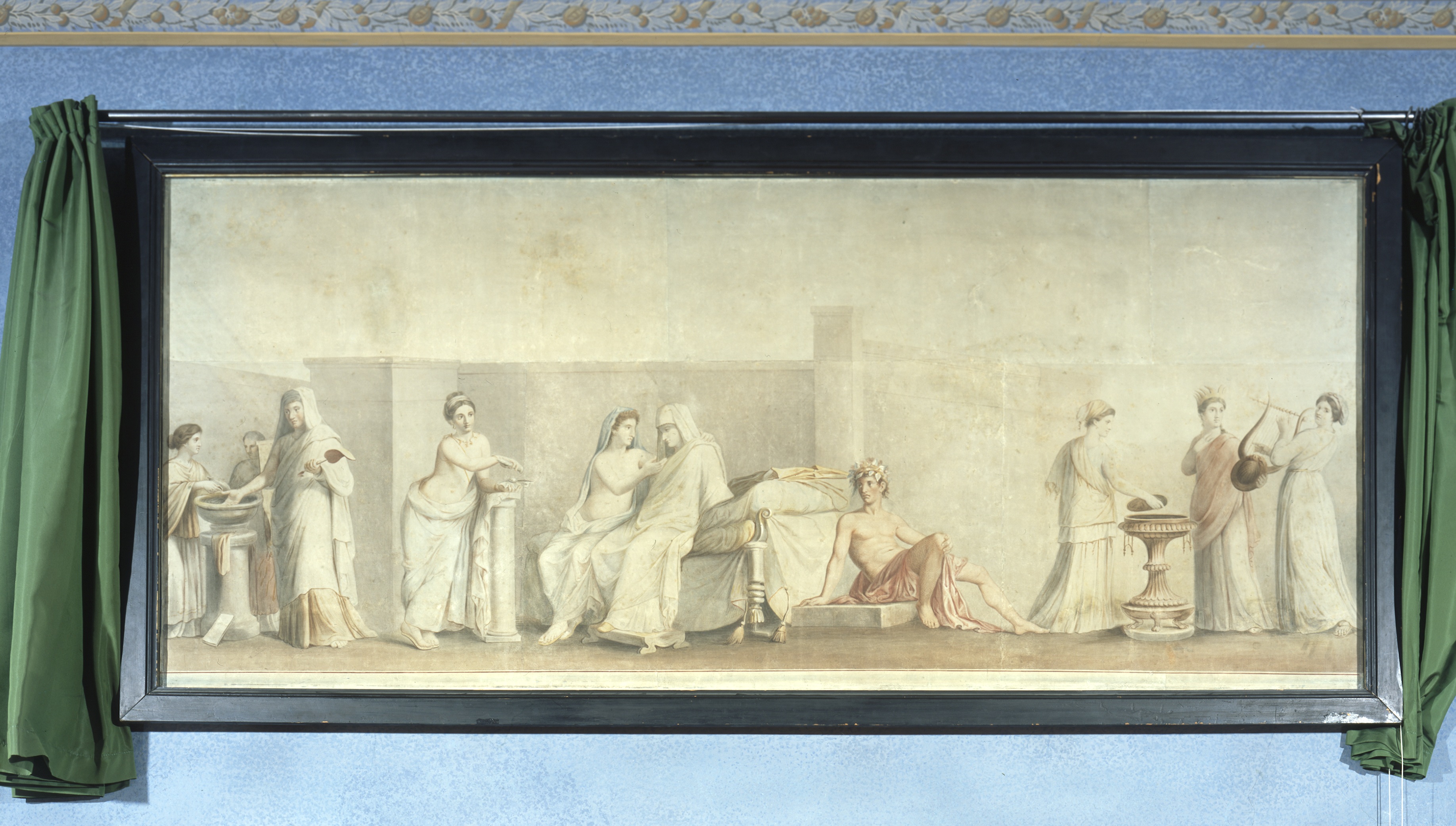
In any case, it seems that the fresco was of such interest among connoisseurs in the 18th century and earlier that Meyer made several copies of it. The  top one pictured above hangs in the “Juno” room of the Haus am Frauenplan, with the green curtains that were to protect it from outside light. It was Meyer’s first copy, from 1796. A second one, from 1808/1809, is in the Klassik Stiftung Weimar. (Click to enlarge.) A comparison with the details in the image at the top of this post shows how difficult it is to reproduce the ancient effects. (Rössler did, however, make an interesting comparison of those effects with those in the painting Autumn Forest (1906) by the German Impressionist artist Max Stevogt.) (BTW, the reason I link to articles in Wikipedia is that the site does not include ads.)

Max Stevogt, Autumn Forest

Among the scholarship I discovered on this subject is the work of the late Pamela Currie, whose Goethe’s Visual World appeared in 2013. In the last chapter, “An Alternative Antiquity,” she discusses “Goethe’s preference for lightness in painting.” (I have not seen the book, so I am quoting from the 2015 Goethe Yearbook review by Walter Stewart.) Further, “In terms of specific artworks, Goethe and Meyer most preferred the lightness that they observed in The Aldobrandini Wedding.” An article by Currie in Oxford German Studies in 2008 has this to say: “Goethe's and Heinrich Meyer's idea of colour harmony in painting required all the six colours of the wheel, so arranged and modulated as to avoid harsh transitions between them. This prescription resembled the aesthetic of fresco as seen in the ancient Roman 'Aldobrandini Wedding' and in work by Raphael and Paolo Veronese.”

As I said, doing work on any specific area of Goethe leads you far afield. To get an idea of how much effort Goethe devoted to the effect of specific colors, one only has to the look at table of contents of the “Didactic” part of the Farbenlehre. Its final section concerns the “sensuous/moral effect of color” (sinnlich-sittliche Wirkung der Farbe) beginning with yellow, which, Goethe writes, “ist die nächste Farbe am Licht” (the closest color to light).

Image credits: Youpedia; Klassik Stiftung Weimar

Wednesday, January 11, 2023

Goethe scholars past


Ernst Grumach

Aside from a short excursus here and there, e.g.,  the subject of Goethe and world literature or a piece on Goethe and Fanny Burney (see this issue of Arion), my work on Goethe has focused on the “young Goethe,” specifically the years before he went to Weimar and he was still developing his literary creds. It’s not a well-traveled area of Goethe scholarship these days. Today the “Green Goethe” is a popular subject. So, in my research I end up reading authors whose work is more philological than theoretical. In this connection I came across a few days ago a fascinating article on Ernst Grumach (1902–67), whose initial scholarly studies lay largely in the field of classics. Within Goethe studies, he is the editor of the study Goethe und die Antike (publ. 1949). He is also the editor of a collection of essays that I wanted to consult on a very under-researched area of Goethe’s early efforts, the fragment of an epistolary novel entitled “Arianne an Wetty.” It was while Googling for this collection that I came across the above-mentioned article on Grumach in the Leo Baeck Institute Yearbook in 2018 by Anna Holzer-Kawalko: “Jewish Intellectuals between Robbery and Restitution: Ernst Grumach in Berlin, 1941–46.” Most of what follows is taken from this article, even when not directly quoted.

It turns out that Grumach’s Goethe scholarship arose principally after World War II. During the war, he worked as a forced laborer in the library of the Reichssicherheitshauptamt (RSHA) in Berlin in the years mentioned in the title of the article. While having trained in classical studies and pursuing a habilitation thesis on Lydian inscriptions, as a Jew he found his career upended in 1933 by the Aryan laws. He began working as a bookseller in Königsberg, where he sought emigration opportunities without success, but continued to be immersed in his own intellectual pursuits. In 1937, he moved to Berlin with his family, where he was employed as lecturer of classical philology and literature at the “Hochschule fur die Wissenschaft des Judentums.” This institution had been founded 65 years earlier as a center for the research and teaching of the so-called “science of Judaism,” but its curriculum expanded beyond Judaic subjects when Jews were denied entrance to universities in November 1938 and, as author Holzer-Kawalko notes (quoting Richard Fuchs), when “German universities had degenerated into biased Party institutions.”

Memorial at bus stop at Eichmann's former office

The story Holzer-Kawalko tells is quite gripping: one feels throughout that any false step would have landed Grumach on a train to Auschwitz. In 1941 he was assigned to be head of a group called “the Reich Association of Jews in Germany.” In other words, he went to work for the persecutors of Jews at the RSHA, established by Himmler in 1939, which played a major role in the NS extermination policies, alongside in seizing Jewish assets. After an interview at Adolf Eichmann’s office, Grumach became part of a group whose task was to “establish a bibliographic order” for the seized Jewish book holdings, which included manuscripts and rare volumes. Even as Jewish heritage was being banned and persecuted, here was this working group, under “the highest authorities of the holy Gestapo,” reading, enjoying, and discussing “what nobody else in Germany could view anymore.” Ideology and hatred were of course the reason for this “commitment” on the part of the Third Reich. I am reminded of something I learned while a student many years ago — it was still a divided Germany — while on a trip to Prague with a group of students from the university in Marburg, where I was studying. One of the sites we viewed on the week-long visit — this was in 1970 — was the oldest Jewish cemetery in the country, which the Nazis intended to be a monument to a vanished race.

Grumach was one of the only two librarians of “Department VII” of the RHSA who survived the war. Both were married to non-Jews, but, even though he had never been an observant Jew, Grumach  and wife raised their daughter as Jewish.

Portrait of young Gershom Scholem

As per the title of her article, Holzer-Kawalko’s subject is the restitution of Jewish heritage after the war. Grumach’s contribution, she writes, has “not gained public recognition or been the subject of comprehensive scholarly examination to date.” I won’t go into the details here. Suffice it to say that Grumach’s proposal for “the project of a Jewish central library or a ‘supreme collection of Jewish books in Europe’” came to nought amid other visions, including that of Gershom Scholem, who “categorically refused even to negotiate with those Jews who had stayed in Germany.” As Holzer-Kawalko writes: “He [Scholem] and other representatives of the Hebrew University sought to redefine the looted German-Jewish book collections as belonging to the collective body of Jewish people rather than to German-Jewish communities.”

In conclusion, she writes: “The heroic efforts of Jewish librarians working in the ‘Grumach Group’ to preserve Jewish literary heritage while being forced to serve the National Socialist project of ‘culturcide’, and the physical dismantling of German-Jewish libraries for the sake of post-war cultural restoration show the extreme complexity of this period, thus making easy historical judgements impossible.”

Image credit: Leo Baeck Institute; Wikipedia (Eichmann's office); Wikipedia (Scholem portrait)