Showing posts with label Johann Jacob Bodmer. Show all posts

Tuesday, July 5, 2011

The Discontents of Intellectuals

I just read a book over the Fourth of July weekend that was appropriate to the holiday, Crane Brinton's The Anatomy of Revolution. The American Revolution is one of his four cases, along with the 17th-century "Glorious Revolution" in England and the French and Russian revolutions. Brinton's initial thesis is that the financial/economic inefficiency of the government hinders the economic activity of citizens (high taxes and other onerous financial impositions) in societies that are themselves growing economically. As he writes, the four cases do not reveal a picture of "the old regime as an unregenerate tyranny, sweeping to its end in a climax of despotic indifference to the clamor of its abused subjects." In all cases, the bankrupt governments were actually working to "modernize," but the attempts at reform were part of the process that issued in revolution.

What interested me was the role of intellectuals, who, in the modern world, are a particularly disaffected lot, but whose disaffection (think Victorian England) does not always rise to the level of demands for a total transformation of society. In 18th-century France, however, the "roll" of intellectuals convinced that the world, and especially France, needed making over, "from the tiniest and more insignificant details to the most general moral and legal principles," was quite long. As Brinton writes, "Literature in late 18th-century France is overwhelmingly sociological." But, as he adds, throughout "Enlightenment Europe" there are few "active literary conservatives like Samuel Johnson or Sir Walter Scott, or even literary neutrals, men pursuing in letters a beauty or an understanding quite outside politics."

This is the case even with Joseph Addison and Johann Jacob Bodmer, on whom I have posted much lately. Both men used "letters" in the cause of social transformation. Addison's Spectator essays and Bodmer and Breitinger's Discourses of the Painters had the aim of improving people's conduct by being "entertaining." I think that after the 1720s Bodmer became more "actively literary," if one considers the critical treatises of the early 1740s, but certainly his later dramas and epics were explicitly in the service of social and moral transformation.

Where does Goethe fit in? Certainly in the Sturm und Drang period there is much criticism of existing social arrangements. The Sorrows of Young Werther, aside from its literary charms, makes the case that bright young men of merit have little chance of social ascent because they are excluded by the hidebound aristocratic class. Moreover, the institution of government itself, as portrayed in Werther, seems equally sclerotic. Of course, one might say that Werther finds pushing papers beneath him, that he is a pathological case unwilling to adapt himself to the demands of reality, for instance, working and thereby having an income to marry and raise a family. "Pathology," however, is exactly what Brinton is describing in the case of pre-revolutionary France. The hatred of government and of the ruling class was intense.

There is another characteristic of the such intellectuals that Brinton mentions, namely, "the deliberate espousal of the cause of discontented or repressed classes -- upperdogs voluntarily siding with underdogs. ... Such upper-class mavericks must be relatively numerous as well as conspicuous in a society in disequilibrium." Again, one sees signs of this "decadence" in the Sturm und Drang writings, for instance, in the dramas of Lenz and Klinger. Goethe, of course, introduces the "repressed" classes, most notably in the figure of Gretchen. (Drawing above by Peter Cornelius.)

Germany (insofar as one can speak of "Germany" in this period) was of course different from France. One thing that distinguishes Goethe from the French intellectuals is that he actually went to work in government. He was also pretty dedicated. At close hand, however, dealing with the governed, he must have recognized the limits of what government is able to do. His literary work after his move to Weimar certainly becomes less "sociological," even more so after Rome. Schiller, it must be said, did want to transform society, and his literary works and writings on aesthetics were in that service. (But even Schiller became skeptical of the French Revolution.) Goethe, in his relationship with Schiller in the 1790s, was coopted in this effort, but after Schiller's death Goethe seems to have become even more a man "pursuing in letters a beauty or an understanding quite outside politics." Think The East-West Divan. Which is not to assert that political conditions are not reflected in his later writings. Even the Divan is an attempt to escape the pervasive demands of contemporary politics. This pervasiveness is a curse of modern intellectuals.

Picture credits: Cardillowiki; Goethezeitportal

Monday, May 16, 2011

But is it art?

Having finished my article on the "pre-Kantian" sublime, I have now turned to a long overdue book review. The book in question, by Jesko Reiling, is entitled Die Genese der idealen Gesellschaft: Studien zum literarischen Werk von Johann Jakob Bodmer (1698-1783). Yes, I seem not to be able to get away from Bodmer. There is not much in Reiling's treatment on the sublime in Bodmer (though he did give me a few ideas). The subject, per the subtitle, is Bodmer's "literary work," in particular the epics Bodmer began to write in the 1740s and his "political dramas." Nevertheless, there has been so little scholarship on Bodmer's literary work that Reiling spends the first half of his book filling in Bodmer's intellectual and cultural background.

As I already noticed when I began working on Bodmer's early criticism, in the 1720s, it was clear that Bodmer was interested in the improvement of "manners." He had been much affected by Joseph Addison's Spectator essays and hoped that The Discourses of the Painters, the "moral" journal he founded with Breitinger, would play a similar role in shaping the manners of the newly emerging bourgeoisie in Switzerland. And, like Addison in England, he was rather lighthearted in imparting "lessons" to his readers and in his treatment of socially backward customs and practices. As I learned when I began reading Reiling, however, Bodmer became decidedly heavy-handed in his literary works, especially in the Noah epic and in the political dramas. Critics have judged them harshly, speaking of "Tugendterror" (virtue terror) and "Totalitarismus der Sitte" (totalitarianism of manners).

In the Old Testament the story of Noah begins with his birth (Gen. 5, 28). At the age of 500 (so Gen. 5, 32) he becomes father of Shem, Ham, and Japheth. The next chapter opens with the increasing wickedness of humankind, while supplying very little detail. The Lord, regretting that he had created men, simply decided to wipe out all life on earth, sparing only Noah and his family, who had found favor with Him. Though there is very little "back story," Bodmer nevertheless provides one, as Noah, in a dream, travels over the earth with the angel Raphael and views all the evil ways of men. As contemporary readers noted, the vices on display were those of European men and women over the past several centuries. The desire to turn a profit or to make oneself better than one's neighbor existed in the antediluvian world as well. Noah and his breed, on the other hand, were perfect in every way, untouched by jealousy, envy, greed, lasciviousness.

I must admit that I have not slogged through any of these works by Bodmer. It was enough to slog through Reiling's descriptions. In Bodmer's defense, however, he was simply adhering to an earlier tradition concerning the purpose of art, namely, that it was supposed to be edifying. I wonder what Bodmer would make of the exhibition now on display at the Metropolitan Museum: "Reconfiguring an African Icon." On display are what are called "highly creative reimaginings of the iconic form of the African mask."

Two of the artists are Africans from Benin (which has a rich sculptural tradition in any case), Romuald Hazoumé (mask at top of post) and Calixte Dakpogan (at the right). Among the materials they use are discarded plastic containers, shells, computer wiring, hair brushes, and lots of metal scraps. All very inventive and delightful. They remind me of something I have posted on before, namely, Schiller's notion of "Spieltrieb." There is nothing useful, nothing to be gained even morally from these objects; they are simply playful, and play is fun. A child's game is fun, but it is not art, not made, whereas these contemporary masks are made and, as Roger Scruton writes, are "consciously intended."

Monday, May 2, 2011

"Real life is not a theater"

I was familiar with the name Ronald Blythe from reviews in the London Times Literary Supplement, but I recently picked up a small book of his, The Bookman's Tale, as part of my Lenten readings. Blythe, from Suffolk in England, is known as "Britain's greatest living rural writer," and The Bookman's Tale consists of short chapters in which Blythe relates the progress of his work (often having to do with the poet and Anglican priest George Herbert), his friendships, including with the writer Vikram Seth (who bought and is renovating George Herbert's house), Marina Warner, Imogen Holst (daughter of the composer), and lots of local folks. Blythe reports of evensong, of house calls by plumbers and other workmen, of books he is reading. His thoughts on the letters of W.H. Auden (like Blythe, an Anglican) made me want to order them from Amazon. I learned where T.S. Eliot got the inspiration for Little Gidding. He writes of Chaucer's pilgrims as if they were Suffolk neighbors. Well, no doubt Chaucer portrayed real people.

A couple of days ago I read his chapter on "The Great Essex Earthquake" and was thinking of a way to post something about it. A month ago I had posted on earthquakes, drawing on Bodmer's problematic category of "the turbulent" (das Ungestüme) as it relates to the sublime. Earthquakes and other catastrophes, as I wrote, are unlike "the great in nature." The latter refers to natural phenomena the extent of which is too large for us to grasp at first sight. These would include the heavens above, the oceans, natural grandeur (e.g., the Grand Canyon, the Swiss Alps). Despite our inability to get hold of their extent, they don't literally knock us over. Moreover, these phenomena are accessible to study by us, as modern science shows. The turbulent, however, literally disarms us and indeed is occasionally annihilating. Thus, earthquakes, such as recently occurred in Japan and New Zealand. The turbulent allows us no freedom, unlike the great and the beautiful, to which we are free to react or even to ignore.

The events of the morning of September 11, 2001, represent the turbulent. The very issue of freedom arose after the German composer Karlheinz Stockhausen called the attacks "the biggest work of art that there has ever been." In comparison with the attacks, he said, his own compositions were as nothing. Of course, as he also said, the people affected (the ones, for instance, jumping from the Towers) had not "come to the concert." Thus, the difference between art -- a realm of freedom -- and real life. Such catastrophes are not theater. In real life we are often affected by things over which we have no control.

So, what did Ronald Blythe say about the Great Essex Earthquake of April 22, 1884? He mentions that a local photographer happened to be around on the "lovely spring day" and was thus able to record the after effects. No deaths, but the property damage was extensive. "A thousand roofs slid to the ground; 20 churches were in ruins. Three entire villages went to wreckage. Boats were thrown from the harbours on to the shore. There was a noise that nobody would ever forget. There was a blinding dust, and there was the pathos of what would later be the exposed interior, the wallpapered rooms hanging in the air, the fires blazing in the suspended grates, the unmade bed."

Mr. Damant, the photographer, "hurried around with his fine plate camera." Ronald Blythe writes that one of his favorite photos shows an "elegantly grouped picture of the Rector of Langenhoe and his friends standing in the ruins of his church clasping umbrellas and gently smiling." There then follows a paragraph that seems apropos to today, a reminder of the fragility and also the resilience of our civilization. Perhaps it is this fragility to which Bodmer was presciently alluding with his category of the turbulent:

"They had curiously prophetic expressions, which would appear again and again during the next century, shaken looks that hid the shock, the automatic grin. And the strange stench of fallen architecture. All this would repeat itself -- all over the world. And human beings would stand and stare at the swift demolition of their achievements as the dust settled, and would look so differently from how they felt."

Picture credit: Hornbeam

Saturday, April 16, 2011

The Natural Sublime

I have occasionally read articles by Roger Scruton over the years, but recently my friend Maureen Mullarkey posted an item on her blog about his book Beauty. Maureen has great taste in writing and in artists, so I immediately acquired the book. Scruton writes the clearest, most accessible prose, breaking down really big ideas into portion athat non-philosophical minds (like mine can grasp. Herewith an example, from the chapter "Natural Beauty," in which he distinguishes our experience of, say, the songs of birds and the colors or shapes of flowers from works of art:

"Works of art are expressly presented as objects of contemplation. They are framed on a wall, contained between the covers of a book, installed in the museum or reverently performed in the concert hall. To change them without the artist's consent is to violate a fundamental aesthetic propriety. Works of art stand as the eternal receptacles of intensely intended messages. ... Nature, by contrast, is generous, content to mean only herself, uncontained, without an external frame, and changing from day to day."

I also like his use of the term "apartness" to speak of natural phenomena, "their capacity to show that the world contains things other than us, which are just as interesting as we are."

Now, it was in the 18th century that people discovered nature as an object of aesthetic interest. Starting with the English critic John Dennis and then expanded on by Joseph Addison, the experience of the natural sublime was practically synonymous with an encounter with grand mountains (and also with the starry skies above and so on). In the essay I am writing on Bodmer, I have posed this question: Why in none of his treatises on poetry did Bodmer consider natural experience or natural beauties as potential poetic subjects? Surrounded his entire life long (1698-1783) by the mountains of Switzerland, about which otherwise so much ink was spilled in the 18th century, he never even mentions them when writing of "the Great" in nature, a notion he took over from Addison. Bodmer never uses the term "sublime" in reference to nature's effects. "Sublime" is reserved for the portrayal of noble and grand actions. Even the actions of Satan in Milton's Paradise Lost can be described as sublime, exceeding as they do in evil. When speaking of the grand in nature he resorts to stock formulas that are repeated by almost every writer on the sublime in the 18th century -- mountain gorges and abysses, violent storms, shipwrecks -- all drawn from literary accounts. The real world of nature does not interest him.

Bodmer's late essay on the sublime of 1746 indicates that he was aware of the connection that was being made between the sublime and personal encounters with nature. Reading Scruton, I seem to see that Bodmer's conventional references to nature, whether of natural beauty or of grandeur, are attempts to "frame" nature, to place it in a poetic world of its own, where the imagination can, as Scruton writes, "wander freely, with our own interests and desires in abeyance." Thus, his literary examples came from Homer and Virgil and even from some early 18th-century German poets (e.g., Brockes). Whether it is scenes of nature or of human action, the works of those poets, as Scruton writes, "come to us soaked in thought." Art is thus "freed from the contingencies of everyday life."

Scruton doesn't mention it, but it may be that freedom "from the contingencies of everyday life" is what attracts us to nature, whether to walks in the country or, in my case, kayaking on the river in the summer. (Kayak season starts in exactly one month, when the water temperature reaches 55 degrees.) Just being lazy, without any purpose.

Sunday, March 20, 2011

"Emotion recollected in tranquility"

The above quote is from Wordsworth, from the preface to the second edition of Lyrical Ballads (1800). A fuller quote is that a poem, though a "spontaneous overflow of powerful feelings," nevertheless "takes its origin from emotions recollected in tranquility." I was reminded of Wordsworth's words by a piece in the March 11 issue of the Times Literary Supplement, about the relationship between the critic Kenneth Tynan and C.S. Lewis, who had been Tynan's don at Oxford from 1945 until 1948. Though the two men shared very different sensibilities, Tynan had always esteemed Lewis, and, in the 1960s, when Tynan produced a television program on the arts, he seems to have induced Lewis to appear on a program entitled "Eros in the Arts." Footage of the interview of Lewis by Wayland Young (who had written a book entitled Eros Denied: Sex in Western Society, "which came to be seen as something of a manifesto for a permissive society") has not survived, but there is a transcript, a portion of which was reproduced in the TLS piece.

Wayland asked Lewis whether literature could not have as one of its "intentions" "the arousing of thoughts of lust." Quoting Lionel Trilling, Young asked whether one of literature's functions was "to arouse desire" and whether there could be any grounds "for saying sexual pleasure should not be among the objects of desire which literature presents to us along with heroism, virtue, peace, death, food, wisdom, God etc." Trilling's comment appeared in his own essay on Vladimir Nabokov's Lolita, originally published in Britain in 1958.

Lewis disagreed with Young "about stimulating other things," and went on to say that he didn't think literature was "operating as literature when it is simply and directly stimulating these emotions in a practical way." And, then, referring to Wordsworth's definition of poetry, he said that "there are some things which can't very well be recollected in tranquility." Later, speaking of pornographic writing, he criticized the "appalling solemnity" of descriptions of sexual acts. "The Greeks," he said, knew that the goddess of love was the laughter-loving goddess, and this is what seems to be entirely crushed out by, what I would call, our modern aphroditology, if I might coin this nasty word, the serious worship of Aphrodite." One is always impressed by Lewis' insights. Of course, he wrote the seminal work on mediveal love poetry, The Allegory of Love. (I couldn't find an image of Lewis as a young man; he is always portrayed in his don period. Thus, the lovely photograph at the top of a monument to Lewis, in Belfast.)

The interview also made me reflect a little bit more on Bodmer's ideas on poetry. One of the predominant aims of poetry is to delight with its imitations, which appeal to the imagination, indeed to the passions. Unlike historians, whose aim is to instruct us and who thus use rather prosaic language, Bodmer, influenced by Longinus' treatise on the sublime, thought that poets should make use of striking, bold imagery, thereby producing surprise and delight. Indeed, referring to Longinus -- "the design of the poetical image is enthrallment" (§15) -- he writes that poetry has as its purpose "to astonish and awe us."

Bodmer, however, is not recommending the stimulation of emotions for "practical" effect. If we are reading a thrilling battle scene, e.g., in Homer, we are not to go out and get in a fight or even join up for war. (The latter would be an aim of rhetoric, which is to "convince.") He doesn't use Wordsworth's phrase, but he is getting at the same thing. The powerful emotion we may feel from a poem or another piece of literature is only the basic stage of our reaction; it should be followed by reflection on the causes of our feeling and of the situation the poet is describing. In the end, the effect should be one of "edifying delight" (erbauliches Ergetzen).

Wordsworth was encouraging poets to lay aside conventional poetic and rhetorical language and to search their hearts for the right expression. Bodmer also thought that poets should write "from the heart" and from experience, but he his conception of experience was one mediated by the writings of the best poets. Thus, if you wanted to learn about the emotions, indeed, if you wanted to find out how you "should" feel about things, your best guide would be writers like Ovid or Homer. Feelings had not yet been "naturalized" this early in the 18th century. That ordinary people had feelings and that these should become subjects of artistic representation were new concepts, and a vocabulary had to be invented to write about them. Part of the process was the "dialogue" between individuals and the natural world, as numerous poets took walks (or imaginative ones) in the countryside and explored their reaction to nature. Poetry on sublime subjects (the starry skies above) expressed awe; graveyard poetry allowed one to feel melancholy; and so on.

Still, until Wordsworth (and indeed long after), most of this "experiential" poetry was heavily mediated by other poetry. A good example is to be found in Goethe's The Sorrows of Young Werther. When Werther falls in love with Lotte, his favorite reading material is Homer's Odyssey: his favorite scene is the return of the hero to hearth and home. (Tischbein, painter of the iconic portrait of Goethe, executed the above painting of that sentimental scene.) When he is depressed and becoming suicidal, he reads Ossian, in which the scenes of gloom and doom foreshadow his own end.

Picture credits: John Mooney; I Like Nice Life

Sunday, February 20, 2011

The Sublime (again)

I have been really remiss in keeping up with my "letter writing," which is my way of describing a blog. Long ago, I used to write long letters to friends. That was when I was living and working in far-away places (mostly in the Far East -- what a quaint term that now seems). The letters were a way of keeping friends and family up to date on what I was seeing and thinking about. If I sent out half a dozen letters at once -- and, indeed, I did have that many correspondents back then -- the content of the letters would be more or less the same.

How much could I vary my impressions of being totally overwhelmed by the subway stations in Tokyo? That was shortly after my arrival there. I had signed up for a Japanese-language course at the Naganuma language school (which a Google inquiry tells me is still in business). It was an evening class, and I went to Shibuya after work. (I was an editor at the University of Tokyo Press.) "Take such-and-such exit," I was told, "and walk up the hill. Fifteen minutes." Shibuya Station is one of the busiest subway stations in Tokyo, and at rush hour it was bedlam. (It was only later, when I had to navigate the train stations of India, that I encountered larger crowds at rush hour.) All the exit signs were of course in Japanese back then; in the meantime, so I've been told, there is much more English signage to be found in Tokyo. Still, even today I defy anyone who has just arrived in Japan and has learned very few Japanese characters to find the right exit at Shibuya Station. Perhaps it's a feature of the internet, but I notice that the Naganuma school tries to be access-friendly these days.

I digress. I wanted to write something about the sublime, with which I have been struggling for over a month, trying to write a decent scholarly article on the so-called "pre-Kantian sublime." Really, it's all about Bodmer and Breitinger again, with a dash of Goethe and Fuseli thrown in. Thus, it's not as if I don't have something to blog about, but the academic exercise demands a narrowness that is at odds with the freedom of posting one's thoughts.
It was a visit to Chelsea the other evening, however, in particular the sight of some really nausea-inducing works, that deepened my thinking about the sublime. These photographs, including the one at the top and at left, are by Coke Wisdom O'Neal. According to the gallery's propaganda, "O'Neal has become known for his monumental plywood boxes, where people are invited to climb in an be photographed." The new series, however, marks a "significant" change: "What was once a project about space, identity, and identification has become a venture exploring anonymity, constraint, and escape." Gallery-speak.

It was Edmund Burke who first associated physiology with the sublime, in particular feelings of pain, because of the danger the sublime object represents, for instance, such grand natural phenomena as the Alps. A tsunami or a flood wouldn't count, because both represent real danger, but the portrayal of such phenomena would evoke in us the feeling of danger, while at the same time we would be aware that we were safe.

On a gut level, the feeling of revulsion I experience with O'Neal's works would seem to corroborate Burke: looking at these paintings, one seems to feel the danger represented by situation the models are in. Of course, I am not trapped in one of the plexiglass boxes. On a reflective level, however, which is where Bodmer invites us to go in our contemplation of art, I am divided. I wonder to what purpose O'Neal chooses to represent such "human action." Is it to make us reflect about freedom, which would be commendable?

According to the gallery press release, the bodies on view in these photographs are "forever entombed in a static, yet performative, state." That is not much fun to think about.

Thursday, January 13, 2011

Goethe in Italy, once again

I got a little more insight into Goethe's stay in Italy yesterday, specifically his avoidance of things contemporary while he was there. Again, the insight was provided by a seemingly unlikely source.
After having given two papers this past fall on the pre-Kantian sublime, I am trying to work up the material into a publishable essay. The pre-Kantian sublime in German letters has much to do with Johann Jacob Bodmer, for whom the sublime remained always linked to a discourse about art and was not, as would later be the case with Kant, a way of establishing the conditions for the possibility of thinking. Kant's interest in the sublime led him so far as to make it the foundation of our knowledge of the world.

Though perception is subjective, the fact that all of us can agree that we are seeing the same object -- a rose is Kant's example -- argues for a common cognitive apparatus. Because we feel, because of our ability to respond subjectively, we can think and make judgments about the world. Thus, though Kant started out writing a work on aesthetics, called "Critique of Taste," about our judgments of art, the final product went beyond the realm of art and extended aesthetics to the moral and philosophical spheres: "Critique of Judgment."

For Bodmer, as I said, the sublime always remained tied to art and our reaction to works of art. His greatest influence was on a painter, namely, Henry Fuseli, who was a student of Bodmer and Breitinger at the Collegium Carolinum in Zurich in the 1750s and was known as Johann Heinrich Füßli. I will not go into his entire story here, but in 1770 he arrived in Italy (where he made the final change of his name to "Fuseli," which was easier for the Italians to pronounce). While now more known for the somewhat macabre works like The Nightmare (1781; the Institute of Fine Arts, Detroit), he schooled himself on the works of antique and modern masters in Italy. According to his first biographer, John Knowles, however, he was not primarily concerned with measuring proportions or copying but in studying the principles upon which these masters had worked, "in order to infuse some of their power and spirit into his own productions." This drawing nicely combines the division of the Classical and the Romantic spirit that would soon be articulated by Schiller and Friedrich Schlegel.

I am finally getting to Goethe in Italy, for Knowles includes Fuseli's own evaluation of Italy in a letter to a friend in 1778, a decade before Goethe was there. Fuseli was then getting ready to leave Italy and head north. Though he would miss his friends in Italy, he was not, writes Knowles, partial to the modern Italians who, Fuseli said, "were lively and entertaining, but there was the slight drawback of nerve feeling one's life unsafe in their presence." Fuseli reported the following: "When I was one day preparing to draw from a woman selected by the artists for a model, on account of her fine figure, on altering the arrangement of her dress, I saw the hilt of a dagger in her bosom, and on inquiring, with astonishment, what it meant, she drew it, and quaintly answered, 'Contro gi'impertinenti.'" It may be that Goethe ignored informing people of these aspects of contemporary life because they existed, so to speak, in the contextual earshot of what he did include.

Picture credit: Randel Plowman

Wednesday, October 6, 2010

"Irregularity" in Art


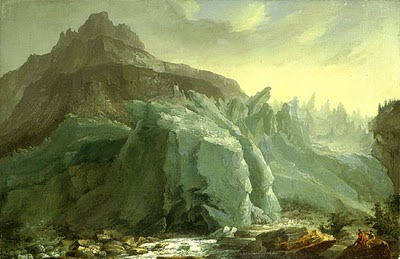
In my last post I mentioned that Bodmer and Breitinger, in their defense of John Milton's Paradise Lost, made a case for "irregular" beauties, as against the symmetry and proportion demanded by neoclassical poetics. What could be more irregular than the Alps, with which both men were surrounded their entire lives long. And, indeed, those mountains are often invoked in discussions of the sublime in the 18th century. Joseph Addison, in Pleasures of the Imagination, writes of the delight occasioned by great objects: "the Prospects of an open Champian Country, a vast uncultivated Desart, of huge Heaps of Mountains, high Rocks and Precipicies, or a wide Expanse of Waters." He goes on to say that our "imagination loves to be filled with an Object, or to grasp at any thing that is too big for its Capacity." Immanuel Kant, in his pre-Critical Observations on the Feeling of the Beautiful and the Sublime (1764), mentioned mountains with peaks above clouds, raging storms, and Milton's portrayal of hell as arousing "enjoyment but with horror."

What surprised me about Bodmer and Breitinger, however, is that neither mountain beauties nor mountain horrors play a role in their thoughts on the sublime. Still, I think that their advocacy of "irregularity" in poetry may owe something to accounts of travelers concerning the effect on the imagination of the Swiss Alps. A major account of the mixed feeling of delight and dread was written by an English cleric, Thomas Burnet. In Sacred Theory of the Earth (1681 in Latin; 1684 in English), he wrote of seeing in the Alps "vast Bodies thrown together in Confusion. ... Rocks standing naked round about him; and the hollow Valleys gaping under him." He found himself appalled at the "incredible Confusion" that broke down all his ideals of symmetry and proportion. "They are the greatest examples of Confusion that we know in Nature; no Tempest nor Earthquake puts things into more Disorder."

At the same time, Burnet also conceded that the majesty of the mountains produced awe in him. Though the mountains are "ruins," they also "shew a certain Magnificence in Nature."

As I said, neither beauty nor dread in Bodmer or Breitinger, but in their advocacy of art that grips the imagination they may have been influenced by such accounts.

Yesterday, when I was looking for images to illustrate the post, I came across this painting by Salomon Gessner, whose pastoral tales Goethe criticized for their tameness. The scene shows nymphs, to be sure, but what struck me was the setting. It definitely does not look like a tame landscape. For Gessner and for Bodmer, the sublime was not so much a pyschological category as it was a tool of artists or poets to stimulate the imagination of viewer or reader. Here, Gessner introduces some "irregular" natural forms, while Bodmer defended Milton's irregular diction and striking metaphors.

Picture credits: Harold's Planet (click on image to enlarge); Kunsthaus Zurich

Thursday, August 5, 2010

The Sublime, Again

Ernst Cassirer, in his book The Philosophy of Enlightenment, devotes a chapter to "Fundamental Problems of Aesthetics." Cassirer points out the uninterrupted exchange of ideas in aesthetics in the 18th century, with the thread of ideas becoming so "intertwined that they can scarcely be distinguished in the finished fabric and traced back to their various origins." French, Germans, Italians, the English -- all seemed to echo and parallel each other. In German letters, however, the problem of aesthetics took on a decidedly philosophic cast, indeed, was "placed under the guidance and care of systematic philosophy." The initial systematic spirit was Leibnizian, which received its doctrinal codification under Christian Wolff, and culminated in the Kantian sublime.

I am tracing the reception of the sublime in German letters. The point of entry seems to have been the writings of Johann Jakob Bodmer and Johann Jakob Breitinger, whom I have already discussed in earlier posts. On the one hand, Bodmer and Breitinger are, like their antagonist Gottsched, advocates of "neoclassicism" in poetry. They accept the rationalist poetics of Boileau as set down down in his L'art poétique. Two important aspects of that poetics. The first concerns form: genres are a given, not something invented by the writer. Thus, you don't add merry songs to a funeral ode. The second concerns subject matter, based on the conviction that some things are simply contrary to nature and that a poet violates the truth of nature by choosing subjects that venture beyond certain boundaries. I would add here that the subject matter of most contemporary fiction, theater, film, etc. violates this 18th-century conception of nature, which is understood as an orderly, and ordered, system. We are talking about the Enlightenment, remember. "Dysfunction," especially if rewarded, would not be acceptable.


Gottsched was perfectly in accord with these restrictions, but Bodmer and Breitinger found a way to expand neoclassical practice. Expression, including the use of figures and metaphors and such other rhetorical conventions, became the place for an artist to do something new and at the same time reveal his mastery. Bodmer and Breitinger found the justification for their advocacy of the "new" and the "marvelous" in poetry in the treatise of Longinus on the sublime.

Ironically, it was Boileau, the strict neoclassicist, who also introduced Longinus into European aesthetics, with his translation of the Greek's treatise in 1674. Basically this treatise -- On the Sublime -- discusses how ancient poets, great ones and not so great ones, moved their readers by the power of poetic expression. Thus, most of it is a discussion of "figures." It is not that Bodmer and Breitinger's "critical" works on poetics, from the early 1740s, foreground Longinus so much as that their treatments are totally informed by Longinus' treatment of figures. Interestingly, the German word for "sublime" -- erhaben -- is not mentioned often in these works. It is only in 1746, in his Critische Briefe, that Bodmer devotes a chapter to a definition of the sublime: "Lehrsätze von dem Wesen der erhabenen Schreibart" or "Theorems concerning the Essence of the Sublime Style." In other words, as Boileau had written, the sublime is "a certain power of discourse the aim of which is to elevate the soul."

Bodmer and Breitinger were men of the early 18th century, when art had not yet been divorced from ethics, and were not interested in the violent emotions that came to be associated with the sublime by mid-18th century. Thus, neither pays much attention to natural grandeur, which forms the starting point of discussions of the "psychological" sublime. This would be articulated by Edmund Burke and culminated in the writings of Mendelssohn, Kant, and Schiller. Bodmer and Breitinger did play a role in this transformation, however, but I will save that for the next post.

Picture credit: Karol Mack

Monday, July 19, 2010

Happy Birthday, Bodmer!

The Swiss man of letters Johann Jacob Bodmer was born on this day, July 19, in 1698. Bodmer was a figure that, if you were studying German, you encountered in graduate school. He was always linked with another Swiss literatus, Johann Jakob Breitinger, and the two B's were further presented as oppositional figures to a certain Leipzig literary "pope," Johann Christoph Gottsched. The opposition between the two critical camps -- Zurich and Leipzig -- came down to the issue of figurative language in poetry. Both Bodmer and Gottsched were apparently figures capable of attracting a number of acolytes, indeed very many of those who were working as writers or critics in the early part of the 18th century in German-speaking lands. The battle between the two, carried out with much invective, went on during the decade of the 1740s.

Gottsched was in some ways a more commanding figure, especially physically, which may have something to do with why he is more likely to be heard of today than is Bodmer. Lessing reacted pretty harshly to Gottsched's neoclassic literary recommendations in 1759, after which it was felt that Gottsched's time as arbiter of taste was over. Later, Goethe, in his autobiography, penned a satiric portrait of Gottsched, and this view has pretty much stuck.

Bodmer must have had a milder character, and seems to have been much loved by his friends and "pupils," including the painter Heinrich Füßli, or Henry Fuseli, as he was known after he emigrated to England. The portrait of Fusseli with his mentor indicates the reverence with which Bodmer was held by those who knew him. Among his literary acquaintance and correspondents were the poets Wieland and Salomon Gessner; the critic and philosopher Johann Sulzer; Johann Casper Lavater, author of the famous "physiognomic fragments" (to which Goethe contributed); and the educational reformer Johann Heinrich Pestalozzi.

Bodmer was instrumental in launching the career of Friedrich Klopstock, but there is much more to his literary influence. Important in connection with my current research, he is probably the principal conduit for the transmission of the aesthetic concept of the sublime into German letters. Later, he translated John Milton's epic Paradise Lost, and his enthusiasm for Milton was the bone of contention between him and Gottsched, who found the Englishman's flowery language too "Baroque." If Gottsched represented the influence of French poetics in German letters, it was Bodmer who introduced English literary currents. Being from a "republican" nation, he felt great admiration for England. Peter Hanns Reill, in his book on the German Enlightenment and the rise of historicism, has noted that the early journal published by Bodmer and Breitinger, The Discourses of the Painters, was much influenced by Joseph Addison's Spectator essays, especially its "cosmopolitan description" of English customs.

When the Sturm und Drang era of German letters began, in the late 1760s, Bodmer was pretty much regarded by the young shakers and movers as superannuated, but this literary movement was precisely a reaction against the French neoclassical poetics recommended by Gottsched. Sturm und Drang writers, including Goethe, had by now discovered the liberating effect of English writers, including Shakespeare and Ossian, a discovery that owes much to Bodmer's pioneering efforts. This image of Bodmer as a young man shows, however, the different time in which he and Goethe came of age. This may, however, have been the way Bodmer looked when Henry Fusseli first knew him.

Sunday, January 17, 2010

Goethe and the Sublime

What do we mean when we say that something is "sublime"? For instance, a slice of cheesecake or chocolate mousse? Or a hairdo or a dress? I suspect in both cases there is an intense feeling of something very delicious to our sense of taste and also very much out of the ordinary run of things. This contemporary use of the word is an attenuated descendent of a rather important aesthetic category in the 18th century, when the measure of the sublime was not food or dress but something much larger, say, mountain massifs or the the extent of the oceans. At the same time, there was a correspondence between the outsized, out-of-the-ordinary object of admiration and the feeling it evoked in us. Thus, the object was sublime, but a person had to feel it to be so. As Kant wrote, in The Critique of Pure Reason (1788), "Two things fill the mind with ever new and increasing admiration and awe, the more often and steadily we reflect upon them: the starry heavens above me and the moral law within" (tr. Paul Guyer).

Not too be overly immodest, but just about everything Goethe wrote about the sublime can be found in my article in the Goethe Yearbook. By the time he occupied himself with the subject, in the early 1770s, he was the beneficiary of almost a century of European discussions on the role of the sublime in aesthetic theory. Kant in turn made the aesthetic sense the basis of his moral philosophy.

It all began with the translation of the treatise On the Sublime into French by the critic and poet Nicolas Boileau, which appeared in 1674 and introduced the ancient rhetorician Longinus to the European literary world. Europe was ready for a change in its way of thinking about art. Before the 18th century theorists on art agreed with Aristotle that art was a particularly good way of transmitting universal and objective truths in graspable form. And since there were objective truths, it was also agreed that there were objective criteria for producing works of art.

By the 18th century in western Europe, however, there was a move toward more subjective criteria for judging art. This is where Longinus and his treatise on the sublime come in. Longinus, who had lived in the time of Marcus Aurelius (indeed, according to Boileau it was Marcus who ordered Longinus' execution), went beyond the conventional resources of the rhetorical tradition for achieving elevated effects and conveying powerful emotions. He suggested that nobility of soul and powerful and inspired emotions -- innate qualities in a person -- were more essential than in the traditional discipline of art.

One's inner state is occasionally the site of calm and docile emotions, but just as likely one of powerful, chaotic forces. There was nothing cute or nice about the sublime, and thus it was drafted to suggest the more powerful emotions of the soul. The sublime had its correspondence in the outer world -- be it God or infinity or some otherwise uncalculable natural phenomenon, like the massive, irregular, and chaotic geological formations of Switzerland -- while the sublime experience was the response of a person to the grandeur of the sublime object.


I have lately been working on the sublime, in particular the early transmission of this aesthetic idea into German literature in the 18th century. My focus has been Johann Jacob Bodmer (1698-1783), the learned Swiss man of letters who also introduced John Milton, in particular Paradise Lost, to German readers. Milton was for Bodmer the poet with the most noble mind and soul who likewise produced an epic on the most noble and sublime subject. Not much attention has been paid to the effect of the Swiss mountains on Bodmer's thinking. I like very much the paintings of Swiss mountains by Caspar Wolf, for instance, the above one, which shows visitors admiring the splendid ragged formations, which in effect indicates the taming of the sublime. Wolf was a predecessor of the Romantic-period painter Caspar David Friedrich in the portrayal of awesome natural subjects. By Friedrich's time, however, the awe felt in the face of powerful nature seems almost sentimentalized, as can be seen in the painting Wanderer in the Sea of Fog, at the top of this post, from 1814. Wolf seems to have been a much more modest figure, to show by this self-portrait.


Already by 1712, when Addison wrote his Spectator essays, these mountains (which Addison had seen on his trip to Italy) were a conventional trope in connection with the sublime. (They also figure prominently in Edmund Burke's 1757 essay on the beautiful and the sublime.) For Bodmer, it was Addison's emphasis on the quality of "great imagination" that drew him to John Milton. This subjective quality went on to play a huge role in the development of German literature in the 18th century, for instance, in the notion of "Genius."

It also played a role in Goethe's early oeuvre, in the so-called Storm and Drang period of the early 1770s. An expression of the sublime style and the expression of sublime emotion is on view in Goethe's essay on German architecture (1772), in which he rhapsodizes about the Gothic cathedral in Strassburg and its inspired architect, whom he compares to a second creator. Like God, such artists look down on their works and exclaim, "It is good!"

Later, Goethe abandoned this enthusiastic response in connection with sublime subjects. He became a "classicist," subsuming himself to the "edle Einfalt und stille Größe" (noble simplicity and quiet grandeur), which Winckelmann believed characterized ancient Greek art. I think Goethe's immersion in his scientific pursuits, beginning in the late 1770s, also distanced him -- made him more objective? -- vis à vis nature's more powerful and chaotic phenomena. He also was reacting against the kind of sentimental self-aggrandisement that is suggested by the Friedrich painting and that the discourse on the sublime had done so much to introduce to the European consciousness. Terry Eagleton, the Marxist literary critic, has something interesting to say about this secularization of emotion in The Ideology of the Aesthetic. He writes of the "production of an entirely new kind of human subject [in the 18th century] -- one which, like the work of art itself, discovers the law in the depths of its own free identity, rather than in some oppressive eternal law. The liberated subject is the one who has appropriated the law as the very principle of its own autonomy, broken the forbidden tablets of the law in which that law was originally inscribed in order to rewrite it on the heart of flesh."

Picture credit: Alpenverein