Showing posts with label Utopias. Show all posts

Sunday, June 28, 2015

Utopian writers

Georg Forster and father in Taihiti
For mundane reasons (although one was serious: a broken little finger), I am very behind in blogging. The new edition of the Goethe Yearbook arrived this past week, and already the opening section, on "Goethe and the environment," deserves a response, which I will get to shortly. There is much there to disagree with.

In the meantime, a short report on two writers, living a century apart, but both involved in radical politics, Georg Forster and Ernst Toller. Radical means active in attempting to establish utopias, one of my research interests. The attraction of utopia remains for me a conundrum. Both were the subject of recent podcasts.

The first podcast introduced a new work by Jürgen Goldstein, Georg Forster: Zwischen Freiheit und Naturgewalt, which traces Forster's trajectory from enthusiast for Taihiti to revolutionary. Affected by what he perceived as Taihiti's harmonious and egalitarian human order, which contrasted so starkly with European social conditions, Forster believed that the laws of nature could be applied to politics. Thus, he threw in his lot with the Jacobin Club in Mainz and the Mainz Republic. He was in Paris in 1793 when the Mainz Republic was overthrown and never returned to Germany, where he had become an outcast. He died alone, neglected, in poor health (probably the enduring effect of his three years at sea with James Cook), and disillusioned by the turn the revolution in France had taken.
The Tanna ground dove, now extinct, drawn by Forster
Goldstein calls Forster "der ungelesene Klassiker der deutschen Geistesgeschichte." Indeed, Forster is a wonderful stylist, but I had never before connected his travels, especially to Taihiti, with his later utopian visions. It is interesting to compare European reactions to other countries and mores with the stance of, say, Chinese, who would not have found anything to admire in Taihiti. Perhaps it was because Forster was viewing the island through the lens of the Enlightenment, particularly the French variety, that he was so receptive to what appeared to be life lived in accordance with nature. As the podcast reporter noted: "Er hat die Natur und das Politische kurzgeschlossen, d.h., er war der Meinung, es könnte natürliche Revolutionen geben. ... Er hat sich vorgestellt, Revolutionen gehen naturwüchsig vonstatten."

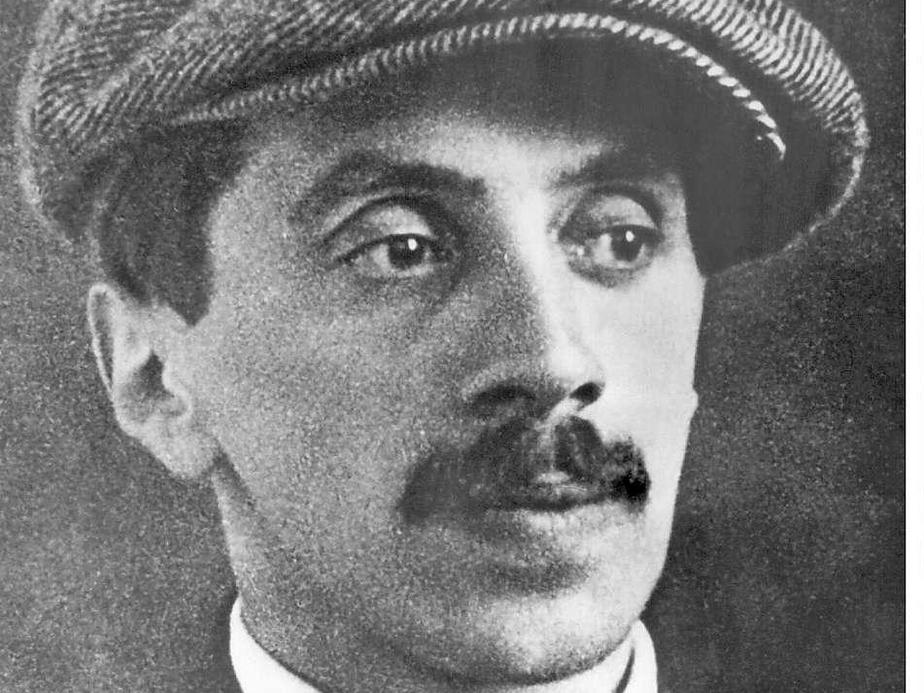
Ernst Toller, Revolutionär
I encountered Ernst Toller late in graduate school, but never had any notion of how wide ranging his literary and essayistic work is, nor the extent of his political activities. While Forster was involved with the Mainz Republic, Toller was actually president, for six days, of the Bavarian Soviet Republic in 1919. As soon as he took office he began issuing proclamations, including one mandating Sunday as a day of rest (for the workers, of courseö this was a workers' republic), but his term ended before the first Sunday was reached!

For his role in these activities, he served five years in prison, escaping a death sentence through the intercession of Thomas Mann and Max Weber, among others. He wrote some of his well known Expressionist works in prison. He was of course persona non grata to the Nazis and emigrated in 1933 already, first to London, then to the U.S., where he died, a suicide, in May 1937. W.H. Auden wrote the poem "In Memory of Ernst Toller" at that time.

The shining neutral summer has no voice

To judge America, or ask how a man dies;

And the friends who are sad and the enemies who rejoice
Are chased by their shadows lightly away from the grave


Of one who was egotistical and brave,

Lest they should learn without suffering how to forgive.
 

What was it, Ernst, that your shadow unwittingly said?

O did the child see something horrid in the woodshed

Long ago? Or had the Europe which took refuge in your head

Already been too injured to get well?


O for how long, like the swallows in that other cell,

Had the bright little longings been flying in to tell

About the big friendly death outside,


Where people do not occupy or hide;

No towns like Munich; no need to write?
 

Dear Ernst, lie shadowless at last among

The other war-horses who existed till they’d done

Something that was an example to the young.

We are lived by powers we pretend to understand:


They arrange our loves; it is they who direct at the end

The enemy bullet, the sickness, or even our hand.

It is their tomorrow hangs over the earth of the living


And all that we wish for our friends; but existing is believing

We know for whom we mourn and who is grieving.

The occasion for the podcast review of Toller is the publication of a 6-volume edition of his works (in bright red binding) by Wallstein Verlag.

Photo of Toller: Der Tagespiegel

Wednesday, September 17, 2008

Happiness and the Discontent with the Present


My dentist is very talkative, and during a recent visit our recent conversation concerned the new equipment in his office. Immediately after your teeth are x-rayed, the result is posted to the computer in enlarged format. No more waiting for development, no more holding up tiny negativess to the light and trying to see what the tiny dark spots in the lighter areas indicate.

"Isn't modern technology marvelous?" I say.

"Well, yes, " he responds, "but ..."

Even before he started to speak, I knew there would be a "but." Doctor R is  an interesting mixture, an extreme environmentalist who is, at the same time, anti-government. (I suspect he is a "Paulista" and probably packs a gun.) Thus, my question was a bit of a bait.

"Well, yes," he says, "but if you consider the atomic bomb ..." He leaves it at that.

I was referring to the marvels of medical technology, say, the laporoscopic surgery by which my gall bladder was removed seven years ago. Instead of undergoing a big abdominal gash to remove the offending organ, followed by a week in the hospital (risking infections) and who knows what kind of recovery, I was operated on in the morning and went home before dinner.

How easy life is today compared to 200, even 100, years ago! Dental braces, dialysis machines, not to forget the iPod, the computer, and the cell phone: few in 2008 would wish to return to the condition of 1908, when a man's life span was fifty years (and a woman's much shorter), compared to almost eighty today. It is no understatement to speak of "progress" in connection with the past two centuries: for people living in 1908, enjoying the benefits of efficient indoor plumbing (Thomas Crapper, c. 1880), antiseptics, aspirin, and elevators, the way of life of 1807 would have seemed positively backward.

I haven't asked Doctor R what he thinks about energy exploration, but I suspect he thinks that man has messed up the earth. There is much nostalgia among environmentalists in their desire to maintain the earth in an unchanging state, if not to return it to a pristine condition. Yet who would go back in time to 1908 when gall bladder surgery would have probably been fatal? (Could gall bladder problems have even been diagnosed back then?) Would we want to live when, if we lost a front tooth, we could not get a new one that looks even better than the original? Would we agree to live in an age without anesthetics or aspirin?

  
Goethe lived to the ripe old age of 82, but his friend and fellow poet Friedrich Schiller died at forty-six in 1806 already of something that could have been cured by a week of antibiotics.

Now, there are also people who have what might be called a nostalgia for the future. They are "utopians," who like to project a future unburdened with the problems of the present. In the utopian future, the earth will be protected from the ravages of mankind, including the worst ravage of all, war. There will be no war because the lion will lie down with the lamb.

As with returning to the past, however, there will be trade offs. We will still have antibiotics, but, since they will be free, everyone will want them; but since demand will exceed supply, not everyone will get them. This restriction will apply to all the products invented by human ingenuity and hard work in the last 200 years. New criteria for receiving these products (besides ability to pay) will be applied.

What will those criteria be?

One system is that of John Rawls, a favorite philosopher of liberals. In a book entitled A Theory of Justice, he designs a social contract that reconciles liberty and equality. Starting from a hypothetical "original position," members of society will choose those principles for living together that will allow the most liberty and equality to members, with the proviso that you will not know what position in society you will occupy in the resulting society. In other words, you might be a princess or a pauper, a hedge fund manger or a newspaper vendor. Rawls was of the opinion that people would choose to abolish the kinds of social inequalities that exist because, well, because of the fact that some people are smarter (more beautiful, talented, etc.) than others. In other words, his system will penalize people who, traditionally, work hard for their success. It leaves out of account that people might not want to continue working to produce the things that have made them wealthy -- and the lives of the rest of us easier -- if they are not going to be rewarded. The social justice set (which includes many Americans) sees society as a zero sum game: if I am rich, I am taking away your share.


Every age has its trade offs, but we only live when we live. Just as most of us would not like to return to the past, before we design a new future we should keep in mind that we might not like the future we get. Think back on the bright futures promised by so many well-intentioned programs, including (in my own lifetime) the "Great Society." Have they done what they set out to do? Or have they produced more problems that people are now wishing to escape into new future visions?