Showing posts with label Goethe's Venetian epigrams. Show all posts

Thursday, January 26, 2012

Goethe's Venetian epigrams

I have wanted to continue the previous postings, on Goethe in Venice, and I spent some time in the past couple of weeks reading the so-called Venetian Epigrams. At first glance, I was not too impressed. They seemed to me to be rather sterile. The meter also didn't seem natural (Goethe was experimenting with classical forms), and the attempt to imitate Latin grammar meant that you often have to read the poems several times to figure out which noun goes with which verb. Moreover, the mythological apparatus sounds false. There is also the offputting cynicism, which, however, is part of the conventions of the genre.

Yet a deeper immersion proves more interesting. At the same time, there are some problems in discussing the epigrams as a poetic "product" or collection.

The stay in Venice, from March 31 to May 22, 1790, inspired Goethe to write "several hundred" epigrams, which he began to assemble in a Libellus Epigrammatum on his return to Weimar. Twenty-four such poems appeared, under the title "Sinngedichte" (the German poetic term for epigram), in Deutsche Monatschrift in 1791. It is a fairly innocuous effort. At Schiller's encouragement Goethe made a larger selection, of 103 epigrams, which appeared in Musenalmanach fur das Jahr 1796. The Munich edition of Goethe's works includes these 103 poems, under the title "Epigramme. Venedig 1790," but it also publishes (alongside the "Sinngedichte") "Epigrammen Erstes Buch Venedig 1790" and "Epigramme Zweites Buch," containing 136 in total.

There are various manuscripts of Goethe's epigrams, but none can be taken as definitive. The Munich edition is clearly trying to demonstrate that there is some kind of structural principle. The collection containing 103, for instance, and that of 136 show many duplications, but the poems also follow a different order. Compounding the problem is that some of the people who handled Goethe's manuscripts after his death went through them and literally used a razor to excise offensive passages. I mentioned in an earlier posting on this subject that one of the themes of the epigrams was religion. I was quite taken aback at the animus toward Christianity in "Epigrammen Erstes Buch Venedig 1790." At least in formal terms, this animus in toned down in the collection of 103 epigrams.

It strikes me that these problematic aspects are irresolvable, and as I read and reread the poems it seemed that the greater problem is that Goethe's epigrams seek to accommodate material that is not appropriate to the genre. The overriding theme is the felt tension between the present situation of Venice, a place that draws travelers and is therefore to be savored, and the longing for home, where the beloved is.

I think that there are two ways that Goethe might have solved the problem. The first would have been to restrict himself to composing a cycle of poems based on the love for Christiane and their child. These are, in my view, the best in the collection (see e.g., nos. 95, 96, 98-102). Here, for instance, is David Luke's translation of the first four lines of no. 102:

It is such joy to hug my beloved so close, to desire her,
And in her heartbeat to hear her first confession of love:

Joy still greater to feel life coming, another life pulsing
As it moves, as it thrives, in her dear nourishing womb!

Goethe, however, took his Martial along with him on the trip, evidently intending to be inspired by the ancient genre. In his attempt to be "symbolical," these lovely poems about the beloved jostle uncomfortably alongside very cynical observations on Venice, many about prostitutes and other low life. Since the beloved is Christiane Vulpius, a woman to whom he was not married but who had just borne his son out of wedlock, the juxtaposition of her with prostitutes is jarring, not to mention not very complimentary.

A second method, and more interesting, would have been to have used the material in the epigrams as the basis for a short novel. In that way, the observations on politics and religion and street life would have served as the realistic background for the traveler's musings about what has been left at home. In fact, I may write this novel myself!

Picture credits: Démodé; National Gallery of Art (UK); Sunday Observer; Amazon

Friday, January 13, 2012

Goethe in Venice

I mentioned earlier that friends had vacationed in Venice before New Year's and sent me the reminder in the photo at the left (click to enlarge and see the sign indicating "viale Goethe") that Goethe had left his mark on the city. Today I will write a bit about the city's mark on him, which is one of the lesser fields of Goethe scholarship.

Travel accounts of the past two centuries are often records of desire, particularly the attempts of travelers to discern the past in the milieu of the present. Thus, 17th- and 18th-century travelers to Italy sought to resurrect the vanished classical past from the ancient ruins. For northern European travelers, especially Germans, Rome in particular occupied an outsized role in the imagination.

Goethe had longed since his youth to visit Italy, which he finally did in 1786, spending two years there. As Nicholas Boyle writes in his biography of Goethe, however, the real Italy itself was merely confirmation that "the object of his desires had a place and habitation on this earth." Those two years in Italy were not really spent on the ground, but "in Arcadia, in a creation of his mind and heart." Goethe devoted little attention to the actual Italy (unless it was geological or plant in nature), exploring few of the customs of the land, the very thing that most of us look forward to experiencing in foreign countries. The difference can be seen by comparing Goethe's Italian Journey with the diaries and memoirs of Friederike Brun, who spent considerable time in Rome and southern Italy exploring both the past and documenting the present. Her writings of these years were published before Goethe's Italian Journey, and I suspect he studied them closely. (My account of Frederike Brun as a traveler can be found in this publication.)

Goethe had passed through Venice on his first Italian journey, but it was in 1790 that he returned, on a quasi-official Weimar mission: the Duke's mother had been in Rome for the past two years, and Goethe was to accompany her on this stage of her return trip to Weimar. Her delay in leaving Rome, however, meant that Goethe stayed longer than expected. By now, Goethe had settled in Weimar with Christiane and had a small son, a domestic situation that was clearly satisfactory. Thus, the epigrams record disappointment at what is not in Venice: the snowy mountains of the north and the German Faustina left behind in Weimar. The erotic vein of the Roman Elegies is abandoned. In contrast, Italy on this second journey was more clearly observed than on the first, "imaginative," visit. It was now, writes Boyle, "a place of dusty roads and dishonest hotel keepers."The literary product that emerged is the Venezianische Epigramme, a "cycle" of 100 or so short poems that drew their formal inspiration from such ancient precedents as Martial.

This collection occupies a secondary place in Goethe scholarship, probably because of the seemingly unmediated character of the reflections in the poems. Boyle writes of this being a "distempered time" for Goethe. What is unprecedented about this work is that they are "full of Goethe's opinions. ... Never before in his writing have views been expressed in so undramatized a form, so unattached to any persona other than of Goethe at a particular time and in a particular place." Boyle also adds that "the image of the traveler, of the man who is not at home, is fundamental to the collection." Thus, Goethe would seem to exemplify the flâneur (see also here), before being a flâneur became a literary and artistic subject.

Though the subjects are wide-ranging and, unlike in the Roman Elegies, contain quick sketches of Venetian daily life, Boyle identifies three thematic areas: political, cultural, and sexual. The effects of the French Revolution was in its early stages, and Goethe's references to street-corner revolutionaries contain some interesting observations, including, I was interested to see, the following two lines on the nature of freedom of speech. (The epigram itself, however, went unpublished in his lifetime.)

Leider läßt sich noch kaum was rechtes denken und sagen
Das nicht grimmig den Staat, Götter and Sitten verlezt.

(Unfortunately it is hardly possible to think or say anything right that is not savagely wounding to the state, the gods, and morals.)

Sex seemed to preoccupy Goethe at this time. For instance, he devotes some lines to Venetian prostitutes, whom he had seen in his wanderings in the labyrinth of Venice streets. Of these epigrams Boyle writes that their character was so explicit -- nudity, erections, masturbation, sodomy, venereal disease -- that they were not published for over a century.

The third theme shows Goethe, as Boyle writes, at his most "explicitly and violently" anti-Christian. "Christianity is presented as a series of illusions," while the epigrams consistently focus instead on "Epicurean materialism," which offers "the unadulterated truth" about God, man, and the world.

According to the Goethe-Handbuch, Goethe failed to mention ("with a single word") the grand palaces on the Canal (seen above in the gorgeous photo above by Todd Landry), and the Byzantine and Gothic influences on the architecture simply passed him by. He had the following to say about St. Mark's: "The architectural style is commensurate with every manner of nonsense that was taught or perpetrated there." Goethe did not, however, neglect the paintings to be found in Venice, and he and his companions, Friedrich Bury and Johann Heinrich Meyer, made a systematic tour of practically every church and public collection in the lagoon city and, in this way was Goethe's understanding of the history of Venetian painting enriched.

This post is becoming very long. Thus, I hope to devote the following post to a continuation of Goethe in Venice, in particular to his impressions of the paintings he saw there, reflected in an essay from 1825, Ältere Gemälde. Venedig 1790.

Picture credit: Visual Culture; Todd Landry (as above)

Monday, March 22, 2010

Goethe's Third Italian Journey

As I have written elsewhere, Italy has had a special place in the imagination of German artists and writers. Think, for instance, of Thomas Mann's Death in Venice, which portrays the longing and repulsion. Albrecht Dürer first went there in 1494, two years after Columbus discovered the New World. The watercolor above, in the British Museum, was executed shortly after his return from Italy.

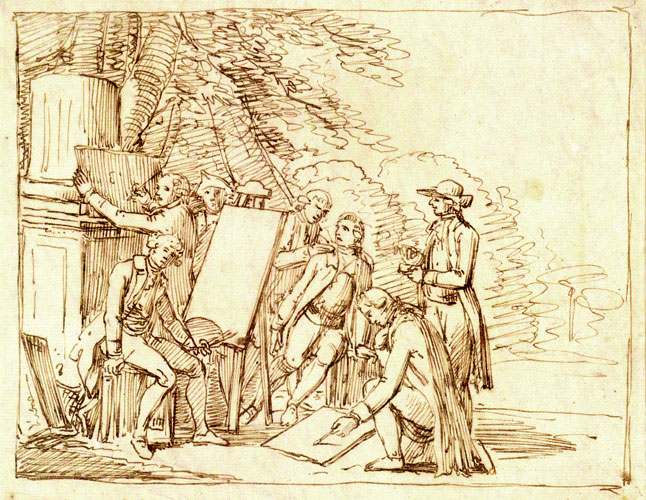
Goethe tried his hand at such landscapes as well. During his stay in Italy, from 1786 to 1788, most of his friends were artists. In the contemporary drawing below by Frederich Bury, Goeth is shown (third from right) with his German friends. Goethe even thought he might become an artist himself, but he soon gave up the notion.

He returned to Italy in 1790, to Venice, where he stayed for two months waiting for Anna Amalia, Carl August's mother, whom he was to accompany back to Weimar after her visit to Rome, which was no doubt inspired by Goethe's earlier journey. He seemed to have the same feeling about Venice as did Thomas Mann. He was enjoying domestic pleasures in Weimar with Christiane Vulpius, and his impressions of Venice, as recorded in the Venetian Epigrams (first published in 1796), are much more sharp and also lebensnah. Many of these poems are erotic, as per Goethe's model Martial, and they are also "snapshots" of daily life, culture, and politics in Venice. Goethe would seem to be prefiguring here the 19th-century flaneurs.

Here is an example, about a prostitute, in David Luke's translation:

"If I'd the husband I need, and if I kept house for him, I'd be
Happy and faithful and true, hug him and kiss him all day."
That was the song, among others more coarse, of a little Venetian
Whore; and so pious a prayer never I heard in my life.


Many of the epigrams suggest Goethe closely observed the habits of Venetian prostitutes. (See here for more translations of the epigrams, especially of the erotic ones.)

Goethe planned a third trip to Italy, in 1797, in order to make a comprehensive study of art. He got as far as Switzerland, before deciding to turn back. Napoleon's troops were all over the peninsula by now, and, like Hitler later, they were ransacking churches and private collections for art that would be transported back to Paris.

Though he didn't enter Italy, he sought to retrace the steps of his first trip to Switzerland, in 1774, during his Sturm und Drang period. Goethe was at that time engaged to Lili Schönemann in Frankfurt, but he was, as we would now say, "conflicted" about this engagement. He wrote a beautiful poem about his shifting moods, "On the Lake." The "high point" of this trip was his ascent with a travel companion to the Gotthard Pass, where they were welcomed at a Capuchin friary and served bread, cheese, and Italian wine.

In 1797, he repeated the ascent to the Gotthard Pass, as if to relive those earlier days. The pass is reached by several "bridges," which no doubt looked very much as in this painting of the pass by Turner, from 1803. Goethe wrote a lovely poem, which addresses the nearby summits whitened with snow. According to Goethe biographer Nicholas Boyle, Goethe was here acknowledging that this, his third Italian journey, "had become a journey into the 'autumn of life'":

Yesterday thy head was brown, as are the flowing locks of love,
In the bright blue sky, I watch'd thee towering, giant-like, above,
Now thy summit, white and hoary, glitters all with silver snow,
Which the stormy night hath shaken from its robes upon thy brow;
And I know that youth and age are bound with such mysterious meaning,
As the days are linked together, one short dream but intervening.

(This translation, by William Edmondstoune Aytoun, appeared in Blackwood's Edinburgh Magazine in 1845.)