Showing posts with label Goethe and utopia. Show all posts

Sunday, June 16, 2013

Goethe and utopia

Charles Gore, Mainz After the Allied Victory in 1793
I have been away far too long from posting. My research on 18th-century utopia would seem at cross purposes from Goethe, as the research has led to reading lots of French philosophes. At the same time, I try to keep Goethe in the picture: insofar as he is absent from utopian thought, this absence says much about him. Today I was thinking that he was perhaps fortunate in coming of age just when there was a reaction against "Gottschedism" and against French neoclassicism in literature. Likewise, growing up in Frankfurt and even, it seems, while going to the university in Strassburg, he seems not to have been contaminated by the apocalyptic views of some of the philosophes. Writing about this period in Dichtung und Wahrheit, Goethe mentions his disdain for the materialism of La Mettrie.

Frank Manuel's book The Prophets of Paris offers some great writing on the "prophets of progress." In July of 1793 Condorcet wrote the following: "Long since persuaded that the human species is infinitely perfectible and that this perfection ... cannot be arrested but by physical revolutions of the globe, I considered the task of hastening progress to be one of my sweetest occupations, one of the first duties of a man who has strengthened his reason by study and mediation." In October he was branded a traitor and a warrant issued for his arrest. He went into hiding. In March of 1784 he was arrested and died two days later in his cell.
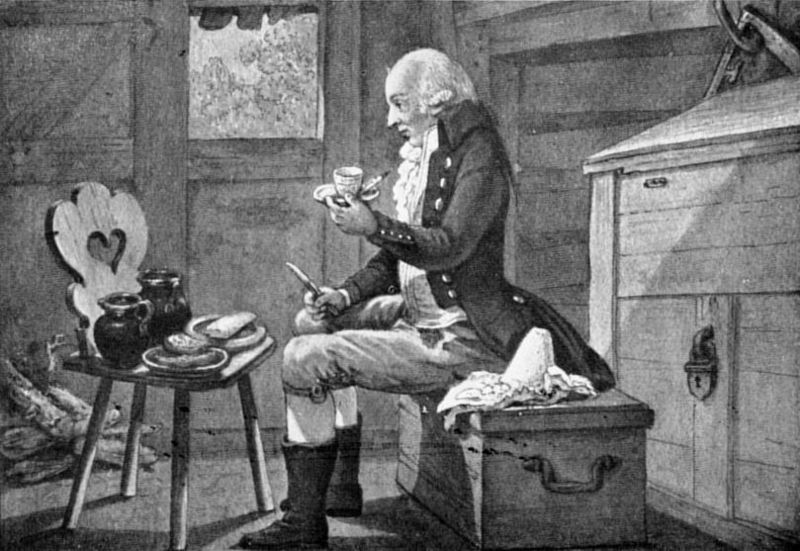
Charles Gore, painted by Melchior Krauss, 1793
In July of 1793 Goethe was in Mainz where he was a first-hand observer of the Prussian bombardment of the city and the end of the French occupation. As Die Belagerung von Mainz was first written in 1820, the tone is dispassionate. Still, the things Goethe saw, both the physical destruction of the city and the mortality, could not have made him an such an optimist about human perfectibility.

The painting at the top of this post is by Charles Gore, whom Goethe mentions in The Siege of Mainz. Gore had traveled from Weimar with Georg Melchior Kraus who, at the time of Goethe's visit at their encampment, was painting a portrait of "our dear friend." As Goethe writes, because of the painting "we can see him and remember him fondly every day." Goethe's description is exactly that of the painting directly above, with Gore all dressed up, "because he was going to put in an appearance at the Duke's table. .. Now he was sitting on a chest in a peasant's room in a little German village, surrounded by all kinds of household and agricultural implements, next to him his half-eaten sugar loaf on a piece of paper; he was holding a coffee cup in one hand and and a silver drawing pen instead of a spoon in the other. And so the Englishman was quite decently and comfortably established in this simple billet." (Translation by Robert R. Heitner.)

Picture credit: ingenieurgeograph

Thursday, January 17, 2013

Goethe, utopia, and world literature

Most recently I have been listening to Thomas More's Utopia on my iPod, along with Plato's Republic, both of which are considered Urtexte in utopian theorizing. I am trying to ignore the cringe-worthy aspects of these proposals for social amity and, instead, to focus on why utopian thinking continues to attract, even as the past several centuries have amply demonstrated that one-size-fits-all solutions to governance have been disastrous.

Plato was pure philosopher, but I was struck to find so many similarities between Thomas More's career and Goethe's. According to Karl Kautsky, More was appointed "Under Sheriff" in 1509, "in which position he had sufficient opportunity to gain an insight into the economic life of the people." In 1515 Parliament appointed More a "Commissioner for Sewers." He became Treasurer and, in 1523, Speaker in the Commons," positions (according to Kautsky) that presupposed experience in financial maters. And then, shortly afterward, he became Chancellor to the king.  Goethe's many duties in Weimar governance were similarly wide-reaching, including his close relationship with the sovereign, Carl August. (I recommend the Goethe Handbuch entry, vol. 4/1, pp.35-46, on Goethe's "Amtliche Tätigkeit.") Some of his duties concerned finances.

Thomas More had more diplomatic experience than Goethe. For instance, he went to Bruges in 1515 as a member of a group conducting commercial negotiations. Another mission, to Calais, in 1517, concerned commercial disputes between English and French merchants. He went to Bruges again in 1520 to settle disputes between English merchants and the Hansa.


More's Utopia reflects the contemporary interest in travel and concourse among nations and in the customs and governance of other nations. More was writing at the very beginning of the period when the European countries began the oversees trade that would bring such wealth to England and Holland. Goethe was formulating his ideas about world literature at the moment when that trade had made the lives of Europeans similar in material respects. By the 1820s Goethe was quite a gourmand (see my post on this subject), and the table at his home on the Frauenplan in Weimar was supplied with the products of foreign trade. His household accounts show outlays for delicacies that were not produced in Weimar: chestnuts, fermented mustard, foie gras, mussels, Spanish raisins, caviar. This appreciation for fine food among the middle class was a phenomenon of commerce, and, today, we can see that people all over the world either enjoy or aspire to enjoy similar material comforts. Thus, though Goethe lacked overseas experience, he was aware of the equalizing effects of commerce and trade. World literature  is commerce on an intellectual or spiritual level, one, so Goethe hoped, that would produce amity among diverse peoples.

Photo credit: Coin Talk