Thursday, September 28, 2023

Goethe and the oral tradition of literature

Brad Pitt as Achilles

In the previous post, concerning the pastoral genre, I sought to convey how much Goethe drew on traditional poetic genres in his poetry and dramas, but which he "modified" in such a way as to create something new poetically. I have recently come across an illuminating account of the epic poetic transmission that throws light on Goethe's innovations. For instance, he wrote Hermann und Dorothea at the start of the French Revolutionary Wars, which, like the tales of the Trojan war in the Iliad, were a pretty brutal period in history. No one in the 1790s in Europe, however, wrote epic poems in the style of the Iliad about Napoleon's conquests. Novels, yes (War and Peace?), but the epic was passé as a genre. Hermann und Dorothea has been called an "epic poem," but there are no heroes in it, although Dorothea, among the refugees, can be called courageous. Hermann und Dorothea is more properly an idyll, in nine cantos of hexameters. So, Goethe has taken a traditional genre, epic, and a traditional theme, war, and come up with something new.

The account I mentioned is entitled The Mortal Hero, an introduction to Homer's Iliad by Seth Schein, who was a professor of mine in a comp lit class in graduate school. The "overwhelming fact for the heroes of the Iliad" is their mortality, unlike the immortal gods, as Seth Schein remarks in chapter 1. We have learned from studies of history that the ancient world was a battle-filled one, and tales of heroes and of mortality were evidently a "popular" subject of oral literature. The Iliad itself is the "end product of a poetic tradition that may have been as much as a thousand years old by the time the epic was composed," ca. the 8th century B.C. Lesser and greater singers gave expression to the Trojan War, representative of wars of the Late Bronze Age. And the memory of the events of the heroic age was kept alive by these singers, re-imagining the events, re-telling them over and over, and, as an aid to memory, using formulas of scenes, episodes, words, phrases, and so on. Homer's epics were the end products, so to speak, of this tradition, but also "equally the first in Greek literature," i.e. in writing.

Do these guys look like heroes?

When Goethe came of age there was also a strict classification of literary genres, inherited from the Greeks and Romans, each of which had its own subject matter and its own linguistic formulas. In an essay I published in 1996 in the Goethe Yearbook, I wrote about Goethe's five-act play Clavigo. Shakespeare, whose plays young Goethe was enthusiastic about, worked with a five-act structure in his tragedies. And a tragedy, according to Aristotle in the Poetics, is a genre about a noble hero who goes from good to bad fortune. Goethe imitated this pattern in Clavigo: ein Trauerspiel, but the problem is that Clavigo himself was not a heroic individual. He was a courtier who, in order to rise at court at the king of Spain, reneged on a promise to marry the sister of Pierre Augustin Caron de Beaumarchais. It's a very bourgeois situation. As I wrote in my an essay, however, the play received a certain "existential weight" by this generic contamination:  the introduction into a classicist play of a non-heroic (i.e., bourgeois) character literally altered the character’s self-conception.

Picture credits: Warner Bros.; New York Public Digital Library

Monday, September 18, 2023

Goethe in Love


I am back in New York City after three months on a small island adjacent to Port McNeill on northern Vancouver Island. As I wrote in earlier posts, my intention was to read as much of "young Goethe" as possible this summer, and I managed it. Today's brief post is simply to note a few things that were on my mind as I flew high in the sky from Vancouver to New York.

Goethe grew up in a time when it was understood that poets imitated other poets, especially earlier ones. Whether writing about love or despair or whatever the emotion, poets employed the conventions of existing poetic forms and genres. Besides love and grief and so on, poets also wrote about events in the world, but these too were clothed in certain poetic conventions. An example from painters might make this clearer. Take Spanish painters of the golden age. Some are esteemed as "better" or "greater," but all of them painted the same subjects: e.g., the Crucifixion, the Nativity, shepherds, kings and queens, battles. Did Murillo, Zurbaran, Velasquez keep diaries? It's difficult to know what the painters' feelings were concerning the subjects of their work. So, too, the poets and dramatists in the period right before Goethe came of age. When they wrote about shepherds in love, did they also feel in love? Probably not. Did they even know any shepherds?


Goethe's earliest poetry collection has shepherds. In other words, he drew on this long-standing poetic genre. But he also used conventional forms to write of something personal. Goethe did not keep a diary in the way of famous personalities, but, unlike the private lives of earlier writers, we know a lot about his life, and he mediated his experience of jealousy in Die Laune des Verliebten, from 1767–68. It is a pastoral play, one of the most conventional genres of the mid-18th century, in which two shepherd couples learn some lessons in love. He wrote many letters at this time of writing this play, some of which are preserved, and several of which portray his youthful ardor for a young woman, an innkeeper's daughter, with whom a young man of his standing would not likely marry. The play details the curing of a jealous shepherd. The letters he wrote at the time document the bitter jealousy to which he was reduced in regard to this girl, to whom his earliest collection of poetry was addressed: Annette. The manuscript image at the top of this post is the poem "Die Liebhaber" (The Lovers) from that collection.

Photo credit: Charlotte Zilm

Thursday, August 31, 2023

"Stories of Love and Eros"


No, Goethe fans, this post will not be about Goethe's love life, although there is much to be said in that connection. As mentioned in an earlier post I have been reading this summer, among other writings, Goethe's Roman Elegies, and at some date I will do a post on the subject. In a few days I will be leaving this island on which I have spent the summer. This will be the last post before I am back in New York in early September. For this post, something new.

 Many of you know that I have published fiction in the past, including in my relative youth, two mystery novels. Over the years I have written a number of short stories on the above-titled theme, for which I am hoping to find an agent and publisher. Two of the stories have recently appeared as an eBook. For those interested in purchasing it, here is the Amazon link.

And now a description of the two stories:

Love and eros know no bounds, especially for Ching-mei and Laura, two women living in very different times and places.

“The Treasure of the Poet” tells of eroticism and creativity on the eve of the Mongol invasion of China in the 13th century. Ching-mei, who aspires to be a great calligrapher, has had the misfortune of dying too early in a previous life. Is her fortune about to change on meeting the poet Li, whose own dream is to travel to the City of Flowers, one dedicated to the highest ideals of art and poetry and music?

“The Perfect Lover” takes place on Axel Isle, a planet known for its beautiful women, especially the Companions, who are created for men according to their own specifications. So, too, Laura, who appears one day in the life of William Babilot. William discovers in Laura the perfect lover, but the poetry she writes presents complications on one of the best functioning planets in the universe
.


Monday, August 28, 2023

Happy Birthday, Goethe!


Yes, August 29 has rolled around again. And, again, another mention on this blog of Goethe's birthday. This year, however, it struck me that Goethe was a Virgo. And yesterday was the annual Virgo Party on this small island. Above some of the Virgos present, including myself, along with a few friends. The party, held at the end of August or beginning of September, marks the end of my stay out here, as I will be heading back to New York within the next couple of weeks. Above a photo of yesterday's party-goers, taken at Bere Point. As always, click to enlarge.

Monday, August 21, 2023

Goethe and plants


As I mentioned in an earlier post, I planned this summer to concentrate on Goethe’s pre-Weimar writings, having brought with me Karl Eibl’s two-volume edition of Der junge Goethe. (The five-volume Fischer-Lamberg edition was too much to carry.) But as often happens when following up one thing on Goethe, I become diverted. In any case, I never thought I would be making my way this summer through Goethe’s writings on the metamorphosis of plants. It was in particular the poem “Metamorphose der Pflanzen” from 1779 (nice translation here) that interested me initially because of the use of the diptych poetic form. And that was only because of a review I was writing of a translation by John Greening of several poems by Goethe that includes stanzas from the Roman Elegies. (See previous post.) So I led myself through a tutorial, so to speak, on the diptych, “the segmented structure of two lines and caesuras” (this is from Karen Schuler’s article on the form in the Goethe-Lexikon of Philosophical Concepts). Which led me to look at the MM poem, likewise written in that meter. Well, it was not as easy a read as the Roman Elegies, not by a long shot.

Lamb's quarters

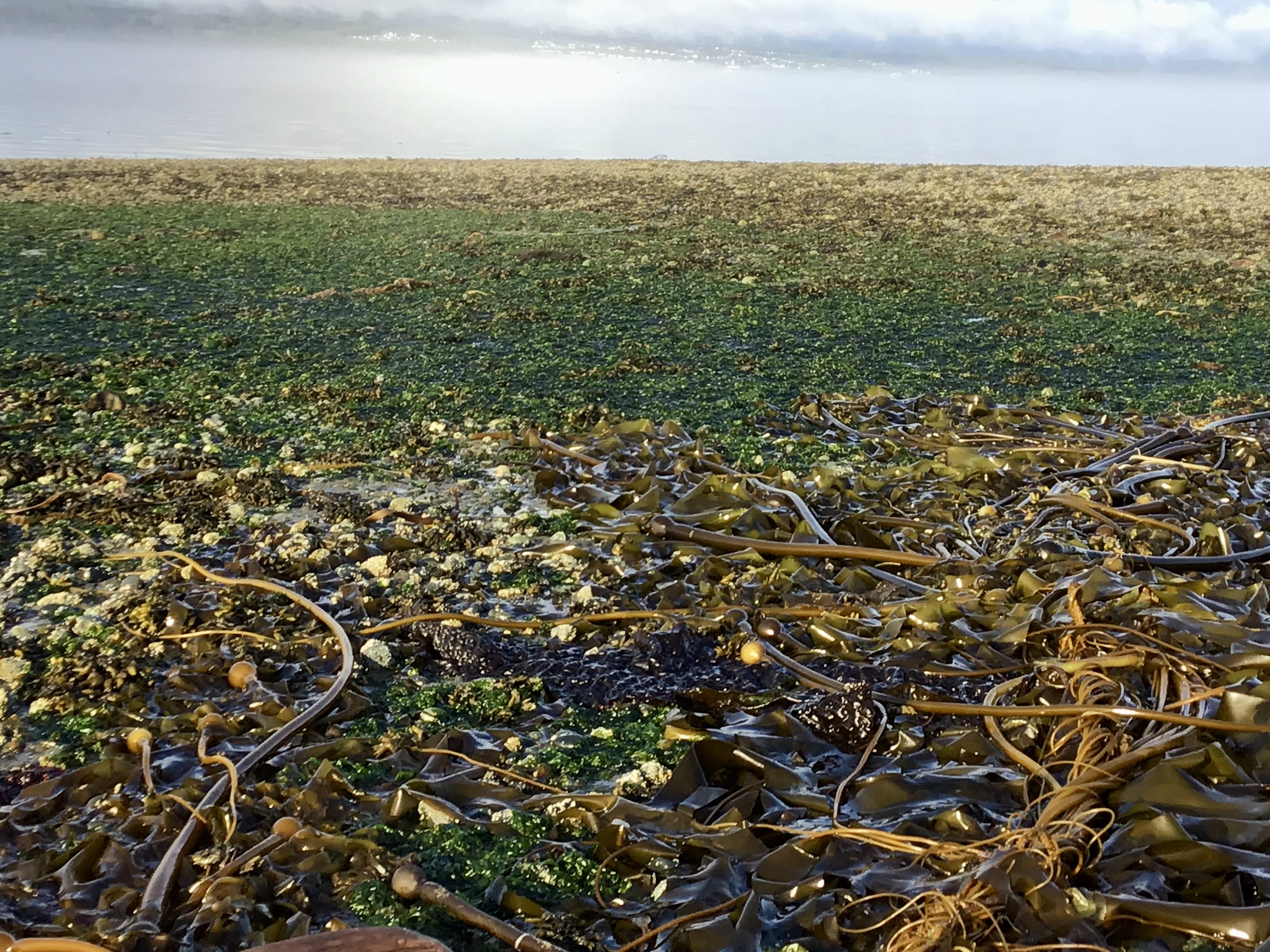
Anyway, during this my annual summer visit to an island in the Northwest Pacific, with the beach right before my windows, I like to walk on the rocky shore when the tide is out. In connection with Goethe’s writings on plants, I turned my attention to studying the seaweed, which flourishes in what is called the intertidal zone. Goethe of course does not consider seaweed in his study of the development of plants, although he does mention underwater plants (“water buttercups”) in paragraph 24 of his metamorphosis essay. My Goethe Society colleague Heather Sullivan has written an article on this essay by Goethe, which appeared in the Goethe Yearbook in 2019. I was intrigued by her use of the term "Pflanzen-Ozean" (plant ocean) in connection with Goethe's vision of the earth as a vast landscape of green life.

Rockweed
Fortunately, the small museum in this small town offers for sale a pamphlet entitled A Field Guide to Seaweeds of the Pacific Northwest by Dr. Bridgette Clarkson, which inaugurated my enlightenment concerning seaweed. Unlike the plants that Goethe describes, seaweed has no roots, flowers, or seeds. It does have a form of rootedness, which in the language of seaweed is called “holdfast.”

Sea lettuce
There are also three varieties: green, brown, red. Being a totally urban person, I will not risk trying to sound like I know anything more. The identifications on the images here were supplied by a friend who grew up in this part of the world. Annie has generously sent me the descriptions, which appear at the end of this post. As she mentions, there have been many changes in the nomenclature (the scientific names) that have likely occurred since she worked in the field. In contrast, as she says of the common names here, they are "a little more flexible and forgiving." Thanks, Annie! As always, click on the photos for a larger view.

Surfgrass


Lamb’s quarters is a terrestrial plant you would have found in the upper tidal zone, generally just above the high tide line

Rockweed,  sometimes called bladder wrack. There are different varieties of rockweed — some with shorter and rounder bulbs and some more like this one, with sharper, longer bulbs. These bulbs are filled with carbon dioxide, which keeps the plant floating and closer to the sun — helps with photosynthesis!

Surfgrass (as opposed to eelgrass) is a terrestrial plant with roots — transitional, as it is found in a marine environment. It has a narrower blade than eelgrass and is likely attached to a rock and not embedded in sand. (Won't venture to identify the red seaweed that is around the surfgrass. Might be Cryptosiphonia or Prionitis, but I can't really tell)

Sea lettuce is  often found in the mid tidal zone. It is quite edible when cleaned and dried.

The two bottom ones are of bull kelp, likely washed up in the big northwesterly blows we've had these past few days. The top photo of the two shows the stipe and fronds, while the bottom one, as best I can tell from the photo, shows a closeup of the fronds. The off-color areas in the middle of the fronds contain reproductive spores that will disperse in the water and float around as phytoplankton before settling to the bottom and growing into new plants in the spring.

Tuesday, August 15, 2023

Translating Goethe's poetry

Consider the following a book review of a very small volume (47 pp.) of translations of poems by Goethe entitled Nightwalker’s Song. I saw an ad for the book in the London Review of Books and wrote the publisher, Arc Publications, expressing my interest in writing about it for the blog. Arc kindly sent me a copy. The translator is John Greening, and the selection of poems, with German and English texts, is from Goethe’s early and middle years, from one of Goethe's most famous poems, “Wandrers Nachtlied” (Über allen Gipfeln; 1780) to the sonnet “Natur und Kunst” (1800; publ. 1809). In between are poems that have been a favorites of poets (among others, Christopher Middleton, David Luke, and David Constantine) who have tried their hand at reproducing Goethe’s rhythms, structures, and vocabulary : “Willkommen und Abschied,” “Prometheus,” “Harzreise im Winter,” “Römische Elegien” (I, V, XIV, XX), “Nähe des Geliebten,” “Der Zauberlehrling,” and “Faust im Studierzimmer.” Each poem is prefaced with a few lines of background.

John Greening himself is a considerable poet and writer about poetry. His poetry, from what I have gleaned online, can be recondite, at least for this American reader.  (A collection of his poetry for “American readers” has been published  by Baylor U Press.) Take a poem entitled “Heath XXIX,” from a collection “about an airport and its surrounding area.” The collection, a joint project with the poet Penelope Shuttle, “merges voices on the impact of Heathrow Airport on Hounslow Heath, and the things we’ve lost as a result of it.” It turns out the heath on which the airport is located has a long history in the west and southwest of Britain. The venerable Bede is among the ghosts of this history, along with the Church of St. Mary the Virgin. Herewith the opening lines:

Richard Wilson, Hounslow Heath (ca. 1770)

Twenty-four thousand times in any year, lightning strikes
and kills. On the Heath, the timber shells, like bony Flemish spires,
point heavenwards in warning. The stags take note and bow their heads
at the sky’s first challenge, or hurl a bellowing peal back in defiance
.

Besides his many books of poetry, Greening has published essays on poetry. One subject of interest is the poets of World War I. He is not a scholar of German literature, but he did spent time as a student in Mannheim, and even spent a summer in residence month living in the Heinrich Böll cottage in Dugort, Achill Island. In one of his essays, Greening addresses the issue of being a “European,” in which he takes on an “indigestible” essay by T.S. Eliot and considers his own bona fides on the issue. In this connection, he has translated Georg Heym, Georg Trakl, Ernst Stadler and August Stramm, “poets who wrote about (or anticipated, in Heym’s case) the First World War.”

I am guilty of not having given much thought to the subject of translation, although, like many of us, any learning I posses is a result of having read works in translation, both in the Christian and the Western classical tradition — and in recent decades literature from non-Western parts of the world. Goethe himself was of course a beneficiary of all that inheritance, even as he was more fluent in Greek and Latin, not to forget French and Italian, than I ever was — not to forget being bibelfest. Whether it be the evidence of the Roman Elegies or the West-East Divan, Goethe certainly knew the value of this inheritance. In turn, Goethe’s language had an immense influence on the German language going forward, similar, as it is said, to the King James version of the Bible.
 
German is an intransigent language to translate, even in prose. For those who do know German, I suspect their interest in translations of Goethe’s poetry will be attuned to issues of structure, rhythm, rhymes and meter, vocabulary, and the like, all of which render an inimitable musicality. That said, there is simply no way that English can match Goethe’s German, especially his musicality. For those who don’t know German, there remain some who might be interested in what the poetry has “to say.” For those potential readers, I suspect it is the content of his poetry, the “spirit,” that would be of interest. This has been called a “culture to culture” translation.

While aware of the semantic differences between German words and their English equivalents, Greening has sought to reproduce Goethe’s original meters. From my recent experience working on a translation of a German novella, rendering the different emotional expression that words convey is exceptionally frustrating. And German has these strange word formations, especially Goethe’s German.

Of course, a translator must render that content in a readable idiom. Here are a few lines from a stanza of “Willkommen und Abschied,” followed by Greening’s translation. The lines present a simple picture, easy to understand. We’re not talking Klopstock here. Someone with a couple years of German could recognize the different semantic values of the German vocabulary as well as the rhyme.

Der Mond von einem Wolkenhügel
Sah kläglich aus dem Duft hervor,
Die Winde schwangen leise Flügel,
Umsausten schauerlich mein Ohr.
Die Nacht schuf tausend Ungeheur,
Doch frisch und fröhlich war mein Mut:
In meinen Adern welches Feuer!
In meinem Herzen welche Glut!


The moon looked sadly through a veil
of cloud, the winds began to beat
soft whirring wings about me, till
my ears could no more bear, the night
revealed its thousand horror masks.
And yet my fiery spirits cheered,
hotly defying such grotesques,
from heart and veins the lava poured
.

Greening has abandoned Goethe’s rhyme, and also the definitiveness of Goethe's couplets. In the process, however, the enjambment of the first five lines of his version intimates the flow of loving feeling between the speaker and his beloved. But, then, in the final three lines of the stanza, Greening abandons enjambment and follows Goethe: three stand-alone lines echo Goethe’s defiant response to the effect of the dark night and its accompanying grotesques.

Ernst Barlach, Harzreise im Winter (1924)
 This is only one small example of the many choices Greening has made, which he discusses in his introduction. I particularly liked his recommendations of G.H. Lewes’ biography of Goethe as conveying “the full scope of Goethe’s genius” (and as also the most entertaining book about Goethe) for English readers. Many non-specialists may feel inspired by the tale of his own path to Goethe, while Greening's translations also remind us scholars about what real poets appreciate about Goethe. Greening, for instance, wishes more attention were paid to the free-verse “Harzreise im Winter”: “It would be good to encounter this poem as often as one finds modern versions of, say, Rilke’s ‘First Duino Elegy.’” My favorites among his translations are “The Sorcerer’s Apprentice,” “Faust in His Study,” and “Nature and Art.”

Images: The Tate; Art Net


Sunday, July 30, 2023

Goethe and Time, updated

François Boucher, Pastor tocant per a una pastora

There is at least one important exception to what I wrote in the previous post, namely, the absence of Goethe's references to times of day in his early letters. In several letters to his Leipzig literary mentor, Ernst Wolfgang Behrisch, Goethe poured out his jealousy concerning Katherine Schönkopf. The letter dated  November 10–14, 1767, is composed of six installments, each headed with a specific time and/or a time of the day or night: Abends um 7 Uhr; um 8 Uhr; Mitwochs früh; Abends um 8; Freytags um 11. Nachts; Sonnabends.

I have recently finished an article that discusses this letter, but it is also the subject of excellent essays by Stuart Atkins and Albrecht Schöne. The letter is something like a first-person novelette detailing the depths of jealousy with its attendant sicknesses and fevers at the outset, to be followed at the end by the sweet pleasures of consolation and healing. As Schöne pointed out, in the next-to-final installment (Friday around 11 at night) Goethe remarks that he has reread what he has written and is astonished to discover its literary potential. It was in this same period that Goethe wrote the play Die Laune des Verliebten, in which the excessive jealousy of the shepherd Eridon threatens the harmony of the pastoral order. As with the play, both Atkins and Schöne discern in this and other letters of this period the development of Goethe’s apprenticeship in narrative prose, which will find its great expression in Die Leiden des jungen Werthers.


That novel includes specific dates on each letters written to Werther's friend Wilhelm, beginning with May 4, 1771, but there is only one letter — Werther’s final letter to Lotte — that details the time of day. It is headed “nach eilfe,” after which he records his last thoughts before putting the pistol to his head. And then: “es schlägt zwölfe! So sey’s denn — Lotte! leb wohl! Leb wohl!

Any thoughts of this specificity?