Sunday, August 28, 2022

Happy Birthday, Goethe!


It seems like only yesterday that I wrote a long post on the above subject, but it was actually last year. That is a sign of how fast the years roll around. I notice that I also wrote a post on Goethe's birthday in 2009: thirteen years ago!!!! Since that long ago day, I have been working pretty extensively on Goethe's autobiography, and in connection with 2009 post I would only add that I recently came upon some information concerning that astrological account mentioned at the beginning of Goethe's autobiography This is how the account goes:

It was on the 28th of August 1749, at the stroke of twelve noon, that I came into the world in Frankfurt on the Main. The constellation was auspicious: the Sun was in Virgo and at its culmination for the day. Jupiter and Venus looked amicably upon it, and Mercury was not hostile. Saturn and Mars maintained indifference. Only the Moon, just then becoming full, was in a position to exert averse force, because its planetary hour had begun. It did, indeed, resist my birth, which did not take place until this hour had passed.

These good aspects, which astrologers in later years taught me to value very highly, were probably responsible for my survival, for the midwife was so unskilled that I was brought into the world as good as dead, and only with great difficulty could I be made to open my eyes and see the light.


Ernst Beutler, in his notes on Dichtung und Wahrheit, writes that the seeming originality of the opening actually draws on the autobiography of Geralomo Cardano. That reminded me that I actually wrote a post on Goethe and Cardano back in 2020. Cardano's work appears in English as The Book of My Life, and appears as a New York Review of Books Classic. Here is the Amazon description of the work:

"Whether discussing his sex life or his diet, the plots of academic rivals or meetings with supernatural beings, or his deep sorrow when his beloved son was executed for murder, Cardano displays the same unbounded curiosity that made him a scientific pioneer. At once picaresque adventure and campus comedy, curriculum vitae, and last will, The Book of My Life is an extraordinary Renaissance self-portrait—a book to set beside Montaigne's Essays and Benvenuto Cellini's Autobiography."

Obviously, with Goethe there is always something new to investigate. The image at the top of this post is from Etsy. I receive no commission for mentioning this, but the card can be purchased.

Image: Etsy


Friday, August 19, 2022

The Summer of '72


That was the summer Goethe spent in Wetzlar ostensibly building up his legal bona fides. As with Goethe’s earlier legal education (first in Leipzig, then in Strassburg), there was less attention to the law and more to cultivating friendships and to literary matters. And as in Leipzig and in Strassburg, there was a lady. This time, however, the lady was already promised to another. Yet the acquaintance with Lotte Buff (die Braut) and her fiancé, Johann Christian Kestner (der Bräutigam), was a close one, and the time they spent together that summer represented what Goethe called an authentic German idyll.

The story of this idyll, both the natural scenery and Goethe’s relationship with Kestner and Lotte, is beautifully rendered in Book 12 of Dichtung und Wahrheit, and is reproduced in The Sorrows of Young Werther. The description of Lotte in particular mirrors the character we know  from the novel, as well as Goethe’s infatuation with her. She was the person who introduced him to life’s everyday world (Alltagswelt), and they became inseparable companions in fields and meadows, in pastures and gardens. Sometimes Kestner even accompanied him, when not working! Goethe was the carefree one.


We can imagine how attractive the young Goethe must have been. He was gregarious, charming, attentive. He liked to talk about his ideas and to read aloud from what he was working on, but he was also open to learning from others. Kestner’s first sighting of him indicates he must have been jolly company. Kestner had gone on a walk with Friedrich Wilhelm Gotter, one of the founders of the Göttinger Musenalmanach, when they came across Goethe lying on the grass under a tree in discussion with three men whom Kestner characterized as an Epicurean philosopher, a Stoic one, and a “middle thing” between the two. Kestner also said that Goethe’s main interests in life were the fine arts and sciences, but not the “bread” sciences.

The other figure in this story was Karl Wilhelm Jerusalem, whom Goethe also considerately and courteously portrays in Book 12. He is one of several individuals whose name is still known to us today because he is the figure on whom Werther was modeled, including his blue tailcoat and yellow vest and his suicide due to unrequited love for a married woman. But we don’t get the whole story here; it takes up about five pages of fifty-six in Book 12 in the Hamburg edition.

In Book 13 Goethe states that, on hearing the news of Jerusalem’s suicide in November 1772, he immediately felt the similarity of his own intense experience in Wetzlar and Jerusalem’s and sat down to write the novel, without distinguishing between what was “poetic license” and reality. Isolating himself from friends and distractions, he finished The Sorrows of Young Werther in four weeks. Of course, that was not the case, as the novel appeared in the summer of 1774.


In 1773 he was at work on many things, including the drama that first brought him to literary fame, Gottfried von Berlichingen (Götz von Berlichingen in the revised edition of the play, 1775). It is treated rather summarily in Book 13, with more attention to the money spent on the financing of the publication (although I think we are meant to understand that the events of the imperial coronation narrated in Book 5 refer to the decrepit Reich that forms the background of the play).

His own letters of 1773, when Werther was probably gestating, do not reveal a man who was in great turmoil, but he was definitely feeling unanchored. He uses the word Grille to refer to his behavior. But what’s love got to do with it? Clearly, Goethe had been infatuated with Lotte Buff in the summer of 1772. After leaving Wetzlar he was in an extensive correspondence with Kestner, and every single letter testifies to how lovable he found Lotte. In hindsight, one could assume that he was fairly obsessed with her, and at one point he responds to something Kestner wrote to him concerning his effusions. 

But the letters don’t quite start out that way. There are many subjects covered in the letters, including the report of Jerusalem’s suicide in November 1772. On receiving the news from Kestner, he traveled to Wetzlar from Frankfurt with Georg Schlosser (soon to be his brother-in-law) to obtain more news. Not long thereafter, Kestner sent him a long report of the details of the events preceding the suicide and the suicide itself, which would two years later appear in The Sorrows of Young Werther.


The letters to Kestner, by the end of 1772 (a long Christmas letter), seem instead to show him trying out the matter of love, as he had done in correspondence with Behrisch in Leipzig in 1767, which resulted in his earliest poetry. This time, however, even though Goethe may have been besotted with Lotte Buff, it was not so torturous as with Kätchen Schönkopf. He was now almost ten years older and wiser: “It’s physical/Only logical/You must try to ignore that it means more than that.”

Most scholarship considers that he began writing the novel in January 1774, right after the marriage of Maximiliane von la Roche, she of the brown-eyed Lotte in Werther. However, in October 1773 he wrote to Johann Fahlmer (later his sister-in-law) that his “authorship” was an inconstant thing. He had been working on various pieces, but nothing had come to fruition. And then: “Ein schöner neuer Plan hat sich in meiner Seele aufgewickelt zu einem grosen Drama.” Drama, of course, could refer to the play Clavigo, which would also appear in 1774, but it could also apply to the drama in prose. Could it have been the news that Max was going to marry that spurred him?

Since Goethe relied on so many documentary sources in writing Dichtung und Wahrheit, was it likely that he conflated the date of Jerusalem’s suicide (1772) and the period in which Werther was written (late 1773–early 1774)? Perhaps it is the case that Goethe was inadvertently trying to establish a background for the reception of Werther on its appearance. Thus, the long excursus in Book 13 concerning the state of the soul of young men (in particular) in Germany in the 18th century, including the effects of morose English poetry. Unlike himself, many of the readers of the novel did not distinguish between poetic license and reality. Some were said to have committed suicide in emulation of Werther.

Werther reading Ossian to Lotte

I could write more, but this longwinded post concerning the genesis of Werther must suffice, treating only a few of the many influences on him, at least in his own account, that began with his return from Strassburg to Frankfurt in 1771. Goethe liked company and most of all liked to read aloud his ongoing work to others. In Book 13 he writes of himself (in the third person) using another technique when alone, that of imaginary listeners. Such are my posts as I continue my investigation of the young Goethe:

Er pflegte nämlich, wenn er sich allein sah, irgend eine Person seiner Bekanntschaft im Geiste zu sich zu rufen. Er bat sie, nieder zu sitzen, ging an ihr auf und ab, blieb vor ihr stehen, und verhandelte mit ihr den Gegenstand, der ihm eben im Sinne lag.

Whenever he found himself alone, he would mentally summon someone he knew, ask that person to  sit down, while he paced back and forth and discussed the subject that was on his mind.

Friday, August 12, 2022

The Wanderer continues his journey


As I mentioned in my previous post, Goethe’s autobiography is not the best place to look for the “facts” about his life or even the kinds of personal details that reveal a person’s character. His experiences are instead filtered via a larger portrait of the tendencies of the period in which he came of age and which, as he writes, offered little in the way of direction for young writers like himself. Books 12 and 13 are devoted to the three years when things started to fall into place for him and when he rather explosively appeared on the literary scene: 1772 to 1774. As I wrote in the last post, Darmstadt was the first important stage of this development. In the spring of 1772 in Darmstadt he became friends with Merck, who, like Behrisch in Leipzig, encouraged him and, equally important, brought him into contact with another literary current, Empfindsamkeit. Here is a report in a letter in the spring of 1772 to Herder from his fiancée Caroline Flachsland that gives an idea of Goethe at that time and of the mood. (Please go to Google translate and paste in.)

 Wir waren alle Tage beisammen und sind in den Wald zusammengegangen und wurden auch zusammen durch und durch beregnet. Wir liefen alle unter einen Baum und Goethe sang uns ein Liedchen, das Sie aus dem Shakespear [As You Like It] übersetzt: ‘Wohl unter grünen Laubes Dach’ [Under the greenwood tree] und wir alle sangen den letzten Vers mit: ‘Nur eins, das heißt auch Wetter’ [No enemy/But winter and rough weather].

Caroline also reported that Goethe was reading to this circle of friends scenes from what would become “Gottfried von Berlichingen.”

The next stage was Wetzlar, where he spent the summer of 1772 and was befriended by Kestner and his then-fiancé Lotte Buff. I am going to skip over this stage until the next post. Sorry for the suspense, but Goethe himself leaves Wetzlar at the end of Book 12. It is September 1772, and neither the idea for Werther nor the theme of suicide has taken root. The next stage, as recounted in Book 13, begins with Goethe taking a long trip on foot along the Lahn River from Wetzlar to near Coblenz. (The image at the top of this post does not show Wetzlar, so I have added a star to indicate its approximate location on Goethe's path.) It is in Coblenz that he meets Sophie von la Roche and a new circle of literary people, mostly Catholic. Her novel in letters, The History of Fräulein von Sternheim (Geschichte des Fräuleins von Sternheim), appeared in 1771.

Maximiliane von la Roche with her mother and husband

Are you getting the picture? Things are falling into place. Like The Sorrows of Young Werther, it is a novel in letters. Of course, it was not the first of its kind. Goethe was familiar with the epistolary novels of Rousseau and Richardson, but here he was meeting in person the first woman in Germany to pen such a novel. Unlike Werther, the story of Sophie von Sternheim is told from several different perspectives, more like in the later Liaisions Dangereux. Indeed, Sophie doesn’t appear until fifty pages in.

Sophie von la Roche had a teenage daughter of fifteen going on sixteen, Maximiliane by name, who would be married off within a year and half to a wealthy Frankfurt businessman, Peter Brentano, a 36-year-old widower with five children. The nature of the relationship between Max and Goethe is vague; that he was attracted to her, spent a lot of time with her, is not surprising, especially after her move to Frankfurt on her marriage in January 1774. The important thing in connection with The Sorrows of Young Werther is that she had dark brown eyes, like the Lotte of the novel, but unlike the real Lotte. Before her death in 1793, at the age of 36, Max bore twelve children, among whom were Bettina von Arnim and Clemens Brentano.


Next time, the final building block of the composition of Werther, as recounted in Dichtung und Wahrheit. This is obviously more a story of the composition of the autobiography than of the specific literary merits of Goethe's first famous novel. And before signing off, a lovely photo from my lovely island retreat. I will be here until September, working away on Goethe and other literary projects.


Thursday, July 28, 2022

The Wanderer


 I have been on my small island in British Columbia since mid-June. It is a wonderful place to be, for the silence, the stillness of life, the halibut and the prawns, the reacquaintance with friends from previous summers here. In fact, for the first time I really feel it is a second home. I even have a Vancouver Island library card! It is also a good place to work without the interference of robocalls calls and all the distractions  of New York. Which is not to say there are not distractions here. There is many an evening spent on the deck of a friend’s house watching the wonderful cloud formations on this Pacific shore. Thursdays I join a group of folks who wander the various trails of the island. A friend lent me a bike, and I head out to a beach and sit and read of an afternoon.

It is not from such distractions that I am falling behind in posting on the blog. I spent a lot of time on Goethe’s autobiography in the last year, finishing a long article. Also, I don't have my large Goethe reference collection here, and there are intermittent internet outages, which keeps me from some research.

One thing that I have become of aware in writing about Goethe is that you absolutely cannot depend on what Goethe wrote in his autobiography about himself. He is revelatory, but not in the straightforward way that one is used to in autobiography. He alludes often to his youthful unsteadiness, using terms like Unruhe, but such personal turmoil is nothing like what one reads, e.g., in Rousseau or in the novel Anton Reiser by his contemporary C.P. Moritz. The latter in particular overwhelms you with all of the narrator's failings. Goethe is not confessional in that vein. Still, the theme of Books 12 and 13 concern this turmoil, the end result of which will be manifest in the writing of The Sorrows of Young Werther. He goes about ir very circuitously.

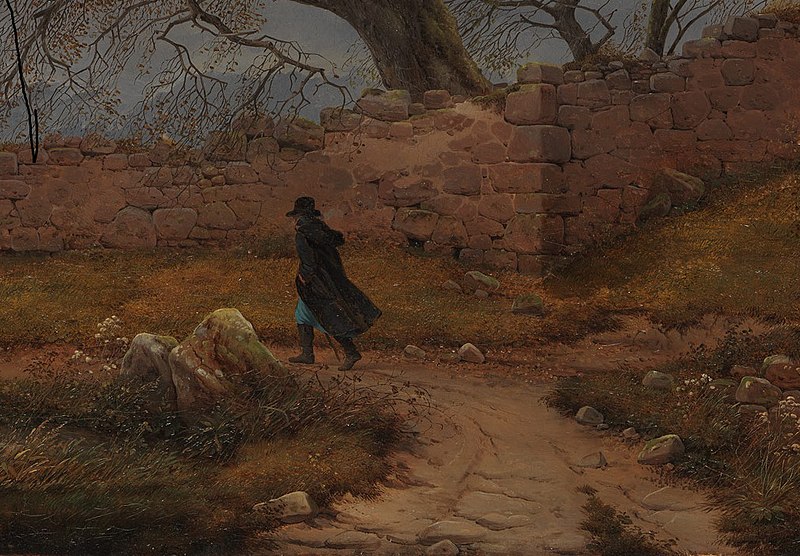
Wanderer in the Storm (1835) by Julius v. Leypold

Book 12 of Poetry and Truth opens with this statement concerning his return from studies in Strassburg to his family home in Frankfurt in August 1771: “The Wanderer had arrived back home at last, more healthy, in better spirits than the last time, but there was about his entire being something unstrung [Überspanntes], which didn't comport with complete mental health [geistige Gesundheit].” The reference here to the "better spirits" contrasts with the physical and mental state he was in on his return from Leipzig in 1768.  He doesn’t mention them here, but a “wanderer” is the subject of two poems from 1772: “Der Wanderer” and “Wanderers Sturmlied.” The poems had their genesis when Goethe was actually on the road a lot, traveling by foot from Frankfurt to Darmstadt, a distance of ca. 19 miles. He refers to the effect of these journeys as contributing to "Beruhigung für mein Gemüt."

The person he went to meet in Darmstadt was Johann Heinrich Merck, who would be an important influence on Goethe, another mentor in the lineage of Behrisch and of Herder. Merck was the military paymaster in the service of the court in Darmstadt, and despite that occupation he was a literary man and critic. It was at the court there that a literary circle had formed, Kreis der Empfindsamen, referring to the German cult of sentimentalism during these years, which took its name from the work Sentimental Journey by Laurence Sterne. Among the members of the circle were three ladies, one of whom was Caroline Flachsland, who was engaged to Herder, and whom Goethe knew in Strassburg. Goethe mentions in his autobiography how much this group nourished his work (belebt und gefördert). He read to them from Shakespeare, and they went on outings during which he recited from his work in progress: Gottfried von Berlichingen. It was this group that bestowed on him the name "der Wanderer," because of what they considered his restless nature.

"Psyche"

He wrote and dedicated three poems to the three ladies in the spring of 1772, of which he mentions not a word in Book 12. In fact, the poems only appeared in print after Goethe's death, in 1835. The one to Caroline (whom he called "Psyche") is entitled "Felsweihegesang." The other two recipients were known as "Urania" and "Lila." Fourteen pages later, he mentions learning after her death many years later that a gentle, gracious woman had secretly harbored an affection for him. At the time he was not aware of her affection, and so was able to be all the more cheerful and charming in her company. Loeper is of the opinion that this was probably Henriette Alexandrine von Roussillon ("Urania"), who died in 1773, and it is she whom Goethe has in mind when Werther speaks of "die arme Leonore!" in the first letter of the novel. Indeed, the language of that letter is pure Empfindsamkeit.

Goethe also doesn't mention in Book 12 the two poems mentioned above in connection with this year of being a "wanderer. (Herewith an English translation of "Der Wanderer"; and here "Wanderers Sturmlied." Sorry I can't find translations for the three Darmstadt-circle poems.) The thrust of the book, however, is to lay the groundwork for the really important work that will appear in 1774, Die Leiden des jungen Werther. Toward the end of the book, recounting his introduction to the so-called Supreme Court in Wetzlar, Goethe introduces two figures who will major roles in Werther, although not by their real names. Instead, der Bräutigam and die Braut. Like der Wanderer, somewhat generic.

I hope in the next post on this subject to discuss book 13 in which he tells the story of the composition of Werther, which at the same time moderates the "subjective" or revelatory nature of the Unruhe that he felt in composing it. As a reward for waiting, below is a photo of the beautiful skies I enjoy on this small island.


Friday, June 17, 2022

Goethe anew


For those of you wondering why Goethe Girl has not been posting, it is true that she came down with the dreaded virus. But that was not the reason there have been no postings since late March. In fact, even with the virus I was able to sit at my desk every morning and work on my current current project (though I admit that food did not appeal to me and that I suffered from fatigue for several weeks when I went outdoors).

The title of the post gives some indication of what I have been working on and that has taken up so much of my time. Goethe, in the preface to his autobiography, Dichtung und Wahrheit (Poetry and Truth), explains his reason for writing. The first edition of his "complete works," in 12 volumes, had appeared in 1805, after which, he claims, a friend had written to him requesting that he offer some insight into those earliest works, that Goethe “rehearse those old productions and treat them anew” (“jenes Hervorgebrachte wieder als Stoff zu behandeln und zu einem Letzten zu bearbeiten”). At a distance of over half a century Goethe may not have had much recall of the specifics of those early efforts, especially before he went to Weimar in 1775. Goethe had the habit of burning letters, and excepting the letters he wrote to his sister Cornelia from Leipzig from 1765 to 1768, he had no access to the correspondence of this period when he undertook the writing of his autobiography. This period, what I called "before Goethe became Goethe," has always interested me; it was the subject of my dissertation.

The article I have been working on for almost a year concerns the way Goethe "rehearsed" his earliest literary works and reworked them anew in the autobiography. Although I don't deal with it in my own article, it has made me suspect that the visit to the shoemaker, recounted in Book 7 of DuW, and that I devoted a blog post to last September, is a total fabrication. Which is not to say that the episode as recounted is solely "Dichtung." Gustav von Loeper, back in 1874 already, wrote that “dichterische Erfindung [kann] nur ein anderer Name sein für Erinnerung” (“poetic invention can only be another name for memory”).

For my research I was very dependent on scholars like Loeper, the first generation of Goethe scholars, who did the legwork, going through archives and tracing all the references, mainly for the purpose of learning about all the influences that had turned Goethe into "Goethe." In the process, of course, they discovered a lot of discrepancies between what Goethe wrote in the autobiography and what "really" happened. I have benefited from such works during the last year, without having to go to the library. Yes, they are all online. Praise be to the Hathi Trust Digital Library.

Here are a few of the long-forgotten scholars whose work I was able to read and who provided "background" on where Goethe "came from," so to speak. They include Elizabeth Mentzel, who wrote about the "home schooling" of Goethe and his younger sister:  Wolfgang und Cornelias Lehrer: Ein Beitrag zu Goethes Entwicklungsgeschichte (Leipzig 1909). Heinrich Pallmann published a book on Goethe's childhood friend Johann Adam Horn: Johann Adam Horn: Goethes Jugendfreund (Leipzig, 1908), from which you can glean the kind of poetry Goethe himself wrote before he went to Leipzig at the age of sixteen. And all that can be discovered about Kätchen Schönkopf is to be found in Kätchen Schönkopf : eine Frauengestalt aus Goethes Jugendzeit Leipzig, 1920) by Julius Vogel. The image at the top is from Vogel's book on Goethe's Leipzig poetry, from the hand-copied production of Goethe's collection "Annette" by Ernst Wolfgang Behrisch in August 1767.

And of course I went through all the volumes of Der Junge Goethe, edited by Hannah Fischer-Lemberg. There is still wonderful stuff to be gleaned about Goethe.

Tuesday, March 29, 2022

The beginnings of "Iphigenie"


Over a month has passed without a posting on Goethe, which doesn't mean that Goethe Girl has been neglecting Goethe. Indeed, I am wrapping up an article on an early book of Dichtung und Wahrheit that I hope to show soon to the world. It has taken up all my energies for the past several months. I wish I could be as multifaceted as Goethe. A couple of posts back I wrote of how industriously he was stepping into his role as a councilor at the Weimar court, for instance, heading the War Commission, which in turn led to two weeks of travel, from March 2, 1779, to village after village in the duchy in connection with military recruitment. Something he wrote about this task to Charlotte von Stein on March 6 is worth mentioning: the cripples would gladly serve, while the best people are married. (Kein sonderlich Vergnügen bey der Ausnehmung, als die Krüpels gerne dienten und die schönen Leute meist Ehehafften haben wollen.)

Amazingly, it was in this very March of 1779, while he was engaged in this activity, that he began working on his drama Iphigenie. And completed it! In the same letter to Charlotte von Stein, written from the town of Apolda, he writes the following: "Hier will das Drama gar nicht fort, es is verflucht, der König von Tauris soll reden als wenn kein Strumpfwürcker in Apolda hungerte." (The play won't progress here; it is damnable that the King of Tauris should be speaking as if there were no hosier in Apolda starving.) According to his diary, he had finished three acts by March 9.

Writing from Denstedt, he noted in his diary on March 28 that the play was completed. The next day he was in Tiefurt with the sculptor Martin Klauer, to whom he read the play aloud. Goethe really like to read his productions aloud to friends. Back in Weimar in April he was already organizing a performance, which took place on April 6. Goethe played Orest, Knebel took the role of Thoas, and Prince Constantin was Arkas. Iphigenie was of course played by Corona Schröter. In his diary Goethe recorded the positive reception: "gar gute Würkung davon besonders auf reine Menschen."

The play was not truly finished. It was the first version, in prose, and it was not until Rome that it would begin to achieve its final verse form.

Friday, February 25, 2022

Faust illustrations


Arabesques. What does that word conjure up? For me, it is a ballet pose, as in the figures in the margins of the above watercolor drawing by Philipp Otto Runge (1777–1810). (Click on images to enlarge.) But it also refers, according to Wikipedia, to “a form of artistic decoration consisting of surface decorations based on rhythmic linear patterns of scrolling and interlacing foliage, tendrils or plain lines, often combined with other elements.” In is in that pictorial sense that it is used in an article by distinguished Goethe scholar David Wellbery, which concerns illustrations of Goethe’s Faust drama by the painter Peter von Cornelius (1783–1867). Since I finished rereading the “Urfaust” this past week, it struck me as a good subject for a post. 

One can imagine that a form so playful and frivolous as the arabesque would have appealed to the "young" Goethe, but Professor Wellbery's article reveals the expansion of Goethe’s aesthetic interests in new directions well into the 19th century. His article appeared in a volume that has just appeared: Arabesque without End. Across Music and the Arts, from Faust to Shaharazad (edited by Anne Leonhard and now available from Routledge). So, consider the following a first review, though in Goethe Girl’s own fashion.

Goethe, it turns out, was not unfamiliar with the aesthetic potential of the arabesque. Wellbery writes that the “meandering, nonconceptual character” of the arabesque had even captured the attention of Kant, disclosing, as it did, a “terrain of aesthetic experience where an unfiltered imagination could exercise itself as ‘play.’” Kant was thinking of wallpaper designs, mollusk shells, vegetal motifs, and the like. Goethe wrote a short piece on arabesques during his stay in Italy, in which he discussed wall decorations from Pompeii, vault paintings in the Vatican Palace by Raphael, and Raphael’s wall decoration for a private home in the park of the Villa Borghese. Goethe noted the “gaiety, frivolity, and delight in ornamental forms,” celebrating “joy, living, and love.”

In May 1811, through through the mediation of Sulpiz Boisserée, Goethe was introduced to a series of six pen-and-ink drawings in the arabesque manner by Cornelius, illustrating scenes from Faust. Goethe had of course given thought to the difficulty, “the sheer improbability of justly rendering verbal action [the Faust drama] as artistically convincing pictorial arrangement.” Schiller and Goethe’s classical “Kunstprogramm” was over. Whatever his irritations with the Romantic artists, his interest in the pictorial potential of the arabesque was piqued.

Before getting around to Cornelius’s illustrations, Wellbery discusses the above-mentioned Runge, whose work brings out the pleasing character of the arabesque. To my eyes, the sinuosity of Runge’s depictions of The Times of the Day (go here for images of the series) matches my sense of what an arabesque is: ballet again. The subjects of Runge’s engravings in the Times series are framed, setting them off in a realm of their own, outside the real world, increasing the “art” potential. In fact, Runge seems to have liked the frame, as can be seen in the wonderful watercolor of the hunt.

I was surprised to read that Goethe, before seeing Cornelius’s illustrations, “had not conceived the [Faust] play as rooted in a particular historical locale” But because of Goethe’s suggestion to Cornelius to study “the artistically created world” of such painters as Albrecht Dürer, illustrations of the drama would henceforth be set in the late medieval German world.  (I am omitting here Wellbery’s discussion of Goethe’s notion of artistic imagination and of “transfigured artistic subjectivity.”) Goethe mentioned his admiration to Cornelius of the  marginal decorations by Dürer that accompanied the so-called Prayer Book of Maximilian I of 1513. Cornelius took the hint, and the title page of the resulting Bilder zu Goethe’s Faust “simulates” Dürer’s  blending of script and picture in the prayer book. At bottom left on that page, Cornelius has set Faust in his study, while on the right can be seen Gretchen and her mother examining the contents of the box that Mephisto has secreted in Gretchen’s cupboard.


This is followed by 11 scenes from the play, including the scene of "Faust mit Gretchen, Mephistopholes mit Marthe im Garten." A  preliminary drawing — maybe Goethe saw something like the sketch above left? — shows the lithesome, decorative aspect of the arabesque, to which has been added, in the final production, the “story” elements: the garden scene that animates the alternating dialogue between the two parties.

After receiving a letter from Goethe in support of his project, Cornelius headed for Italy to seek the inspiration necessary for the final installments of the series. Italy? Really? I would like to have known more about the inspiration Cornelius found there for representing the medieval German world.


What can one make of the final image in the series? As Wellbery writes: “In its depiction of an angel descending to answer the anguished Gretchen’s prayer, the last-mentioned illustration diverges more radically from Goethe’s text than any other in the entire suite.” Wellbery doesn’t make too much of Cornelius’s religious attitudes, only mentioning the influence of the “Nazarenes,” who were a group of “religiously motivated artists.” And, yet, what a sense of drama there is in the attitudes of Faust, Mephisto, and the horse, the rendering of urgency in the gesture of Mephisto pulling at Faust’s robe, or of Faust, his body twisted in two directions, his legs ready to run away, while his right arm reaches beseechingly toward Gretchen, whose posture is one of rejection. The angel behind her is a little too much in the way of "story." Sometimes less is more.

When I started writing my dissertation on Goethe, other graduate students (not in German) would ask me whether everything hadn't already been written about Goethe. David Wellbery shows us anew that there is always something to be discovered about Goethe and especially the influence his works have exercised on the imagination of artists.

Image credit (Runge): Meisterdrucke