Tuesday, March 29, 2022

The beginnings of "Iphigenie"


Over a month has passed without a posting on Goethe, which doesn't mean that Goethe Girl has been neglecting Goethe. Indeed, I am wrapping up an article on an early book of Dichtung und Wahrheit that I hope to show soon to the world. It has taken up all my energies for the past several months. I wish I could be as multifaceted as Goethe. A couple of posts back I wrote of how industriously he was stepping into his role as a councilor at the Weimar court, for instance, heading the War Commission, which in turn led to two weeks of travel, from March 2, 1779, to village after village in the duchy in connection with military recruitment. Something he wrote about this task to Charlotte von Stein on March 6 is worth mentioning: the cripples would gladly serve, while the best people are married. (Kein sonderlich Vergnügen bey der Ausnehmung, als die Krüpels gerne dienten und die schönen Leute meist Ehehafften haben wollen.)

Amazingly, it was in this very March of 1779, while he was engaged in this activity, that he began working on his drama Iphigenie. And completed it! In the same letter to Charlotte von Stein, written from the town of Apolda, he writes the following: "Hier will das Drama gar nicht fort, es is verflucht, der König von Tauris soll reden als wenn kein Strumpfwürcker in Apolda hungerte." (The play won't progress here; it is damnable that the King of Tauris should be speaking as if there were no hosier in Apolda starving.) According to his diary, he had finished three acts by March 9.

Writing from Denstedt, he noted in his diary on March 28 that the play was completed. The next day he was in Tiefurt with the sculptor Martin Klauer, to whom he read the play aloud. Goethe really like to read his productions aloud to friends. Back in Weimar in April he was already organizing a performance, which took place on April 6. Goethe played Orest, Knebel took the role of Thoas, and Prince Constantin was Arkas. Iphigenie was of course played by Corona Schröter. In his diary Goethe recorded the positive reception: "gar gute Würkung davon besonders auf reine Menschen."

The play was not truly finished. It was the first version, in prose, and it was not until Rome that it would begin to achieve its final verse form.

Friday, February 25, 2022

Faust illustrations


Arabesques. What does that word conjure up? For me, it is a ballet pose, as in the figures in the margins of the above watercolor drawing by Philipp Otto Runge (1777–1810). (Click on images to enlarge.) But it also refers, according to Wikipedia, to “a form of artistic decoration consisting of surface decorations based on rhythmic linear patterns of scrolling and interlacing foliage, tendrils or plain lines, often combined with other elements.” In is in that pictorial sense that it is used in an article by distinguished Goethe scholar David Wellbery, which concerns illustrations of Goethe’s Faust drama by the painter Peter von Cornelius (1783–1867). Since I finished rereading the “Urfaust” this past week, it struck me as a good subject for a post. 

One can imagine that a form so playful and frivolous as the arabesque would have appealed to the "young" Goethe, but Professor Wellbery's article reveals the expansion of Goethe’s aesthetic interests in new directions well into the 19th century. His article appeared in a volume that has just appeared: Arabesque without End. Across Music and the Arts, from Faust to Shaharazad (edited by Anne Leonhard and now available from Routledge). So, consider the following a first review, though in Goethe Girl’s own fashion.

Goethe, it turns out, was not unfamiliar with the aesthetic potential of the arabesque. Wellbery writes that the “meandering, nonconceptual character” of the arabesque had even captured the attention of Kant, disclosing, as it did, a “terrain of aesthetic experience where an unfiltered imagination could exercise itself as ‘play.’” Kant was thinking of wallpaper designs, mollusk shells, vegetal motifs, and the like. Goethe wrote a short piece on arabesques during his stay in Italy, in which he discussed wall decorations from Pompeii, vault paintings in the Vatican Palace by Raphael, and Raphael’s wall decoration for a private home in the park of the Villa Borghese. Goethe noted the “gaiety, frivolity, and delight in ornamental forms,” celebrating “joy, living, and love.”

In May 1811, through through the mediation of Sulpiz Boisserée, Goethe was introduced to a series of six pen-and-ink drawings in the arabesque manner by Cornelius, illustrating scenes from Faust. Goethe had of course given thought to the difficulty, “the sheer improbability of justly rendering verbal action [the Faust drama] as artistically convincing pictorial arrangement.” Schiller and Goethe’s classical “Kunstprogramm” was over. Whatever his irritations with the Romantic artists, his interest in the pictorial potential of the arabesque was piqued.

Before getting around to Cornelius’s illustrations, Wellbery discusses the above-mentioned Runge, whose work brings out the pleasing character of the arabesque. To my eyes, the sinuosity of Runge’s depictions of The Times of the Day (go here for images of the series) matches my sense of what an arabesque is: ballet again. The subjects of Runge’s engravings in the Times series are framed, setting them off in a realm of their own, outside the real world, increasing the “art” potential. In fact, Runge seems to have liked the frame, as can be seen in the wonderful watercolor of the hunt.

I was surprised to read that Goethe, before seeing Cornelius’s illustrations, “had not conceived the [Faust] play as rooted in a particular historical locale” But because of Goethe’s suggestion to Cornelius to study “the artistically created world” of such painters as Albrecht Dürer, illustrations of the drama would henceforth be set in the late medieval German world.  (I am omitting here Wellbery’s discussion of Goethe’s notion of artistic imagination and of “transfigured artistic subjectivity.”) Goethe mentioned his admiration to Cornelius of the  marginal decorations by Dürer that accompanied the so-called Prayer Book of Maximilian I of 1513. Cornelius took the hint, and the title page of the resulting Bilder zu Goethe’s Faust “simulates” Dürer’s  blending of script and picture in the prayer book. At bottom left on that page, Cornelius has set Faust in his study, while on the right can be seen Gretchen and her mother examining the contents of the box that Mephisto has secreted in Gretchen’s cupboard.


This is followed by 11 scenes from the play, including the scene of "Faust mit Gretchen, Mephistopholes mit Marthe im Garten." A  preliminary drawing — maybe Goethe saw something like the sketch above left? — shows the lithesome, decorative aspect of the arabesque, to which has been added, in the final production, the “story” elements: the garden scene that animates the alternating dialogue between the two parties.

After receiving a letter from Goethe in support of his project, Cornelius headed for Italy to seek the inspiration necessary for the final installments of the series. Italy? Really? I would like to have known more about the inspiration Cornelius found there for representing the medieval German world.


What can one make of the final image in the series? As Wellbery writes: “In its depiction of an angel descending to answer the anguished Gretchen’s prayer, the last-mentioned illustration diverges more radically from Goethe’s text than any other in the entire suite.” Wellbery doesn’t make too much of Cornelius’s religious attitudes, only mentioning the influence of the “Nazarenes,” who were a group of “religiously motivated artists.” And, yet, what a sense of drama there is in the attitudes of Faust, Mephisto, and the horse, the rendering of urgency in the gesture of Mephisto pulling at Faust’s robe, or of Faust, his body twisted in two directions, his legs ready to run away, while his right arm reaches beseechingly toward Gretchen, whose posture is one of rejection. The angel behind her is a little too much in the way of "story." Sometimes less is more.

When I started writing my dissertation on Goethe, other graduate students (not in German) would ask me whether everything hadn't already been written about Goethe. David Wellbery shows us anew that there is always something to be discovered about Goethe and especially the influence his works have exercised on the imagination of artists.

Image credit (Runge): Meisterdrucke

Sunday, January 30, 2022

Goethe gets serious

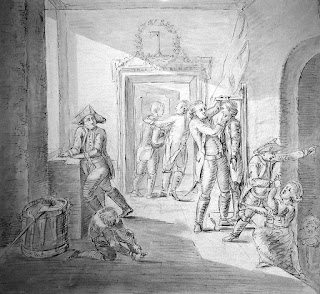
Recruitenauslesung in Buttstädter Rathaus (1779)

Indeed, it was in 1779 that Goethe, as a member of Carl August's council, really began to settle into the role of minister. As I mentioned in the last post, by the end of 1778 the demand of Prussia for soldiers led to a fraught political situation for Weimar, which led to Goethe’s appointment as chairman of the War Commission. In that appointment he replaced long-standing minister Jacob Friedrich Freiherr von Fritsch, who appears to have been one of the truly unassailable bureaucrats, which is shown by his appointment to the Secret Council in 1762, when he was only 29 years old. Effi Biedrzynski, in her book Goethes Weimar, has a nice try on von Fritsch, who naturally took it amiss when the youngster Goethe became one of the duke’s ministers and, later, when Goethe superseded him as head of the War Commission.

Goethe’s diary entries  for February 1779 are not the short, terse ones of preceding months; which I was able to Tweet. They include somewhat longer ruminations and self-assessment. For instance, the entry for Feb. 1, by which time the Prussian situation had become more serious, mentions “Conseil,” and then “Dumme Luft drinne, fataler Humor von Fr.” So, evidently Fritsch was not in a good mood. Moreover, Goethe writes that the duke talked too much at the session. They later met and Goethe advised him not to talk so much, to moderate his expression, and not to get into a heated discussion concerning matters that should not be addressed. But Goethe also adds some self-assessment, indicating a resolve to make the best of what he calls the “Militarischen Makaronis.” “Die Kr. Comm. werd ich gut versehen weil ich bey dem Geschäfft, gar keine Immagination habe, gar nichts hervorbringen will, nur das was da ist recht kenne, und ordentlich haben will.” Later in the month, sometime after Feb. 14, he writes: “Diese Zeit her hab ich meist gesucht mich in Geschäfften auf recht zu erhalten und bey allen Vorfällen fest zu seyn und ruhig.”

Hogarth, English Military Recruitment (1765)

Indeed in February and March Goethe reflects a lot on the work he has to do. Interestingly, there is no mention in the February entries of the letter that was discussed in the last post, which, according to Schöne, must have kept him up half the night composing. At the end of February, we begin to see how busy his official duties keep him. On February 26 and until the middle of March, he  traveled from one town to the next — Jena, Dornburg, Apoda, Buttstädt, Allstädt, and Ilmenau — on a recruitment tour (Auslesung der Mannschaft) for the duchy’s soldiery. As Nicholas Boyle writes, this activity took place in “a succession of draughty town halls and unoccupied castles … measuring heights and listening to excuses from the fit and newly married and pleas for admission by the sickly and unemployed.” And in between Goethe dictated the first three acts of the prose version of Iphigenie!

The drawing at the top of the post, made by Goethe during the days on the road, is traced bz Schöne to a scene by Hogarth, which Goethe is likely to have seen, and which, in much more satirical form, shows the recruitment and measurements of soldiers outside an English village inn.

Images: (Goethe-Nationalmuseum Weimar; Kunstsammlung Staats- und Universitätsbibliothek Göttigen

Tuesday, January 18, 2022

Goethe as Minister of War Commission


This post is a follow-up to the previous one, concerning Goethe’s appointment as director of the Weimar “War Commission,” in particular the letter he drafted for Carl August in connection with demands made on Weimar by Frederick the Great for permission to harvest soldiers in the duchy for his army. Goethe's diary entries for this period are very illuminating. I would have Tweeted them, but they are too long, so I will instead quote here his reaction, in his diary, to his appointment and to his duties. One is dated January 13, 1779; a second “from 14th til the 23”; and a third one January 30. The appointment and the responsibility seem to have brought him to more personal considerations, which can also be seen in the long diary entries for the following months of February and March. One sees in these entries Goethe speaking in lapidary manner, which may be the start of the “quotable Goethe.” He also seems to undertaking some self-assessment.


January 13 notes, in connection with the first session of the Commission, that he is “Fest ruhig in meinen Sinnen, und scharf.” The pressure of the tasks is not unpleasant at all, which leads to the following: “Elender ist nichts als der Behagliche Mensch ohne Arbeit, das schönste der Gaben wird ihm eckeln.” (Nothing is more sordid as a contented man without work; the best gifts will revolt him.)  He refers to the difficulty of activating and maintaining the “Earthly machine.” For an active person (einen Handelnden), past history is not a guide, nor textbooks. Likewise prayers, except one for wisdom, a gift that the gods have denied humans. And then: “Klugheit theilen sie aus, dem Stier nach seinen Hörnern und der Kazze nach ihren Klauen, sie haben all Geschöpfe bewaffnet.” (All creatures have been armed, the bull with its horns, the cat with its claws.)

The following  entry (Vom 14 bis 25) mentions that he has immersed himself in the documents and that the matter is becoming clearer: the appearance in Weimar of the Prussian courier Reinbaben and the issue discussed in the previous post, namely, the Prussian demands and the courses open to Weimar, which will then be elaborated in the February 9 letter to Carl August. Among all this is only a single lament: “Wenig auf dem Eis!”

To be continued.

Friday, January 7, 2022

Goethe as Political Advisor

Friedrich and Feldherr Bernhard Rode

This post continues the subject of the preceding one, namely, Goethe’s acculturation to life in Weimar to the point where, as Herder would write in 1782 to Hamann, he was majordomo of the court: “Er ist also jetzt Wirklicher Geheimer Rat, Kammerpräsident, Präsident des Kriegscollegi, Aufseher des Bauwesens bis zum Wegbau hinunter, dabei auch Directeur des Plaisirs, Hofpoet, Verfasser von schönen Festivitäten …” etcetera etcetera.

It was in that year of 1782 that Goethe was tasked with overseeing the “household finances” of the duchy. This good bourgeois son of Frankfurt — even if now Geheimrat — would introduce many reductions, including in military expenditures. It’s strange now to think of a duchy as small as Weimar having a standing army, even if much of it consisted of poorly trained part-timers, and regular troops who performed guard duty at bridges and gates and the workhouse.

Albrecht Schöne

Albrecht Schöne (96 this year!) devotes a chapter of his book Der Briefschreiber Goethe to his appointment at the age of twenty-nine, in 1779, as director of the War Commission, replacing the very much senior von Fritsch in that capacity. I should say at this point that Albrecht Schöne is a Goethe scholar from whom I have learned a lot. I was fortunate to review this book a few years ago for the Goethe Yearbook. Its nine chapters treat individual letters written by Goethe, from the earliest in 1764 to Ludwig Ysenburg von Bari, to one written in the final year of his life, 1832, to Wilhelm von Humboldt. Each chapter includes the full text of the letter. The one discussed here was written to Carl August in February 1779.

Archduke Joseph by Georg Decker

Already in late 1778, in Schöne’s account, Weimar was under pressure to supply troops for Prussia’s military excursus (Auseinandersetzung) against Austria: the War of the Bavarian Succession (so-called Potato War). The Prussians were determined to stop the ambitions of Josef II for Habsburg expansion into Central Europe. A certain Lieutenant von Rheinbaben, emissary of General von Moellendorff, visited von Frisch in early December 1778 requesting permission to recruit soldiers in the duchy for Prussia (theils einige Recruten, theils die Erlaubniß, in den hiesigen Landen zu werben). Von Fritsch responded negatively (mit einem entschieden abwehrenden Schreiben), on the grounds of insufficient men fit for service.

The Prussians were not to be put off, and another emissary of the Prussian king arrived at the end of the month, who was likewise rebuffed. The situation became increasingly threatening by January 1799, when young Weimar males were press-ganged by Prussian hussars or kidnapped as alleged Prussian deserters. Moellendorf wrote again, expressing the king’s “deep consternation” that von Fritsch had not presented the duke with the king’s most amicable and ardent request, namely, to be allowed some recruits (Ersuchen einiger Rekruten auf das freundschaftlichste, aber inständigste, nochmahlen zu widerholen). So it went, with Carl August declining and the king, Frederick the Great, replying in a tone that was “ruthlessly conciliatory” (mit knocheharter Konzilianz).

Part of the problem for Weimar was that if the Prussians were granted this request, Austria would take it amiss and might invade. The duke had to respond to the king. What was his course of action to be? So, in this increasingly threatening situation, Goethe drafted a letter on February 9, 1779, addressed to Carl August —  “Gnädigster Herr” — outlining the courses of action open to the duke. Schöne reproduces the text of the letter and analyzes it in great detail, including grammatically. The main interest here, however, is Goethe as a political advisor.

Goethe begins by writing that one (he always use “man” here, meaning Carl August) has to weigh two unpleasant courses of action against the other (beyde unangenehme Seiten gegenwärtiger Lage … natürlich gegen einander stellen)  in order to calculate the options open to Weimar, without emotional exaggeration while appraising the facts on the ground (ein sachlich abwägedendes Kalkül ziehen und sich dann ohne emotionale Übertreibungen die eigenen Optionen vor Augen führen, also Weimars Handlungsspielräume anloten).

Entscheidungstheorie

It is in this carefully constructed letter that one comes to appreciate how much Goethe actually learned from his father and from his studies of the law, however much he dismissed them. The duke, after all, only twenty-one years of age, was dealing, with Great Powers: Prussia and Austria. It shows how much he depended on Goethe already, asking his counsel, and not only that of the older and experienced von Fritsch.  Schöne refers to the letter as “ein meisterliche[s] Lehrstück strategischen Denkens.” The seven-page letter, drafted overnight, was not only an example of princely education in the age of enlightened absolutism, but, for Schöne, it also represents a textbook example of political advice. To provide a larger overview, Schöne includes a tree diagram (in Anlehnung an Darstellungsweisen der Entscheidungtheorie) that lays out the pros and cons of the two options (one regarding Prussia, the other Austria). Represented here is only the former, with P representing Prussia and W Weimar. The numbers in parens refer to lines of the letter. (Click on image to enlarge.)

The contents of the letter is of course something we expect “professionals” to consider when advising clients. In the end the letter had no consequences, as the political situation calmed down. Schöne makes the point that the letter was a letter meant privately for the duke. It makes no reference to earlier secret discussions of the Commission concerning the matter at hand, and is not found in Goethe’s “amtliche Schriften,” but instead in Carl August’s cache of private letters from Goethe.

Tuesday, December 21, 2021

Year Four in Weimar Begins

Goethe and Carl August in conversation

Wilhelm Bode, in his book Goethes Leben im Garten am Stern, notes at the beginning of the chapter entitled "Das vierte Jahr: November 1778 to November 1779" a change in the circumstances of Goethe's status in Weimar. He begins by writing that three years earlier the consensus in Weimar would have held that Goethe was not qualified to occupy the office of privy councilor. By the end of 1778, however, his friends might have asked whether he wasn't too great and too good (zu groß und zu gut) for the job. His tasks, as he writes, were to deal always with petty men with petty goals. And indeed, in the month of December 1778, Goethe gives voice in his diary to his feelings about the office. The entries are so long that I gave up Tweeting  them and have decided to summarize here some of his thoughts in the final days of 1778. They show him coming to terms with the new situation. He is coming down to Earth after having been regarded as a "Genie" and realizing what he has got himself into.

On December 14, for example, after reporting about a fire at the school, he mentions a conversation with Carl August about "politics and laws" (Pol. und Gesezze) and notes that they had different notions about the matters. He continues that he may not speak his own opinions. They would be easy to misunderstand and might then be dangerous. There then follows a passage in which he reflects on the difficulty of bettering incorrigible human evils and circumstances. (Paste in Google translate, if necessary.)

[man] verliert die Zeit und verdirbt noch mehr statt dass man diese Mängel annehmen sollte gleichsam als Grundstoff und nachher suchen diese zu kontrebalanciren. Das schönste Gefühl des Ideals wäre wenn man immer rein fühlte warum man's nicht erreichen kann.

On December 15 he writes that he is spending time in architectural drawing in order to distance himself. Then there follows an interesting comment. It seems that while speaking with his friend Knebel about society's disorders (Schiefheiten). the conversation came to a discussion of how his own situation looked from outside. "From outside," he emphasizes, then goes on:

Wenn man mit einem lebt soll man mit allen eben, einen hört, soll man alle hören. Vor sich allein ist man wohl rein, ein andrer verrückt uns die Vorstellung durch seine, hört man den dritten so kommt man durch die Parallaxe wieder aufs erste wahre zurück.

With only the evidence of the diary, it is hard for me to say (although maybe a reader will have a different take on this) whether he is indicating what Knebel has said, or whether this last is Goethe speaking his own opinion. What follows, however suggests that Knebel is giving him some insights into the situation of the privy council itself, as von Fritsch, who was not happy when Goethe was elevated to the council, is mentioned.

The entries for 1778 conclude with this lapidary sentence: "New grievances grow daily and never more so than when you think one has been taken care of" (Es wächsen täglich neue Beschwerden, und niemals mehr als wenn man Eine glaubt gehoben zu haben).

Image credit: Goethe Was Here

Saturday, December 4, 2021

Goethe as Thinker? Goethe as Scientist?


To what extent do the above terms apply to Goethe? Consider the first. It can’t be denied that Goethe was a thinker in the sense of a person who did a lot of thinking. The proof is in his writings, as well as in reports of conversations with contemporaries. But if we consider some of the thinkers of his age and the influence they had during their lifetime — e.g., Kant, Hume, Voltaire, Rousseau, Diderot — Goethe cannot be said to have belonged in such company.  Kant and Hume were both philosophers and created philosophical systems, while the influence of the three Frenchmen was in the realm of ideas in the service of contemporary social and political life. In his lifetime Goethe came to occupy an important cultural and literary position, but he wasn’t a “thinker” in that class. It was only after his death in 1832 that he was portrayed as oracular, when he began to be regarded as an important thinker, but the content of the oracles has been changeable. “Goethe, for instance, can’t be pinned down the way one can “Kafkaesqe” or “Orwellian.”

Goethe’s scientific interests were in the field of natural science, which encompassed fields we today identify as botany, geology, paleontology, zoology, and so on. In monasteries in the Middle Ages there was already extensive collections of plants, and this continued in the Renaissance with scholars documenting animal, insects, plant life and all manner of earth forms. Some important natural scientists in Goethe's lifetime were the Count de Buffon, Charles Bonnet, and Albrecht Haller. One of the greatest natural scientists of Goethe’s era was his friend Alexander von Humboldt. As Wikipedia puts it, natural science is less experimental than it is observational.


Goethe had use of laboratories for his scientific researches, including that of the well-established one at the court in Gotha, where he was a favored visitor. But for Goethe, the eyes were important, the perception of what was before our eyes, not the “unseen” elements that make up the building blocks of modern-day science. “Gegenständliches Denken” was his own term for describing his intellection. Thus, the difference between natural science and what have become the modern scientific disciplines of chemistry, physics, biology, mathematics, and their continuing branchings and flowerings into the present. Goethe was adamantly opposed to what is called such “system building,” and thus immediate predecessors in respect of science were not Euler, Lavoisier, Herschel, or Priestly. Instead, Goethe is part of a long and venerable transmission that includes such observers as Aristotle and extending to Charles Darwin and beyond. 

There are dozens of articles on the internet regarding Goethe as a scientist, so the above is as minimal as I can make things.

The questions in the title of this post are prompted by two recently published articles by Michael Saman, one in the Goethe Yearbook (vol. 27 [2020]), the second in German Quarterly (vol. 94, 4 [2021]). Saman quotes Tzvetan Todorov to the effect that while “Goethe himself had expected his scientific writings to have their most lasting impact on the study of nature, they instead ‘have fallen into oblivion’ in that area, and, ‘since the 1920s, [...] have found an ever-increasing echo among literary scholars, psychologists, and anthropologists, such that one could say that out of all of Goethe’s intellectual legacy, it is precisely his writings on nature that have most strongly influenced the specialists in culture!” Thus, Goethe as thinker.

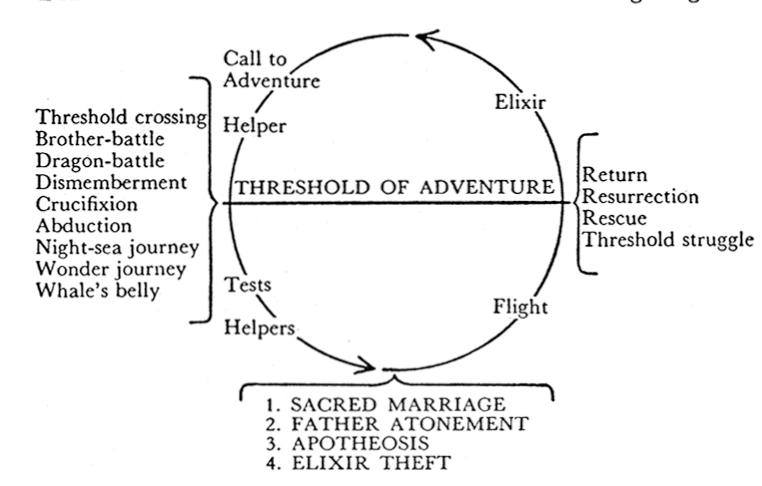
Saman investigates this influence on the discipline of “social science,” in particular in the work of Claude Lévi-Strauss and Vladimir Propp. Lévi-Strauss is best known for his studies in anthropology, and Propp for his work on folklore. And while both these men assembled amazing collections of empirical data, just as do practitioners of natural science, it is not from the tangible bones of the earth and the flowers of field. It is human behavioral practices that constitute the “data.”


While Saman stresses that Lévi-Strauss, like Goethe, had no interest in being a philosophical thinker, the “science of the concrete” that unites them still uses the word science if science means ultimate the representation of something abstract, say, types. Propp, who knew Goethe’s scientific writings well, also spoke of “laws” that were equally valid for the realms of nature and human creativity and “that can be investigated with similar methods.” In Lévi-Strauss we are dealing with what has become known as “structuralism,” whereas Propp’s method is “formalism.” Both present, not “a mere descriptive catalogue of so-called facts” (Saman quotes sociologist Sverre Holm here who calls Goethe a model for social science) but also “types,” “structures” and the like, which are not visible to the naked eye.  Goethe, after all, in his botanical research, sought to discern “the relations that unify” the facts on the ground.

Saman’s articles are well written (distinguishing them from much scholarly writing) and I liked reading his attempt to distinguish structuralism and formalism and the account of the scholarly feud between Lévi-Strauss and Propp. For my part, I have always found structuralism off-putting — I find it ultimately abstract — whereas Propp’s system strikes me as a literary scholar as intuitively of interest. I feel the same way of a similar proponent of formalism, André Jolles, to whom I earlier devoted a blogpost. Reading traditional tales with Propp or Jolles in mind, I find that the reading is enriched.

As I mentioned in my review in the Times Literary Supplement of a book by Stephen Bollmann, there is much interest of late in the “Green Goethe,” I think it is more apt to place Goethe here in the domain of natural science. So, in that respect there can be no doubt that Goethe qualifies as both thinker and scientist.

Image: Semantics Scholar