Sunday, November 28, 2021

Goethe Is Everywhere


The Goethe Global project is something I should have posted on long ago, but things have piled up so much that I haven't posted at all for over a month. Several months ago I was contacted by "The Goethe Global Team," which announced the creation of a new website in order to raise Goethe’s popularity among English speakers worldwide. Further, "On the website, we provide Goethe quotes in English, often newly translated, with the German original and the exact source. In addition, we link to free versions of some of Goethe’s works in English and to online resources about Goethe in English."

After some back and forth I agreed to list the website on my blogroll, but (again, lack of time) did not include a blogpost about it. I think the best way to inform readers of this blog about the site is to provide a link to the blog of Cynthia Haven's website The Book Haven, which tells more about the activities of Tino Markworth and The Goethe Global Team. Cynthia mentions Markworth's other passion: he organized the first international conference on Bob Dylan in 1998 at Stanford, which attracted more than 400 people. If you are looking for Goethe wisdom in English, the categories of translation range from action, advice, aging to world of delusion, writing, and youth.

I've mentioned elsewhere that Goethe turns up in the darndest places, which is why, when I open a scholarly book, I immediately turn to the index. One is often sure to find him there. Here is a link to something found on the internet: the Goethe Project 2021. The intention is to read Goethe's works in English in 2021. It is late in the year, but here is a link to the reading schedule. The site was founded by two grad students in Classics at NYU. Bravo.


The last item for today concerns a piece by Edward Luttwak that appeared in the London Review of Books of June 3, 2021, entitled "Goethe in China." Luttwak is of the opinion that the founder of the project to translate "all" of Goethe's works into Chinese must be recruiting "every qualified Chinese Germanist" there is. (How many can there be in China, anyway?) This founder is Wei Mao-ping, dean of the School of Germanic Studies at Shanghai International Studies University. (See link to project here.) Such a project requires lots of financing, and Luttwak writes that a major "paying customer" must be  Xi Junping, "the only world leader who knows Faust by heart." At least, so he boasted to Angela Merkel on meeting her.

This reading experience took place when Xi was being "re-educated" at the age of 15 in rural China, when another teenager in exile lent him a copy of Faust.  The translator was Guo Moruo (1892-1978), "a consciously Faustian character himself, though his own, widely accepted claim was that he was China's Goethe." His exceptional prominence as a poet and scholar and early supporter of Mao might not have saved him during the Cultural Revolution, but, when the Guards came after him, he had a self-critical text ready that declared the counter-revolutionary nature of his earlier writings. He even remained silent when the Red Guards persecuted two of his sons, who later committed suicide in order to avoid further torture.

Luttwak describes the fall from grace of Xi's own father (leading to abuse and imprisonment for 16 years), which apparently did nothing to cause the present Chinese leader to turn against the regime. Something to keep in mind.

Wednesday, October 27, 2021

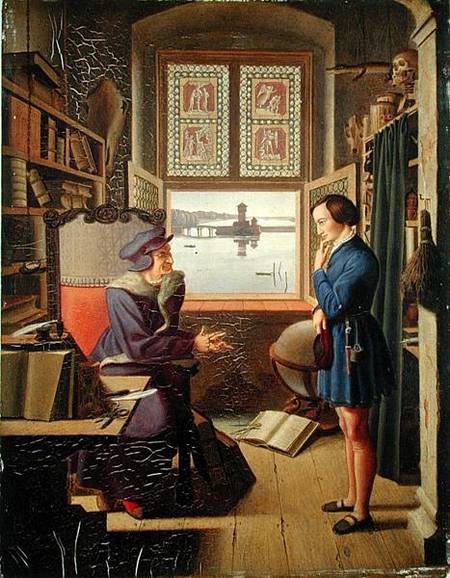
Goethe and Anton Reiser

I am finally getting around to the continuation of the previous post, in which I mentioned what I saw as a connection between Goethe's account of the shoemaker in Leipzig and the account in Anton Reiser of AR's apprenticeship experience. In Goethe's account of his visit to Leipzig, the shoemaker is good hearted and philosophic, a joy to be around. In AR's account, the milliner in his cruelty is Dickensian avant la lettre.

Goethe and the Philosophical Shoemaker

It was not simply that particular contrast that made me think that Goethe had the character of Anton Reiser in mind when he wrote about the shoemaker in Book 8 of Dichtung und Wahrheit. That book, along with the last part of Book 6 and the entire Book 7, concerns Goethe's residence in Leipzig, and in particular his mentors, including the wife of Professor Böhme, Oeser, Behrisch, and even an officer who had fought in the Seven Years' War and to whom young Goethe confided his confusion concerning the nature of "Erfahrung." Each of these individuals was important in some way for Goethe's development. In Anton Reiser, in contrast, Anton also has several mentors who endeavor to assist him to rise from the narrow, impecunious circumstances in which he was raised. In every case, however, good fortune is followed by bad fortune.

What made me bring these two cases into connection was the opening paragraph of Book 9. Goethe is back home Frankfurt, after a less than stellar legal studies in Leipzig. It begins with a quote from a review by the classical philologist Heyne, which seems to sum up the real experience of Leipzig for Goethe. Here is part of the quote:

[W[ir haben eine Einbildiungskraft, der wir, wofern sie sich nicht der ersten besten Vorsellungen selbst bemächtigen soll, die schicklichsen und schönsten Bilder vorlegen und dadurch das Gemüt gewöhnen und üben müssen, das Schöne überall und in der Natur selbst, unter seinen bestimmten, wahren und auch in den feineren Zügen zu erkennen und zu lieben. Wir haben eine Menge Begriffe und allgemeine Kenntinisse nötig, sowohl für die Wissenschaften als für das täglich Leben, die sich in keinem Kompendio erlernen lassen. Unsere Empfindungen, Neigungen, Leidenschaften sollten mit Vorteil entwickelt und gereinigt werden.

Anton Reiser, of course, is never in control of is his imagination, which is always painting pictures of success, whether it be as an actor or a poet. It takes him so far afield that, whenever an opportunity comes his way for betterment, he is so far carried away by the glorioius prospect that his feet seem not to be on the ground. The result is that he ends up being cast down by what he perceives as his failure. The novel is a daunting story of what we might call today manic-depression. What Bodmer wrote of poetic enthusiasm (in his 1727 treatise Von dem Einfluss und Gebrauche der Einbildungskraft) applies to Anton Reiser:

[Sie] jagt die Einbildungs-Krafft in eine ausserordentliche Hitze, und führet den Dichter gleichsam ausser sich selbst, daß er die Einbildungen von den Empfindungen nicht unterscheiden kan, die gerichts von dem Gegenstand, dem wir wircklich, vor dem Gesicht haben, abkommen; sondern meinet er sehe und fühle die Dinge gegenwärtig.

For Goethe, of course, imagination was extremely important, but he had a different personality (to use another modern term) from Reiser. We know that he was occasionally petulant when criticized, but he seems to have been fortunate in being more grounded, so to speak, and was able to take his time, to allow himself to be led by those wiser than himself. As I read on in Der junge Goethe and in the autobiography, this is very apparent in his encounters with men like Herder and Merck.

Anyway, take it as you like. As I wrote in the previous post, one cannot know what was on Goethe's mind when he wrote this account of his early "apprenticeship," but his acquaintance in Rome with Karl Philipp Moritz, author of Anton Reiser, is suggestive of the many influences that affected his writing.

Image credit: AKG images

Saturday, September 4, 2021

Goethe in Dresden

Adriaen van Ostad, The Painter in His Studio

When I have an idea for a blog post, I always imagine it can be accomplished quickly. And, yet, every post on Goethe takes me far afield, because there are so many trails that lead from him or to him. I have a feeling that this will be a two-parter.

Take the case of Goethe’s visit to Dresden in 1768, when he was a student in Leipzig. My original idea for this post came from my recent re-reading of books 7 and 8 of his autobiography, Dichtung und Wahrheit and, in particular the episode of the shoemaker, a relative of a fellow student of Goethe’s in Leipzig. Of all the bad luck, the two pages dealing with that visit are missing in the electronic file of Loeper that I have been reading in conjunction with the autobiography. Trunz, however, in his commentary, asserts that the shoemaker was real, if not the details that Goethe describes concerning his visit and lodgings with the shoemaker. On meeting the man, Goethe engaged with him in a lighthearted conversation that showed the shoemaker to be something of a wit. Goethe felt right at home in this humble dwelling. On his return to the lodgings for lunch after his morning outing to the Dresden gallery, he writes that he could hardly believe his eyes: a scene from a painting by the 17th-century Dutch painter Adriaen Ostade, a scene so perfect that one could imagine it hanging in the gallery itself.

Stellung der Gegenstände, Licht, Schatten, bräunlicher Teint des Ganzen, magische Haltung, alles, was man in jenen Bildern bewundert, sah ich hier in der Wirklichkeit.

 (If necessary, cut and past German quote in Google Translate.)

It’s not known which painting of Ostade Goethe actually saw. Dresden today has lots of paintings by the artist, but I liked the one above, which seems to reflect what might have appealed to Goethe, as per Wikipedia: Ostade “is distinguished from his rivals by a more general use of light and shade, especially a greater concentration of light on a small surface in contrast with a broad expanse of gloom.”

That evening, on returning home near midnight, making his way to his quarters, Goethe again describes the setting in reference to another Netherlandic painter, Godfried Schalken:

Die Türen fand ich unverschlossen, alles war zu Bette, und eine Lampe erleuchtete den enghäuslichen Zustand, wo denn mein immer mehr geübtes Auge sogleich das schönste Bild von Schalcken erblickte, von dem ich mich nicht losmachen konnte, so daß es mir allen Schlaf vertrieb.

Godfried Schalken, Girl Reading a Letter

Again, Wikipedia offers information on the painter that resonates with Goethe's description: "a Dutch genre and portrait painter. He was noted for his mastery in reproducing the effect of candlelight," Further, Schalcken specialized in scenes by candlelight."

In a certain way, this coincidence of Goethe’s visit to the magnificent galleries in Dresden with his meeting with a humble craftsman reminds me of certain experiences I had in my youth when I traveled in Europe and later in Asia. Being a student, I did not have a lot of money and did not stay in grand hotels. At the time of those travels, however, the exchange rate was favorable to Americans. It really was the era when you carried in your backpack a copy of Paris on $5 a day or Asia on a Shoestring. Those days of course are long over, but I often stayed in lodgings like that of the shoemaker and had experiences similar to that of Goethe in Dresden.

It has taken me a while to arrive finally at the idea that initiated this blogpost, namely, that I could not help being struck by the difference between Goethe’s view of a craftsman’s life and circumstances from the experience of Anton Reiser, who spent a couple of years of a really awful apprenticeship with another craftsman, a milliner (Hutmacher) in Braunschweig named Lobenstein. Goethe of course knew Karl Philipp Moritz’s novel, having read portions of it in Rome when he first met Moritz. The description of Reiser’s apprenticeship is contained in the first part of the novel. It is impossible to trace every influence on an artist or a writer, for instance, whether Anton Reiser’s experience inspired the creation of the shoemaker in Dresden. It is not, however, the shoemaker episode itself that makes me suspect a relationship between Goethe’s account here and the "person" of Anton Reiser. As I wrote above, this will be a two-parter, and I will attempt in the next post to strengthen the connection between the episode in Goethe's autobiography and Anton Reiser.

Image credits: Gemäldegalerie Alte Meister

Saturday, August 28, 2021

Happy Birthday, Goethe

Drawing of Gerbermühle by Boisserée

 The Canadian embargo on American visitors was lifted on August 9, and on August 12 Goethe Girl flew to the small island in British Columbia where she has spent almost a decade of summers. She got through the lockdown in New York without major or even minor incidents, but the loss of her visit to B.C. last summer was keenly felt. Since she is staying here only a month, she is restricting herself to one Goethe project, which includes reading some very early scholarship on Goethe’s pre-Weimar years, most of which is online (thus, no need to carry books while traveling). One of these books, a short volume entitled Goethe und Frankfurt am Main: Die Beziehungen des Dichters zu seiner Vaterstadt (published 1876), is by Wilhelm Friedrich Karl Stricker.

Since today, August 28, is Goethe’s birthday, let us quote details from Stricker concerning the festivities for on his sixty-sixth birthday in 1815, which took place at the Gerbermühle, country get-away of the banker Johann Jacob von Willemer and his wife Marianne. There is a prehistory to this visit and Goethe’s acquaintance with Marianne, in whom Goethe, according to Bielschowsky in his biography, discovered his “love nucleus” for the Divan.

In 1814, Goethe had traveled to the Rhine and Main region of his youth. Peace had been restored and he wished to take a cure in Wiesbaden. He had begun work on his Divan. The first word in his travel journal was “Hafiz,” and indeed the journal shows him rejuvenated. It was in September that he went to Frankfurt, his first visit since his mother’s death in 1808. It was there that he met Willemer, a patron of the theater in Frankfurt and with whom he was already acquainted, and Marianne. On October 18 he visited the Willemers at the Gerbermühle. As Stricker writes of the effect of this 1814 visit:  

So flüchtig diese Begegnung war, so nachhaltig waren ihre Folgen; haben wir doch in ihr vielleicht das bestimmende Motiv für die zweite Rheinreise zu suchen.

Johann Jacob Willemer

According to the Wikipedia article on him, Willemer afterward wrote to Goethe and offered him a retreat (something like I enjoy here in British Columbia): “Erholen sie sich doch bald von den Beschwerden des Winters zu Weimar an den Ufern des Mains. Sie könnten ja die Vor-Kur zu Oberrad einleiten und bei uns auf der Mühle wohnen.”

And so in 1815 Goethe traveled for the second time to the Rhein and Main region, staying in the Gerbermühle from the end of May until past the middle of July. He undertook other travels while in this region, for instance, revisiting the Roman antiquities in Mainz, which he had seen before leaving to study in Strassburg decades earlier, and he also was in contact with Sulpiz Boisserée, with whom he had spent time the previous year studying his collection of medieval art. It was with Boisserée that he returned in August 1815 to the Gerbermühle. The evening of August 27 began a grand birthday celebration, arranged by Boisserée, Here is Boisserée’s account (I, 271), quoted by Stricker:

Die Familie Willemer, Herr Scharf und seine Frau, Fritz Schlosser, der Kastenschreiber Riese, und Seebeck sind schon mit dem alten Herrn beim Frühstück versammelt.  Das große Gartenhaus war ganz mit Schilf ausgeziert, wie Palmenbäume zwischen den Fenstern gebunden, oben überhängend. An der hinteren Wand, wo der Alte saß, war ein großer Spitzschild von Laubkränzen angebracht, darinnen ein runder Kranz von Blumen, nach der Farbentheorie geordnet.

The ladies of the house, who included Marianne and the daughter of her husband, presented Goethe with baskets, one containing beautiful fruits, the other gorgeous flowers, mostly foreign. On the basket was a turban of the finest Indian muslin, garlanded with a laurel wreath: “alles in Anspielung auf seine jetzige Liebhaberei für die orientalische Poesie, besonders weil auch unter seinen Gedichten ein großes Lob des Turbans vorkommt.”


Willemer toasted Goethe’s health with a 1748 Rhine wine. There is much more in the account, with birthday greetings and visitors pouring in from all sides. It is somewhat sad to see Goethe referred to as “der Alte.” I wonder what he made of such veneration. He was probably used to it by this time. The mill in any case turned out to be a good place to work on the Divan, which he continue to do mornings until September 15, while spending evenings with Marianne exchanging verse.

Among the above-mentioned personalities at the birthday party, two might be noted: Johann Jacob Riese, Goethe’s childhood friend and one of the few from his early years with whom he maintained a lifelong connection; and Johann Thomas Seebeck, a physicist who worked with Goethe on his color theory.

Speaking of the Rhine/Main region, I would like to add that Goethe, during his travels there in 1814, also visited Winkel, the country seat of Peter and Antonie Brentano, spending eight days visiting the Rheingau. It turns out that Goethe Girl herself was in Winkel 213 years later. See my post “Goethe in Rheingau,” which has some details of Goethe’s comments on his visit there. The photo of Goethe Girl with the bottle of “Goethe Wine” was taken at the nearby Schloß Vollrads.

Image of Willemer from 1793 by Joseph Nicolaus Peroux

Friday, July 23, 2021

Goethe and the literary inheritance


Francis Daniel Pastorius
This post is an expansion of the previous one.

There is current among literary scholars to interpret earlier writers in terms of what their writings telegraph, so to speak, about current preoccupations. This current of scholarship “reads forward.” If we go back to the 18th century, we will of course discover that some writers shared certain modern preoccupations, for instance, concerning colonialism, racism, imperialism, feminism, and so on. But even when we find that an earlier writer was an outspoken opponent of slavery, it usually turns out that the writer came to the subject from a different perspective. For instance, the majority of abolitionists were deeply religious people and did not necessarily share such modern values as equality, a value that has been legally institutionalized in the West. The idea of such civil rights were in nuce back in the 18th century, and codifying them has simply “naturalized” them. That is fine, but in the process we tend to imagine that we are smarter than our forefathers and foremothers.

For myself, I do look for ways in which Goethe telegraphs “modernity,” but whenever I look at portraits (such as those in those in the previous post) of men from the Republic of Letters (and they were for the most part men), from law, religion, philosophy, natural science, and literature, I cannot but feel the difference of the world in which Goethe came of age and wrote his most important works. Still, the late 18th century was an age of transition, from traditional ways of living and organizing life, handed down over generations, to what Goethe himself characterized (in Wilhelm Meisters Wanderjahre) as the “veloziferic” era.

My desire is to ferret out what Goethe knew from living in the world in which he lived. All the annotations that Strack notes of Goethe’s indebtedness to precursors is simply the way that earlier poets acknowledged their legitimacy within an evolving tradition.  It strikes me that Goethe’s “Ephemerides,” discussed in the previous post, is an early attempt at a commonplace book, in which he would compile matters of intellectual and literary interest.


Commonplace books are the subject of a chapter in a new book (recently reviewed in the London Review of Books) by Anthony Grafton entitled Inky Fingers: The Making of Books in Early Modern Europe. It is a series of portraits of scholars from the 16th to the 18th century who sought to compile and transmit the centuries of knowledge written down in medieval manuscripts. This knowledge of the past, as the reviewer writes, “was gained only through hard graft and expertise.” One learns that these scholars created special equipment for the backbreaking, hand-wrenching work: rotating bookwheels for unwieldy large medieval volumes, along with spinning chairs and hooks on which to hang thousands of piece of paper on which they wrote notes.

All this knowledge, excerpted on slips of paper, was organized into categories and written down in commonplace books. One of Grafton’s portraits of these “treasure seekers” was Francis Daniel Pastorius (1651–1720), whose commonplace books contained “not only excerpts from ancient texts but also jokes, stories, reflections, recipes …” It strikes me that Goethe’s “Ephemerides” is an early attempt at a commonplace book, in which he would compile matters of intellectual and literary interest. In fact, there are some jokes in the Ephemerides, including this one: Altum petit ut crepitus in balneo redditus. According to the commentary in Der junge Goethe, this was “ein derber, im 16. Jh. verbreiteter Witz.” Google Translate offers little enlightenment on the punchline. As Grafton writes of such witticisms: “You had to be there.”

However much Goethe criticized old-fashioned scholars — there are entries in the Ephemerides on this subject — reading itself remained for him what Grafton writes of Pastorius, “a deeply serious enterprise.” All of what he read became part of the identity he crafted for himself, which was founded in his polyglot reading and writing. In the Ephemerides he appears simply to be hunting and gathering, so to speak, which would eventually add up to a larger body of work. I am going out on a limb here, because the Maximen and Reflexonen, for instance, is not my area of expertise, but it strikes me that Goethe must have been storing up these apercus for years. He would later have the assistance of a number of secretaries in categorizing them. Someone reading this blog might fill me in on this aspect, which I will then pass on here.

Mephisto and Student by Julius Oldach

Pastorius was of course the founder of Germantown in Pennsylvania. As Wikipedia puts it: “ein deutscher Jurist. Er begründete die Deutsche Überseewanderung und war der einzige deutsche Schriftsteller des Barock in Amerika.” He came from a learned family. According to Grafton, his father, the jurist Melchior Adam Pastorius, was "a compiler on the grand scale and a versifier almost as obsessive as his son. In 1657 he issued a massive study of the election and coronation of the Holy Roman emperors.” His son, who had begun his studies in Altorf, wrote of the tedium of the traditional forms of learning at the university, criticizing the professors who pursued erudition for its own sake, which echoes Goethe’s own complaints about his studies in Leipzig: “Many professors waste their time on useless questions and clever trifling tricks, and while they detail the minds of the learners on empty questions they prevent them from aspiring to more solid matters.” Though learned himself, Pastorius wished to use “the records of the past to challenge what he saw as a sterile orthodoxy in his own day.” And to put it to practical effect, as, for instance, in his opposition to slavery, which existed even among the Quakers in Pennsylvania.  He compared Christian slavers to the Turks who enslaved Christians. With several other Germantown founders, he drafted in 1688 the first protest against slavery in America. Of note about Pastorius, is the lack of that head attire that distinguished the learned in the early 18th century. Unfortunately there seem to be no contemporary paintings of him, but we can take it from the drawing at the top of this post that he became a frontiersman.

I could go on — and will later do so — as I seek to uncover the influences that made Goethe into "Goethe."

Picture credits: Main Post; Science Photo; Kunstkopie

Thursday, July 22, 2021

The young Goethe reads


Paracelsus

The pandemic and the resulting lockdown have led to Goethe Girl doing some intensive reading in connection with her earliest work on Goethe, namely, the pre-Weimar Goethe. My interest has always been “how Goethe became Goethe,” and it is in the period before 1775 that we see (so I contend) the seeds of this development. On my shelves are the five-volume set of Der junge Goethe, which I have again been making my way through, and I have also been able to profit from very early studies of Goethe’s life and literary output in the pre-Weimar period. In this lockdown situation, there was no need to go to libraries; these studies are available online. Among others, they include Elisabeth Mentzel’s (1909) study of Wolfgang and Cornelia’s childhood teachers (see previous post) and Julius Vogel’s Goethes Leipziger Studentenjahre (1923). Just the other day I was able to download Adolf Strack’s Goethes Leipziger Liederbuch (1893).

Both Mentzel and Vogel drew on archival sources, from contemporary Frankfurt and Leipzig, but Strack’s study exemplifies the immersion in detail that characterized the philological scholarship of 19th-century German scholars. Strack, for instance, subjects to minute analysis each line and verse of the 19 poems in The Leipziger Liederbuch of 1769, Goethe’s first “publication.” We learn that some of Goethe’s favorite poetic terms — heiter, munter — were common vocabulary among Anacreontic poets, while Goethe’s use of “Liebste” was uncommon among these predecessors. Strack goes on and on. Goethe was imitating, if not really copying, poetic conceits that were in circulation and that he adapted to his own particular use.

One of the most interesting sections of the first volume of Der junge Goethe is the thirty-four pages of “Ephemerides,” notes that Goethe wrote between January and March 1770, right before he left Frankfurt for his second course of legal study in Strassburg. They give insight into what Goethe was reading in the year and a half after his return from Leipzig in August 1768. The first entry concerns Paracelsus (1493–1541), described by Wikipedia as “a Swiss physician, alchemist, lay theologian, and philosopher of the German Renaissance.”

Many of the entries concern legal matters (the Code of Justinian), to which Goethe appears to have been directing his mind before going to Strassburg, and are written in Latin. Goethe was very competent in Latin, and it would be required for his doctoral dissertation. Strictly speaking, the Ephemerides contain little about literary matters, although one sees the influence (with the help of Strack) of Lessing and of Wieland, especially of the latter’s Idris and of his translation of Shakespeare’s plays. There are a number of entries from the Institutio Oratoria (again per Wikipedia), “a twelve-volume textbook on the theory and practice of rhetoric by Roman rhetorician Quintilian” from ca. 95 A.D.

Count Carl Gustav Tessin

It was these references to works of humanists of earlier centuries that brings home how much Goethe was steeped in another world. Even the image above of Paracelsus testifies to that. (Click on images to enlarge.) As does the more or less contemporary portrait of Carl Gustaf Tessin, a Swedish count and politician, whose bewigged representation recalls Goethe’s account of Gottsched. That there was a transition away from such accoutrements in the 1770s can be seen in another portrait of the count (below), by Jacques-André Aved. Of interest is that Goethe mentions in the Ephemerides reading “die Briefe des Grafen von Tessin,” although what Goethe writes of these letters does not quite accord with the youthful features of the count in these portraits: “ein liebenswürdiger, erfahrender Greiss blickt aus jeder Zeile.” It turns out that the count died in January 1770, which may situate Goethe’s reading of the letters.


The latter pages of the Ephemerides contain less Latin and more German, and in this connection my interest was caught by a translation of a passage from Act 4, scene 2 of Shakespeare’s play King John. According to Adolf Schöll (Briefe und Aufsatze von Goethe aus den Jahren 1766 to 1786, publ. 1857), the translation is Wieland's, “mit Abweichungen.” Here is the English version.

I saw a smith stand with his hammer, thus,
The whilst his iron did on the anvil cool,
With open mouth swallowing a tailor's news;
Who, with his shears and measure in his hand,
Standing on slippers, which his nimble haste
Had falsely thrust upon contrary feet,
Told of a many thousand warlike French
That were embattailed and rank'd in Kent:
Another lean unwash'd artificer
Cuts off his tale and talks of Arthur's death
.

The Gossiping Blacksmith
It turns out that there is a painting from the year 1769 of this very subject —  The Gossiping Blacksmith —  by the English artist Edward Penny. Would Goethe have known of this painting? In the Ephemerides he writes of an address given by Joshua Reynolds on the opening of the Royal Academy of Art on January 2, 1769. The Tate, where the Penny painting resides, does not offer a provenance for the work, so I can’t tell whether it was exhibited at that date. But as with the mention of Count Tessin, one might infer that Goethe had read “news” accounts of both matters.

Image credits: Science Photo Library; Swedish Furniture; The Tate

Monday, June 21, 2021

The Young Goethe

Johann Michael Eben, Rossmarkt in Frankfurt (1780)

In recent years I focused my Goethe research on world literature in connection with Goethe's comments on
the subject and with the work by Fritz Strich, Goethe und die Weltliteratur. Since the publication last year of my essay, I have turned back to my earliest interest in Goethe, the pre-Weimar Goethe and the subject of my dissertation, basically "how Goethe became Goethe." At the time of writing my dissertation (1994), the scholarly literature on this period was sparse. A reader of one of my earliest submissions to the Goethe Yearbook, of Goethe’s early play Die Laune des Verliebten, complained that I included no recent literature on the subject. As I wrote to Tom Saine, then editor of the Yearbook, there were scarcely any recent publications on this early pastoral drama, excepting an article in 1991 by Heinrich Detering. Thus, my dissertation had been heavily reliant on scholarship of the early 20th century, if not earlier: Hermann Baumgart, Fritz Brüggemann, Max Herrmann, Hans Georg Heun (Der Satzbau des jungen Goethe, one of my favorites!), Heinz Kindermann, Albert Leitzmann, Siegmar Schulte.

Anyway, here I am back again, with a new project that may or may not have something to do with Wilhelm Meisters Theatralische Sendung, and am again immersing myself in early scholarship on Goethe's formative years, e.g., the study by Elisabeth Mentzel from 1909 entitled Wolfgang and Cornelias Lehrer: Ein Beitrag zu Goethes Entwicklungsgeschichte. Goethe's father's record of his household accounts indicates the payments made to various teachers, both male and female, but Mentzel's further archival research is indeed impressive, especially as few of Goethe’s teachers merit any contemporary mention, outside of birth and death records, applications for Frankfurt citizen status, tax payments, and the like. Besides the material on the subjects of instruction, the chapters of her book offer much insight into the life of many an aspiringly upwardly mobile individual, most of whom had no family roots in Frankfurt and had to fight hard not only for residence rights and rights to teach but also for their daily existence.

The first thing one notes about the education of Wolfgang and Cornelia is that Herr Rat was a helicopter parent par excellence. Mentzel notes the changing nature of educational practice in the late 18th century, and the instruction employed by Goethe's father's for his children reminds me of parents of children in my neighborhood on the Upper West Side of Manhattan, employing tutors and trainers to prepare their kids from even before kindergarten to get into elite schools and then into elite colleges. So, we may judge that certain similarities exist between economic conditions between the last half of the 18th century and the latter half of the 20th. At one time, Goethe had as many as five instructors.


I should also mention that, though she concedes that Goethe had an excellent memory, he included very few details of his early education in his autobiography, What I most love about Mentzel's book, along with Ernst Beutler's marvelous book, Essays um Goethe, is the way Mentzel extracts hints of sources for later works. For instance, she suggests that the figure of the harpist in Wilhelm Meisters Lehrjahre may have its origin in the siblings' Italian teacher, Domenico Giovinazzi. As Menzel points out, Giovinazzi was already in his late sixties during the years of instruction (1753, 1754, and 1755). A native of southern Italy, he was first a member of a Catholic religious order, the faith of which he rejected before moving north and eventually landing in Zurich, where he converted to the Reformed faith. From there it was on to Frankfurt, where there were many performances of Italian opera in the first quarter of 18th century, which indicates a knowledge of Italian language and music. In the 1730s already, Giovinazzi was the most prominent Italian teacher in the city. He and Goethe's father got along well, having musical interests in common.

Mentzel also traces Goethe's later enthusiasm for Erwin von Steinbach and the Cathedral in Strassburg to Johann Michael Eben, Goethe's rather mediocre drawing teacher who nevertheless was known for his detailed copperplate renderings of "citiscapes." “Erfindung,” writes Mentzel, was not Eben's talent, but “getreue Wiedergabe des Geschauten.” The portrait Goethe made of himself at his desk in his Frankfurt bedroom indicates what he had learned from Eben by the early 1760s: namely, proportion, detail, and architectural features.

Images: eBay; Deutsche Geschichte in Dokumenten und Bildern